Commentary - (2025) Volume 16, Issue 4
Received: 01-Jul-2025, Manuscript No. assj-25-174780;
Editor assigned: 03-Jul-2025, Pre QC No. P-174780;
Reviewed: 17-Jul-2025, QC No. Q-174780;
Revised: 22-Jul-2025, Manuscript No. R-174780;
Published:
29-Jul-2025
, DOI: 10.37421/2151-6200.2025.16.674
Citation: Donnelly, Eira. ”Cultural Mediation: Bridging Divides for Equity.” Arts Social Sci J 16 (2025):674.
Copyright: © 2025 Donnelly E. This is an open-access article distributed under the terms of the Creative Commons Attribution License, which permits unrestricted use, distribution and reproduction in any medium, provided the original author and source are credited.
Cultural mediation serves as a crucial bridge in healthcare settings, especially for asylum seekers and refugees. It navigates complex challenges like significant language barriers, varied cultural perspectives on health and illness, and systemic obstacles within medical systems. This form of mediation transcends mere linguistic translation, actively building trust and facilitating communication to ensure care that is truly sensitive to cultural backgrounds. The ultimate goal is to significantly improve health outcomes for these particularly vulnerable populations[1].
The application of cultural mediation extends effectively into urban environments, where participatory arts offer a powerful medium for engaging migrant communities. Art-based initiatives create unique avenues for fostering social inclusion, promoting intercultural dialogue, and cultivating a strong sense of belonging among migrants. Research highlights innovative methods that empower individuals and groups to collaboratively create cultural experiences, effectively challenging traditional power structures and promoting deeper mutual understanding within diverse urban landscapes[2].
Within higher education institutions, cultural mediation plays a critical role in developing intercultural competence among both students and faculty. Mediating cultural differences in academic contexts is essential for enhancing cross-cultural understanding, improving overall communication skills, and thoroughly preparing graduates for an increasingly globalized workforce. This involves integrating specific cultural mediation practices into curriculum design and institutional support services, fostering learning environments that are more inclusive and globally aware[3].
Museums also benefit significantly from cultural mediation practices, which improve visitor engagement and accessibility for a wide range of audiences. Mediators are instrumental in connecting museum content with visitors' diverse cultural backgrounds, varying knowledge levels, and different learning styles. By encouraging dialogue, offering multiple interpretative perspectives, and designing inclusive experiences, cultural mediation transforms museums into welcoming and profoundly meaningful spaces for everyone, cultivating stronger connections with heritage[4].
The burgeoning field of digital cultural mediation explores how new technologies are revolutionizing intercultural communication. Digital platforms, Virtual Reality (VR), and Augmented Reality (AR) present vast potential for creating immersive and interactive experiences that bridge cultural divides and deepen understanding. Digital mediation addresses both challenges and opportunities, making cultural content more accessible and engaging for global audiences while sparking new forms of cross-cultural dialogue[5].
In social work, cultural mediation is indispensable when assisting vulnerable migrant families. Cultural mediators adeptly bridge communication gaps, accurately interpret subtle cultural nuances, and effectively advocate for families navigating complex social service systems. Integrating this practice into social work significantly builds trust, empowers families, and leads to interventions that are both more effective and culturally sensitive. This ultimately enhances the well-being and successful integration of migrants into their new societies[6].
Ethical complexities are inherent in cultural mediation within conflict resolution settings. Mediators must carefully navigate issues of impartiality, existing power imbalances, and cultural relativism, all while striving to achieve fair and just outcomes. An ethical framework for practice emphasizes cultural sensitivity, transparency, and continuous critical self-reflection. This ensures that mediation processes uphold the dignity and agency of all parties involved in diverse cultural conflicts[7].
Cultural mediation also finds significant application within participatory theatre, fostering connections between diverse communities and varied artistic expressions. Mediators are vital in empowering participants, interpreting narratives, and facilitating collaborative creation, thereby ensuring theatre projects are culturally relevant and widely accessible. Successful examples demonstrate how mediation transforms theatre into a potent instrument for social change, community building, and rich intercultural dialogue[8].
Integrating cultural mediation into public policies targeting migrant integration proves highly effective. When supported by robust policy frameworks, well-designed cultural mediation programs dramatically improve migrants' access to essential services, foster social cohesion, and mitigate cultural misunderstandings. Case studies and policy recommendations highlight how governments can strategically employ cultural mediation to ensure successful and equitable integration for diverse migrant populations[9].
Finally, the evolving relationship between cultural mediation and the digital humanities opens new avenues for accessing and interpreting cultural heritage. Digital tools and methodologies facilitate cross-cultural understanding, enable personalized learning experiences, and democratize access to a wealth of diverse cultural content. Digital humanities projects, by leveraging mediation strategies, can engage broader audiences and cultivate richer, more inclusive interpretations of cultural artifacts and narratives[10].
Cultural mediation serves as a pivotal bridge across numerous societal domains, addressing challenges arising from diverse cultural backgrounds. In the critical areas of health and social services, mediators play an indispensable role by fostering communication and understanding between service providers and diverse populations [1]. This is particularly evident in mental healthcare, where mediators enhance patient-provider communication, actively work to reduce stigma, and ensure care is culturally tailored, which significantly improves mental health outcomes [5]. Here's the thing: culturally sensitive approaches are vital for effective mental health support. Similarly, within broader social work contexts, especially with migrant and refugee populations, mediators are crucial for facilitating clear communication, interpreting subtle cultural nuances, and bridging trust gaps between service providers and vulnerable groups [8]. Effective social support for these communities often depends on navigating complex cultural contexts, a task where skilled mediators truly excel, ensuring comprehensive and equitable care.
The journey of migrant integration is another area where cultural mediation proves invaluable. Mediators act as essential facilitators, guiding migrants through new societal norms, helping them access vital services, and aiding in overcoming the inherent cultural barriers they face [3]. What this really means is that successful integration is deeply tied to effective communication and mutual understanding, capabilities cultural mediators are uniquely equipped to provide. Furthermore, higher education leverages cultural mediation to cultivate intercultural dialogue and promote global citizenship among students. Mediators are instrumental in helping students from varied backgrounds connect, grasp different perspectives, and develop crucial cross-cultural communication skills [4]. The point here is that intentional mediation can transform conventional classrooms into truly global learning environments, preparing a new generation for an increasingly interconnected world.
Cultural mediation extends its reach into the arts and heritage sectors, enriching public engagement and accessibility. In participatory art practices, mediators serve to connect diverse communities with artistic expression. They facilitate active engagement, deeper interpretation, and collaborative co-creation, thereby fostering more inclusive environments within art spaces [2]. Mediators are essential in translating complex artistic concepts into relatable experiences for broader audiences, making art more accessible and meaningful. Moreover, the burgeoning field of digital cultural mediation offers new frontiers for museums and heritage sites. Through digital tools and platforms, institutions can create novel avenues for engaging audiences, interpreting cultural content, and making heritage more globally accessible [7]. The key insight here is that thoughtful integration of technology can significantly amplify the reach and impact of cultural institutions, delivering richer, more interactive experiences to a worldwide audience.
The economic and experiential realms of tourism and international business also deeply benefit from cultural mediation. In tourism, exploratory studies show how cultural mediation influences destination branding and enhances the overall visitor experience [6]. Mediators bridge cultural gaps, offering deeper insights into local heritage and traditions, which enriches tourists' understanding and appreciation. The takeaway is that thoughtful cultural mediation transforms a simple trip into a meaningful cultural encounter. Similarly, in the high-stakes environment of international business negotiations, cultural mediation is critical for successful cross-cultural communication [10]. A proposed framework highlights how mediators skillfully navigate linguistic and cultural differences, interpret subtle cues, and build rapport to achieve mutually beneficial outcomes. What this really means is that a skilled cultural mediator is an invaluable asset in the complex world of global business, ensuring smooth interactions and preventing costly misunderstandings.
Finally, cultural mediation is a powerful force for broader community development. It contributes significantly through various strategies and practices, with mediators acting as key players in fostering social cohesion, resolving conflicts, and empowering marginalized groups [9]. By ensuring that diverse voices are heard and understood across cultural divides, mediators facilitate genuine cross-cultural engagement. The essence here is that mediators build stronger, more inclusive communities, cultivating environments where understanding and cooperation thrive for collective benefit.
Cultural mediation is a critical practice permeating various facets of society, serving as an essential tool for bridging cultural divides and fostering understanding. Across health, social work, and mental healthcare, mediators ensure equitable access and culturally sensitive care by improving communication, building trust, and reducing stigma for diverse populations. Their role in migrant integration is equally vital, helping individuals navigate new social landscapes and access necessary services. In educational settings, particularly higher education, cultural mediation promotes intercultural dialogue and global citizenship, equipping students with essential cross-cultural communication skills. The arts and heritage sectors also leverage mediation, both in participatory art to connect communities with artistic expression and through digital platforms to make cultural content globally accessible. Economically, cultural mediation proves its worth in tourism, enriching visitor experiences with deeper insights into local traditions, and in international business, where mediators are invaluable for navigating complex negotiations and preventing misunderstandings. At a broader level, mediators contribute significantly to community development by fostering social cohesion, resolving conflicts, and empowering marginalized groups. This wide range of applications underscores the universal importance of cultural mediation in building more inclusive, understanding, and connected societies.
None
None
Indexed at, Google Scholar, Crossref
Indexed at, Google Scholar, Crossref
Indexed at, Google Scholar, Crossref
Indexed at, Google Scholar, Crossref
Indexed at, Google Scholar, Crossref
Indexed at, Google Scholar, Crossref
Indexed at, Google Scholar, Crossref
Indexed at, Google Scholar, Crossref
Indexed at, Google Scholar, Crossref
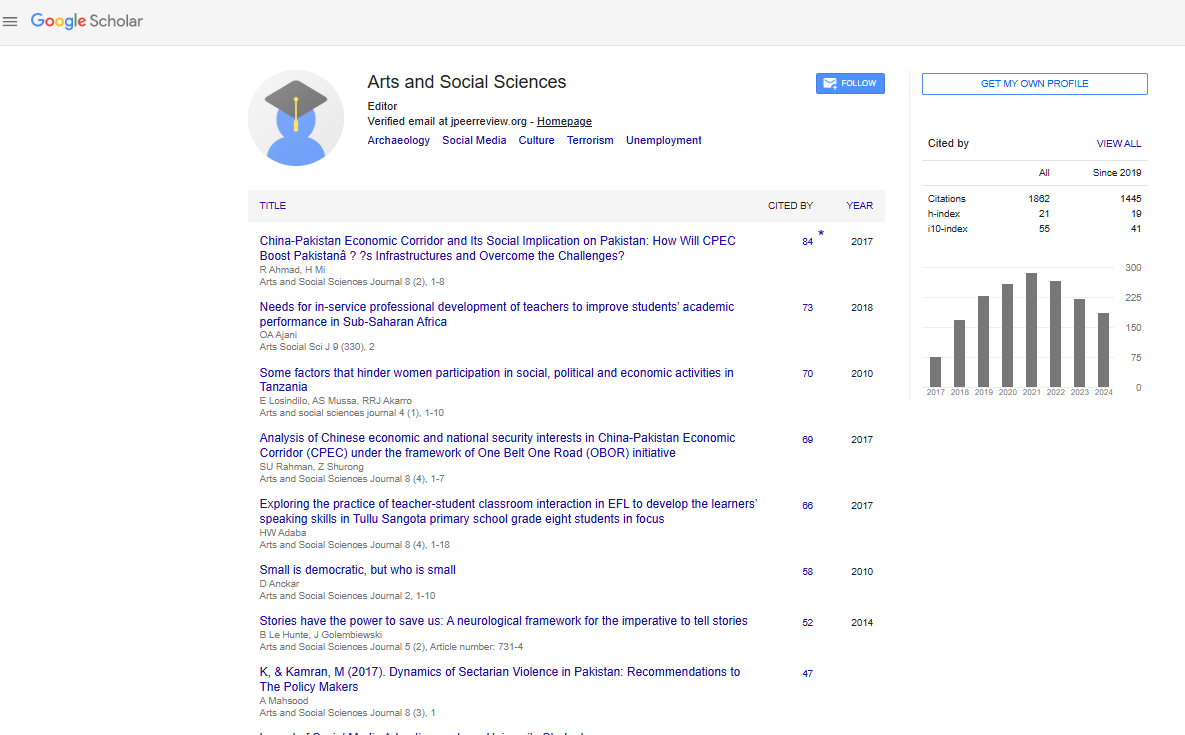
Arts and Social Sciences Journal received 1413 citations as per Google Scholar report