Opinion - (2025) Volume 11, Issue 6
Received: 01-Dec-2025, Manuscript No. JOV-26-186451;
Editor assigned: 03-Dec-2025, Pre QC No. P-186451;
Reviewed: 17-Dec-2025, QC No. Q-186451;
Revised: 22-Dec-2025, Manuscript No. R-186451;
Published:
29-Dec-2025
, DOI: 10.37421/2471-9544.2025.11.336
Citation: Williams, Hannah. ”Crimson Cascade: Hemodynamics Fueling Vasculitis Progression.” J Vasc 11 (2025):336.
Copyright: © 2025 Williams H. This is an open-access article distributed under the terms of the Creative Commons Attribution License, which permits unrestricted use, distribution and reproduction in any medium, provided the original author and source are credited.
This article delves into novel patterns of blood flow within the context of vasculitis, highlighting how deviations from typical laminar flow can trigger or exacerbate inflammatory processes. The "Crimson Cascade" metaphor suggests a chain reaction where disturbed flow initiates a cascade of endothelial activation and immune cell recruitment, leading to vessel wall damage. Understanding these hemodynamic alterations is crucial for developing targeted therapeutic strategies that aim to normalize flow dynamics and reduce inflammatory responses in vasculitic conditions [1].
The study examines the role of specific flow patterns, such as shear stress gradients and oscillatory shear, in promoting pro-inflammatory signaling pathways within endothelial cells. It proposes that these mechanical cues, often altered in diseased vasculature, can prime the endothelium for immune cell adhesion and transmigration, a hallmark of vasculitis pathogenesis. The findings suggest that interventions aimed at modulating these shear stress-dependent events could offer new avenues for treatment [2].
This research explores the intricate relationship between blood rheology and inflammatory responses in vasculitic conditions. Alterations in blood viscosity and cellular deformability, influenced by flow dynamics, are shown to impact the interaction of leukocytes with the endothelium. The "Crimson Cascade" concept is reinforced by demonstrating how altered rheological properties can amplify inflammatory signals and contribute to microvascular occlusion and damage [3].
The article investigates the role of turbulent flow and vortex formation in specific anatomical locations prone to vasculitis. It posits that these chaotic flow patterns create localized areas of high shear stress and wall shear stress fluctuations, which can disrupt endothelial integrity and promote inflammatory cell adhesion. The "Crimson Cascade" is explained as the downstream consequence of these hemodynamically induced breaches in vascular homeostasis [4].
This paper focuses on computational fluid dynamics (CFD) modeling to visualize and quantify novel flow patterns in vasculitic lesions. The "Crimson Cascade" is depicted through simulations showing how geometric abnormalities in vessels, often induced by inflammation, create recirculation zones and pressure gradients that perpetuate endothelial activation. The findings emphasize the potential of CFD in identifying high-risk areas and guiding therapeutic interventions [5].
The article explores the interplay between systemic inflammation and local flow disturbances in the development of vasculitic complications. It suggests that circulating inflammatory mediators can sensitize the endothelium, making it more responsive to mechanical stress. The "Crimson Cascade" is presented as a synergistic process where both chemical and physical factors contribute to vessel wall damage and immune cell infiltration [6].
This work investigates the impact of pulsatility and shear rate variability on endothelial cell behavior in a vasculitis context. It highlights how non-uniform flow patterns, characteristic of diseased vessels, can lead to aberrant mechanotransduction, promoting inflammation and leukocyte adhesion. The "Crimson Cascade" is interpreted as a dynamic process driven by these fluctuating hemodynamic forces [7].
The study examines the role of microfluidic models in simulating the complex flow conditions encountered in vasculitis. It demonstrates how altered flow patterns, including stasis and shear stress gradients, can promote the formation of inflammatory microenvironments, contributing to the "Crimson Cascade." The findings underscore the utility of microfluidic platforms for studying disease mechanisms and screening therapeutic agents [8].
This research investigates the impact of non-Newtonian fluid behavior on immune cell trafficking in vasculitic vasculature. It highlights how complex flow dynamics, particularly in regions of stenosis or tortuosity, can alter leukocyte margination and adhesion, initiating the "Crimson Cascade." The study emphasizes the need to consider non-Newtonian rheology in understanding vasculitis pathogenesis [9].
The article explores the potential of therapeutic interventions targeting flow dynamics in vasculitis. It discusses how agents that normalize blood viscosity, improve endothelial function, or reduce shear stress can mitigate the "Crimson Cascade" and prevent vessel wall damage. The findings suggest that a hemodynamic-centered approach could be a valuable addition to current vasculitis treatment strategies [10].
Hemodynamic forces play a pivotal role in the pathogenesis of vasculitis, with deviations from normal laminar blood flow acting as critical initiators or amplifiers of inflammatory processes. The "Crimson Cascade" concept eloquently describes this phenomenon, illustrating how disturbed flow triggers a sequence of endothelial activation and immune cell recruitment, ultimately leading to damage of the vessel wall. A thorough understanding of these hemodynamic alterations is paramount for the development of precisely targeted therapies aimed at restoring normal flow dynamics and attenuating inflammatory responses in vasculitic conditions [1].
Specific flow patterns, notably shear stress gradients and oscillatory shear, have been identified as key drivers of pro-inflammatory signaling within endothelial cells. These mechanical cues, frequently dysregulated in diseased vasculature, can effectively prime the endothelium for the adhesion and transmigration of immune cells, a defining characteristic of vasculitis pathogenesis. Consequently, interventions designed to modulate these shear stress-dependent events hold significant promise for novel therapeutic strategies [2].
The complex interplay between blood rheology and inflammatory responses in vasculitis is a significant area of investigation. Changes in blood viscosity and the deformability of blood cells, influenced by flow dynamics, demonstrably affect the interaction between leukocytes and the endothelium. The "Crimson Cascade" model is further supported by evidence showing how these altered rheological properties can potentiate inflammatory signals, contributing to microvascular occlusion and subsequent tissue damage [3].
Turbulent flow and vortex formation, particularly in anatomically susceptible regions, are implicated in the development of vasculitis. These chaotic flow patterns generate localized areas of high shear stress and fluctuations in wall shear stress, which can compromise endothelial integrity and facilitate inflammatory cell adhesion. The "Crimson Cascade" is thus understood as a downstream consequence of these hemodynamically induced disruptions to vascular homeostasis [4].
Computational fluid dynamics (CFD) offers a powerful approach to visualize and quantify aberrant flow patterns within vasculitic lesions. Simulations have depicted how the "Crimson Cascade" can be driven by geometric abnormalities in blood vessels, often a result of inflammation itself, which create recirculation zones and pressure gradients that perpetuate endothelial activation. CFD thus emerges as a valuable tool for identifying high-risk areas and guiding therapeutic strategies [5].
The intricate relationship between systemic inflammation and localized flow disturbances is crucial in the pathogenesis of vasculitic complications. Circulating inflammatory mediators can sensitize the endothelium, making it more susceptible to mechanical stress. The "Crimson Cascade" is viewed as a synergistic process where both biochemical and biomechanical factors converge to induce vessel wall damage and promote immune cell infiltration [6].
The behavior of endothelial cells in the context of vasculitis is significantly influenced by blood flow pulsatility and shear rate variability. Non-uniform flow patterns, common in diseased vessels, can lead to aberrant mechanotransduction, thereby promoting inflammation and leukocyte adhesion. The "Crimson Cascade" can thus be interpreted as a dynamic process propelled by these fluctuating hemodynamic forces [7].
Microfluidic models provide a valuable platform for simulating the intricate flow conditions observed in vasculitis. These models have demonstrated that altered flow patterns, including areas of stasis and shear stress gradients, can foster the development of inflammatory microenvironments, thereby contributing to the "Crimson Cascade." The utility of microfluidic platforms for disease mechanism studies and therapeutic agent screening is thus highlighted [8].
The non-Newtonian nature of blood flow plays a critical role in immune cell trafficking within vasculitic vasculature. Complex flow dynamics, particularly in stenotic or tortuous regions, can alter the margination and adhesion of leukocytes, initiating the "Crimson Cascade." This underscores the importance of considering non-Newtonian rheology for a comprehensive understanding of vasculitis pathogenesis [9].
Targeting flow dynamics presents a promising avenue for therapeutic interventions in vasculitis. Strategies aimed at normalizing blood viscosity, enhancing endothelial function, or reducing shear stress hold the potential to mitigate the "Crimson Cascade" and prevent vessel wall damage. A hemodynamic-centered approach is therefore poised to become a valuable complement to existing vasculitis treatment paradigms [10].
Vasculitis pathogenesis is significantly influenced by abnormal blood flow patterns, which trigger inflammatory cascades and endothelial damage. The "Crimson Cascade" metaphor describes how disturbed hemodynamics, including turbulent flow, shear stress variations, and rheological changes, activate endothelial cells and promote immune cell infiltration. Computational fluid dynamics and microfluidic models are valuable tools for studying these complex flow dynamics and identifying high-risk areas. Therapeutic strategies focused on normalizing blood flow, viscosity, and shear stress show promise for mitigating vasculitis progression and preventing vessel wall damage.
None
None
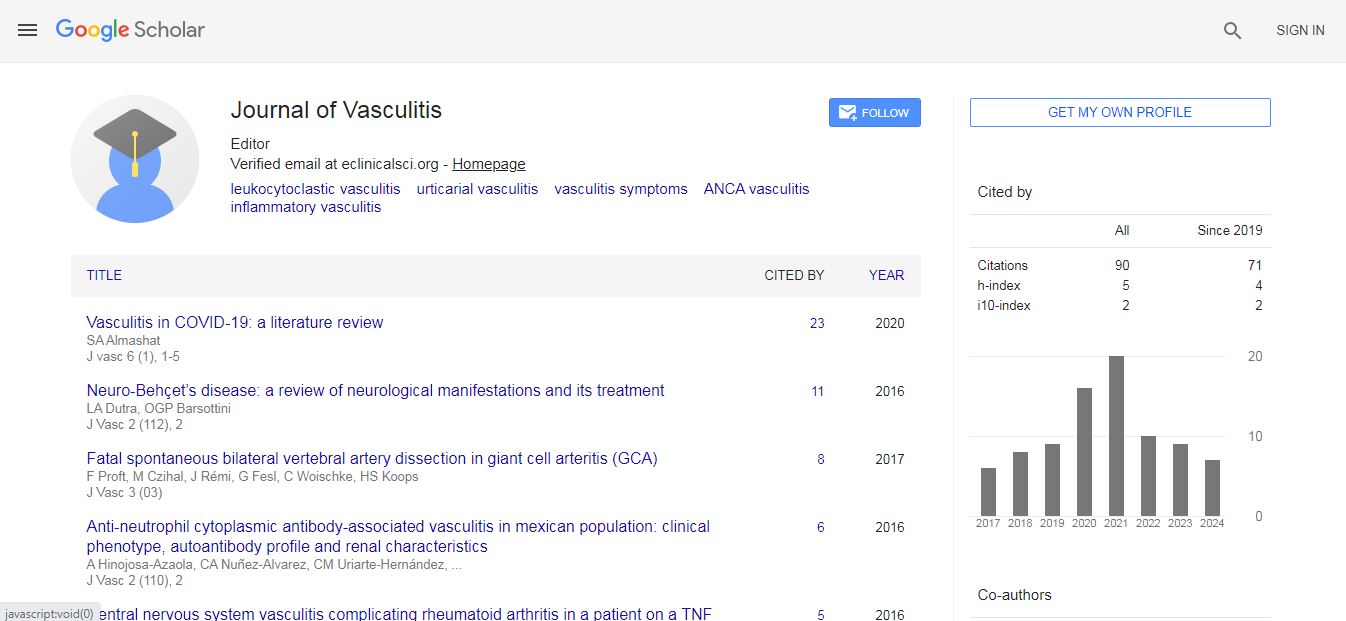
Journal of Vasculitis received 83 citations as per Google Scholar report