Commentary - (2025) Volume 13, Issue 6
Received: 01-Dec-2025, Manuscript No. jaat-26-183185;
Editor assigned: 03-Dec-2025, Pre QC No. P-183185;
Reviewed: 17-Dec-2025, QC No. Q-183185;
Revised: 22-Dec-2025, Manuscript No. R-183185;
Published:
29-Dec-2025
, DOI: 10.37421/2329-6542.2025.13.382
Citation: Volkov, Irina. ”Cosmic Dust: Planet Formation’s Fundamental Building Blocks.” J Astrophys Aerospace Technol 13 (2025):382.
Copyright: © 2025 Volkov I. This is an open-access article distributed under the terms of the Creative Commons Attribution License, which permits unrestricted use, distribution and reproduction in any medium, provided the original author and source are credited.
Cosmic dust serves as the fundamental building material for the formation of planetary systems, playing a pivotal role in this celestial process. These minute particles, originating from stellar remnants, undergo a series of aggregation mechanisms, including coagulation and accretion, gradually coalescing to form planetesimals. These nascent bodies then continue to grow, evolving into protoplanets and eventually into fully-fledged planets, thus outlining the initial stages of planetary assembly [1].
The intricate physical and chemical characteristics of dust grains within protoplanetary disks are indispensable for a comprehensive understanding of planet formation. Through a combination of observational studies and laboratory investigations, scientists can effectively characterize the size distributions, elemental composition, and optical properties of dust particles. These attributes dictate the complex interactions between dust, radiation, and gas, thereby influencing dust settling, aggregation behavior, and ultimately, the types of planets that form and their orbital configurations [2].
Dust coagulation, the fundamental process by which individual dust grains adhere to one another, represents a crucial early step in the construction of larger structures within protoplanetary disks. A variety of physical forces, encompassing electrostatic interactions, van der Waals forces, and gas drag, are instrumental in initiating this initial aggregation. A deep understanding of the efficiency and dominant mechanisms of coagulation across different stages and radial positions within the disk is paramount for resolving the long-standing enigma of rapid planetesimal formation [3].
The elemental makeup of cosmic dust, predominantly sourced from stellar outflows, directly reflects the available raw materials for planetary construction. The metallicity of the parent star profoundly influences the quantity and variety of dust produced, which in turn shapes the composition of the planets that subsequently form. For instance, a higher concentration of refractory elements within dust grains can predispose the formation of rocky planets, while the presence of icy dust contributes to the formation of gas giants and facilitates the delivery of water to terrestrial worlds [4].
Gas dynamics within protoplanetary disks are profoundly influential in concentrating dust particles, a phenomenon that significantly facilitates their growth into more substantial bodies. Processes such as the streaming instability and pebble accretion, which are driven by the intricate interactions between gas and dust, are considered highly effective mechanisms for the formation of planetesimals. Comprehending these complex dynamic processes necessitates the application of sophisticated numerical simulations capable of accurately depicting the behavior of both gas and dust over extended temporal scales [5].
The delivery of volatile compounds, including essential molecules like water and organic compounds, to nascent planets is substantially mediated by cosmic dust. Icy dust grains, which originate in the frigid outer regions of protoplanetary disks, can be transported inwards through various disk dynamics. This inward migration ultimately contributes to the chemical inventory of terrestrial planets, playing a critical role in establishing conditions conducive to habitability. This underscores the vital function of dust in seeding young planets with the fundamental constituents necessary for life [6].
Observational data pertaining to dust within protoplanetary disks, particularly those obtained from submillimeter and infrared astronomical surveys, offer direct empirical evidence for the existence and spatial distribution of dust particles. These observations empower astronomers to deduce crucial properties such as dust mass, size distribution, and temperature, all of which serve as vital inputs for theoretical planet formation models. Significant advancements in observational instruments, such as the Atacama Large Millimeter/submillimeter Array (ALMA), have revolutionized the capacity to study protoplanetary disks with unprecedented detail and precision [7].
The formation of planetesimals, recognized as the critical initial phase in the process of planet building, is intrinsically linked to the dynamic behavior of dust particles. While coagulation can facilitate the clumping of small dust grains into larger aggregates, the subsequent formation of kilometer-sized planetesimals necessitates more potent mechanisms. These include the gravitational instability of dust concentrated in pressure traps or the highly efficient streaming instability. Such mechanisms are vital for surmounting the so-called meter-size barrier, a phase where dust is prone to rapid removal from the disk due to gas drag [8].
The interplay between cosmic dust and radiation fields within protoplanetary disks exerts a significant influence on dust dynamics and thermal properties. Radiation pressure can subtly alter the vertical distribution and drive radial migration of dust particles, while the radiative opacity of dust itself plays a crucial role in shaping the thermal structure of the disk. A thorough understanding of these radiative transfer effects is indispensable for the accurate interpretation of observational data and for the precise modeling of planet formation processes [9].
The temporal evolution of dust grain sizes and their distribution across a protoplanetary disk is an exceptionally complex phenomenon. It is governed by a delicate balance between growth processes, primarily coagulation, and destructive mechanisms, such as fragmentation. The prevailing ratio between these competing processes ultimately dictates the characteristics of the overall dust population and its capacity to aggregate into larger, planet-forming structures. Elucidating the specific conditions under which dust can successfully grow to planetesimal scales remains a central and ongoing challenge in the field of planet formation research [10].
Cosmic dust is fundamentally important as the raw material from which planetary systems emerge. These microscopic particles, originating from the remnants of stars, aggregate through processes like coagulation and accretion, building up into planetesimals which then develop into protoplanets and ultimately, planets [1].
Understanding the physical and chemical properties of dust grains in protoplanetary disks is key to deciphering planet formation. Observational and experimental data help us characterize dust size, composition, and optical properties, which dictate its interaction with radiation and gas. These interactions influence dust settling and aggregation, directly impacting the outcomes of planet formation, including planet types and orbital arrangements [2].
Dust coagulation, the sticking together of small dust grains, is a foundational step in forming larger structures in protoplanetary disks. Electrostatic forces, van der Waals forces, and gas drag are among the mechanisms responsible for this initial clumping. Understanding how efficiently and through which dominant mechanisms coagulation occurs at different disk locations and stages is critical for explaining the rapid formation of planetesimals, a persistent puzzle in planet formation theory [3].
The composition of cosmic dust, largely determined by stellar outflows, directly indicates the materials available for planet formation. The metallicity of the host star significantly affects the amount and type of dust produced, influencing the composition of forming planets. For example, dust rich in refractory elements can lead to rocky planets, while icy dust contributes to gas giants and the delivery of water to terrestrial worlds [4].
Gas dynamics within protoplanetary disks are vital for concentrating dust, thereby facilitating its growth into larger bodies. Mechanisms such as the streaming instability and pebble accretion, powered by gas-dust interactions, are thought to be highly efficient in planetesimal formation. Detailed numerical simulations are required to capture the behavior of both gas and dust over extended periods to understand these interactions [5].
The delivery of volatiles, like water and organic molecules, to forming planets is heavily reliant on cosmic dust. Icy dust grains formed in the outer disk can be transported inwards, contributing to the composition of terrestrial planets and potentially enabling habitability. This highlights dust's crucial role in seeding young planets with the building blocks for life [6].
Observational signatures of dust in protoplanetary disks, particularly from submillimeter and infrared wavelengths, provide direct evidence of dust presence and distribution. These observations allow for the inference of dust mass, size distribution, and temperature, which are essential inputs for planet formation models. Advances in instruments like ALMA have greatly enhanced our ability to study these disks in detail [7].
Planetesimal formation, the initial stage of planet building, is closely tied to dust behavior. While coagulation forms small aggregates, the creation of kilometer-sized planetesimals requires more robust mechanisms like the gravitational instability of dust in pressure traps or the streaming instability. These are crucial for overcoming the meter-size barrier, where gas drag efficiently removes dust from the disk [8].
The interaction between dust and radiation in protoplanetary disks significantly affects dust dynamics and temperature. Radiation pressure influences dust distribution and migration, while dust's opacity affects the disk's thermal structure. Understanding these radiative transfer effects is key to interpreting observations and accurately modeling planet formation [9].
The evolution of dust grain sizes and their distribution in protoplanetary disks is a complex interplay of growth (coagulation) and fragmentation. The balance between these processes determines the dust population's ability to form larger structures. Understanding the conditions for dust to grow to planetesimal sizes remains a central challenge in planet formation research [10].
Cosmic dust is the fundamental building block for planetary systems, aggregating from stellar remnants through processes like coagulation and accretion to form planetesimals, protoplanets, and eventually planets. The physical and chemical properties of dust grains in protoplanetary disks, including their size, composition, and interaction with gas and radiation, are crucial for planet formation outcomes. Mechanisms like dust coagulation and the streaming instability are vital for forming planetesimals, overcoming the meter-size barrier. Dust composition influences the types of planets formed, and it plays a key role in delivering volatiles such as water and organic molecules to nascent planets, contributing to habitability. Observational data from instruments like ALMA provide critical insights into dust properties, aiding in the modeling of planet formation. The balance between dust growth and fragmentation determines the dust population's ability to form larger bodies, a central challenge in the field.
None
None
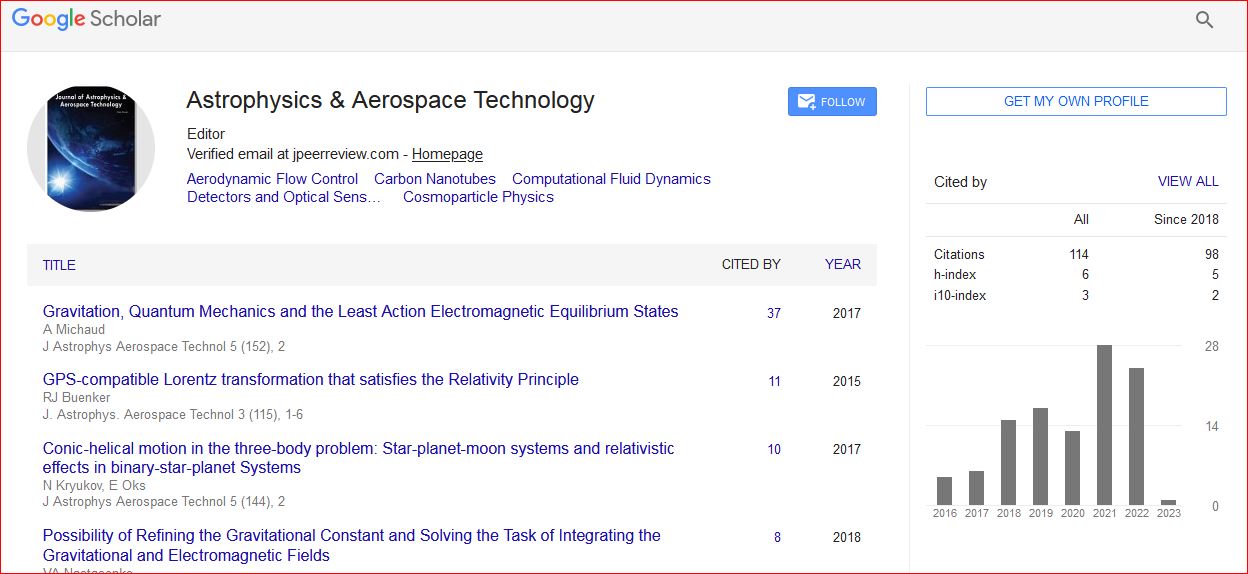
Astrophysics & Aerospace Technology received 114 citations as per Google Scholar report