Opinion - (2025) Volume 11, Issue 3
Received: 01-Jun-2025, Manuscript No. elj-25-173008;
Editor assigned: 03-Jun-2025, Pre QC No. P-173008;
Reviewed: 17-Jun-2025, QC No. Q-173008;
Revised: 23-Jun-2025, Manuscript No. R-173008;
Published:
30-Jun-2025
, DOI: 10.37421/2472-0895.2025.11.326
Citation: Nkosi, Thabo. ”Cortical Excitability: Disorders, Modulation, Interventions.” Epilepsy J 11 (2025):326.
Copyright: © 2025 Nkosi T. This is an open-access article distributed under the terms of the Creative Commons Attribution License, which permits unrestricted use, distribution and reproduction in any medium, provided the original author and source are credited.
How cortical excitability and inhibition are altered in migraine patients, leveraging findings from transcranial magnetic stimulation (TMS) studies. It reveals that migraineurs often show distinct patterns of cortical excitability compared to healthy individuals, suggesting these changes might play a role in the pathophysiology of the condition[1].
The neurophysiological mechanisms underlying non-invasive brain stimulation (NIBS) therapies, specifically how they modulate cortical excitability to improve motor recovery after stroke. Essentially, NIBS, like TMS or tDCS, can induce lasting changes in cortical excitability and plasticity, which is crucial for rehabilitating motor functions[2].
Studies on major depressive disorder suggest there are specific alterations in cortical excitability and connectivity, which this review unpacks by looking at TMS and electroencephalography (EEG) findings. These findings suggest these neurophysiological markers could be key for diagnosing MDD and understanding how treatments, like neuromodulation, actually work[3].
The impact of short-term sleep deprivation on cortical excitability and plasticity. It shows that even a single night of sleep loss can significantly alter motor cortical excitability, influencing how the brain processes and responds to stimuli, which has implications for cognitive performance and learning[4].
Current knowledge on how transcranial direct current stimulation (tDCS) modulates cortical excitability in various neuropsychiatric conditions. This suggests tDCS can predictably alter excitability, offering a therapeutic avenue, but its exact mechanisms and optimal parameters need further refinement for clinical application[5].
Research on how chronic pain affects motor cortical excitability, using advanced TMS techniques. It indicates that persistent pain can lead to maladaptive changes in the motor cortex, affecting both excitatory and inhibitory circuits, which might contribute to motor impairments often seen in these patients[6].
The role of transcranial alternating current stimulation (tACS) in modulating cortical excitability. It explains how tACS, by delivering weak oscillating currents, can entrain brain oscillations and thus influence excitability, offering a precise tool for investigating and potentially treating neurological conditions by directly interacting with brain rhythms[7].
Research investigates how aging influences cortical excitability and plasticity, which is a big deal because these changes are linked to age-related cognitive decline. It highlights specific alterations in inhibitory and excitatory circuits that occur with age, providing insights into potential targets for interventions to maintain brain health in older adults[8].
The role of transcranial magnetic stimulation (TMS) in assessing cortical excitability changes in individuals with autism spectrum disorder (ASD). Evidence shows that differences in cortical inhibition and excitation are prevalent in ASD, pointing towards neurobiological underpinnings that could inform diagnostic approaches and therapeutic strategies[9].
Understanding how cortical excitability differs in various psychiatric disorders is critical. This review synthesizes findings, often from TMS studies, demonstrating how imbalances in excitation and inhibition are common across conditions like schizophrenia, depression, and anxiety disorders, suggesting shared underlying neurophysiological dysfunctions[10].
The neurophysiological mechanisms underlying non-invasive brain stimulation (NIBS) therapies, such as Transcranial Magnetic Stimulation (TMS) or Transcranial Direct Current Stimulation (tDCS), are important for modulating cortical excitability to improve motor recovery after stroke. Essentially, NIBS can induce lasting changes in excitability and plasticity, crucial for rehabilitation [2]. Current knowledge shows how tDCS predictably alters cortical excitability in various neuropsychiatric conditions, offering a therapeutic avenue. Its exact mechanisms and optimal parameters, however, need further refinement for clinical application [5]. The role of Transcranial Alternating Current Stimulation (tACS) involves delivering weak oscillating currents to entrain brain oscillations, influencing excitability. This makes tACS a precise tool for investigating and potentially treating neurological conditions by directly interacting with brain rhythms [7].
Systematic reviews and meta-analyses explore how cortical excitability and inhibition are altered in migraine patients, using TMS studies. Migraineurs often show distinct patterns of cortical excitability compared to healthy individuals, suggesting these changes might play a role in the pathophysiology of the condition [1]. Chronic pain also impacts motor cortical excitability. Research using advanced TMS techniques suggests persistent pain leads to maladaptive changes in the motor cortex, affecting both excitatory and inhibitory circuits, which might contribute to motor impairments often seen in these patients [6]. As previously noted, modulating cortical excitability is key for improving motor recovery after stroke, where NIBS therapies can induce lasting and beneficial changes in cortical plasticity [2].
Specific alterations in cortical excitability and connectivity are observed in major depressive disorder (MDD), as reviewed through TMS and electroencephalography (EEG) findings. These neurophysiological markers could be key for diagnosing MDD and understanding how neuromodulation treatments work [3]. In autism spectrum disorder (ASD), a systematic review highlights that differences in cortical inhibition and excitation are prevalent. These neurobiological underpinnings could inform diagnostic approaches and therapeutic strategies [9]. A comprehensive review synthesizes findings, often from TMS studies, demonstrating how imbalances in excitation and inhibition are common across conditions like schizophrenia, depression, and anxiety disorders, suggesting shared underlying neurophysiological dysfunctions in psychiatric disorders [10].
The impact of short-term sleep deprivation on cortical excitability and plasticity has been explored. Findings indicate that even a single night of sleep loss can significantly alter motor cortical excitability, influencing how the brain processes and responds to stimuli, which has implications for cognitive performance and learning [4]. Furthermore, aging also influences cortical excitability and plasticity, with these changes linked to age-related cognitive decline. Research highlights specific alterations in inhibitory and excitatory circuits that occur with age, providing insights into potential targets for interventions to maintain brain health in older adults [8].
Across these diverse conditions and contexts, the consistent focus on cortical excitability underscores its fundamental role in brain function and dysfunction. From understanding the pathophysiology of migraine to rehabilitating motor functions post-stroke, and from diagnosing psychiatric disorders to mitigating age-related cognitive decline, modulating and assessing cortical excitability remains a critical area of neuroscientific research. The varied applications of non-invasive brain stimulation techniques further emphasize their potential as both diagnostic tools and therapeutic interventions, reflecting a growing understanding of how brain circuit dynamics contribute to health and disease.
Cortical excitability and inhibition are fundamental to understanding various neurological and psychiatric conditions, as well as the efficacy of non-invasive brain stimulation therapies. Studies indicate that migraine patients exhibit distinct patterns of cortical excitability, and major depressive disorder involves specific alterations in excitability and connectivity, which could serve as vital diagnostic and therapeutic markers. For individuals with autism spectrum disorder, prevalent differences in cortical inhibition and excitation point to critical neurobiological underpinnings. Techniques like Transcranial Magnetic Stimulation (TMS), Transcranial Direct Current Stimulation (tDCS), and Transcranial Alternating Current Stimulation (tACS) effectively modulate cortical excitability, offering therapeutic avenues for conditions like stroke recovery and other neuropsychiatric issues, though optimal parameters are still under investigation. Environmental and physiological factors also play a role; short-term sleep deprivation significantly alters motor cortical excitability, impacting cognitive performance. Chronic pain leads to maladaptive changes in the motor cortex, affecting both excitatory and inhibitory circuits, potentially causing motor impairments. Moreover, aging influences cortical excitability and plasticity, linking these changes to age-related cognitive decline. Understanding these imbalances in excitation and inhibition is crucial across a spectrum of disorders, suggesting shared neurophysiological dysfunctions and paving the way for targeted interventions.
None
None
Indexed at, Google Scholar, Crossref
Indexed at, Google Scholar, Crossref
Indexed at, Google Scholar, Crossref
Indexed at, Google Scholar, Crossref
Indexed at, Google Scholar, Crossref
Indexed at, Google Scholar, Crossref
Indexed at, Google Scholar, Crossref
Indexed at, Google Scholar, Crossref
Indexed at, Google Scholar, Crossref
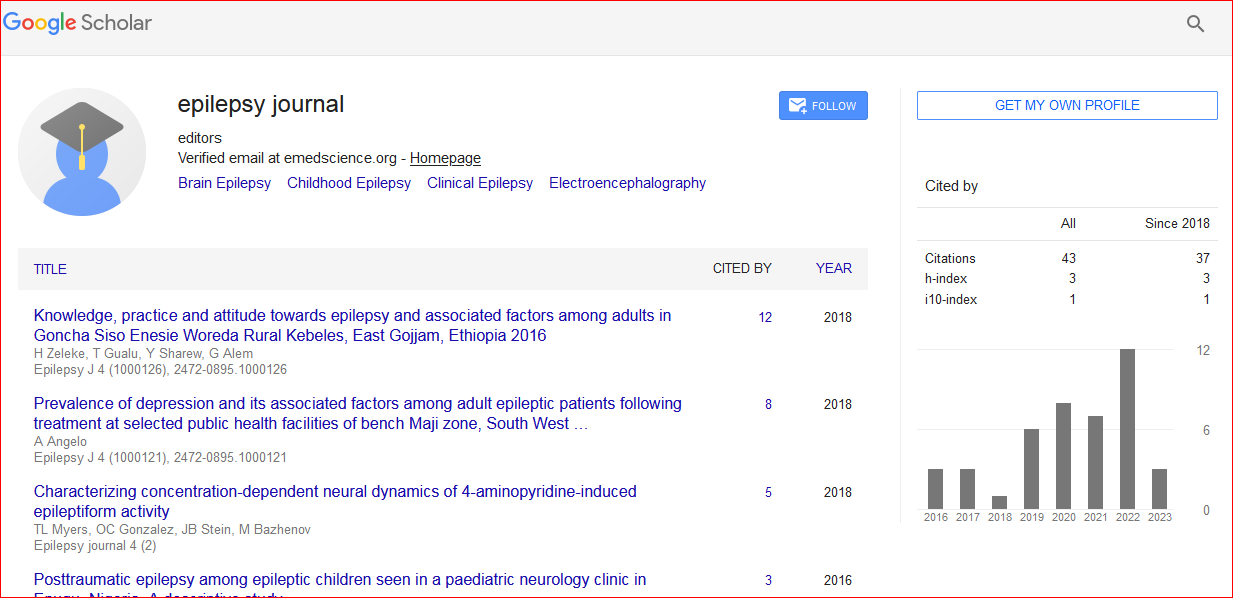
Epilepsy Journal received 41 citations as per Google Scholar report