Brief Report - (2025) Volume 19, Issue 3
Received: 01-Jun-2025, Manuscript No. jmgm-26-185655;
Editor assigned: 03-Jun-2025, Pre QC No. P-185655;
Reviewed: 17-Jun-2025, QC No. Q-185655;
Revised: 23-Jun-2025, Manuscript No. R-185655;
Published:
30-Jun-2025
, DOI: 10.37421/1747-0862.2025.19.723
Citation: Fernandez, Camila. ”Biomarkers: Revolutionizing Precision Medicine and Proactive Healthcare.” J Mol Genet Med 19 (2025):723.
Copyright: © 2025 Fernandez C. This is an open-access article distributed under the terms of the Creative Commons Attribution License, which permits unrestricted use, distribution and reproduction in any medium, provided the original author and source are credited.
Biomarkers are fundamentally reshaping the landscape of precision medicine by facilitating the prediction of diseases prior to the manifestation of clinical symptoms. This proactive strategy enables earlier interventions, offering the potential to alter disease progression and enhance patient outcomes. The development and rigorous validation of biomarkers that are both sensitive and specific are indispensable for accurately identifying individuals at elevated risk. These biomarkers encompass a broad spectrum of molecular indicators, including genetic and epigenetic alterations, as well as proteomic and metabolomic profiles, collectively providing a molecular blueprint of an individual's predisposition or early disease state [1].
The integration of multi-omics data presents a significant opportunity for identifying complex biomarker signatures crucial for early disease prediction. By amalgamating genomic, transcriptomic, proteomic, and metabolomic information, it becomes possible to detect subtle molecular changes that are indicative of preclinical disease. This comprehensive, multi-faceted approach is essential for capturing the intricate biological pathways involved in disease development, thereby moving beyond the limitations of single-marker strategies and offering a more holistic view of biological processes [2].
Liquid biopsies have emerged as a minimally invasive yet highly potent tool for both biomarker discovery and disease monitoring. The analysis of circulating tumor DNA (ctDNA), exosomes, or cell-free RNA within bodily fluids, such as blood, can furnish real-time insights into the current status and progression of a disease. This technological advancement is particularly advantageous for early detection and for monitoring therapeutic responses, obviating the necessity for repeated invasive tissue biopsies and improving patient comfort and compliance [3].
The successful translation of biomarker discoveries into routine clinical practice necessitates stringent validation processes and subsequent regulatory approval. Ensuring the accuracy, reproducibility, and demonstrable clinical utility of any identified biomarker is of paramount importance. The standardization of assay methodologies, coupled with robust quality control measures, are critical components for their reliable implementation in diverse healthcare settings, thereby facilitating their widespread adoption within precision medicine initiatives and clinical workflows [4].
Artificial intelligence (AI) and machine learning (ML) are progressively assuming a more critical role in the identification of novel biomarkers and the prediction of disease risk. These advanced computational methodologies possess the capacity to analyze vast and complex datasets, thereby uncovering intricate patterns and relationships that might remain elusive through traditional statistical approaches. This acceleration in biomarker discovery and the refinement of predictive models are key drivers for the advancement of personalized healthcare solutions [5].
The development of prognostic biomarkers is a vital component in stratifying patients according to their anticipated disease course and their likely response to specific therapeutic interventions. Identifying individuals who are predisposed to rapid disease progression or who are likely to exhibit a suboptimal response to standard therapies enables the implementation of tailored treatment strategies and the exploration of alternative interventions, ultimately optimizing the quality of patient care and resource allocation [6].
Epigenetic modifications, which include processes such as DNA methylation and histone modifications, represent a promising avenue for the development of biomarkers for early disease detection. These molecular changes can emerge early in the disease trajectory and are often reversible, thereby presenting potential targets for therapeutic intervention. The analysis of epigenetic profiles can serve as a sensitive indicator of cellular dysfunction, often detectable before the onset of overt clinical symptoms, offering a window for early intervention [7].
The creation of robust predictive models that effectively integrate clinical data with comprehensive biomarker information is crucial for enabling accurate personalized risk assessment. These sophisticated models empower clinicians to identify individuals who face the highest risk, thereby facilitating the implementation of targeted screening programs and proactive preventive strategies. Continuous refinement of these models is essential for enhancing their predictive accuracy and broadening their clinical applicability across various disease contexts [8].
Metabolomics provides a unique and invaluable perspective into cellular function and the metabolic perturbations that can occur well before the manifestation of overt disease. The identification of specific metabolic signatures that are associated with disease risk or early disease stages can lead to the discovery of novel biomarkers that support proactive intervention strategies. This analytical approach effectively captures the dynamic biochemical state of an individual, reflecting the cumulative interplay between genetic predispositions and environmental influences [9].
The concept of a 'disease precursor state' is being increasingly illuminated through the identification of preclinical biomarkers. These biomarkers have the potential to signal the presence of molecular abnormalities far in advance of any clinical manifestations, thereby enabling targeted interventions designed to prevent disease onset or halt its progression. This fundamental paradigm shift from a reactive to a proactive healthcare model stands as a cornerstone of the ongoing revolution in precision medicine [10].
Biomarkers are instrumental in the advancement of precision medicine, offering the capability to predict diseases before the onset of clinical symptoms. This proactive approach facilitates early interventions, thereby holding the potential to modify disease trajectories and improve patient outcomes. The development and validation of sensitive and specific biomarkers are critical for identifying individuals at high risk. These biomarkers can span genetic and epigenetic variations, as well as proteomic and metabolomic profiles, providing a molecular signature of an individual's susceptibility or early disease state [1].
The integration of multi-omics data shows considerable promise for the identification of complex biomarker signatures essential for early disease prediction. Combining genomic, transcriptomic, proteomic, and metabolomic data can reveal subtle molecular alterations indicative of preclinical disease. This comprehensive strategy is vital for understanding the intricate biological pathways involved in disease development, moving beyond the limitations of single-marker approaches [2].
Liquid biopsies represent a minimally invasive yet powerful method for biomarker discovery and disease monitoring. Analyzing components such as circulating tumor DNA (ctDNA), exosomes, or cell-free RNA in biological fluids like blood can yield real-time insights into disease status and progression. This technology is particularly valuable for early detection and for tracking treatment response, reducing the need for repeated tissue biopsies [3].
The successful translation of biomarker discoveries into clinical practice hinges on rigorous validation and regulatory approval. Ensuring the accuracy, reproducibility, and clinical utility of biomarkers is of utmost importance. Standardization of assay methods and robust quality control are essential for their reliable integration into healthcare systems, thereby supporting their adoption in precision medicine [4].
Artificial intelligence and machine learning are increasingly vital in biomarker identification and disease risk prediction. These computational techniques can analyze extensive datasets to uncover complex patterns and relationships not readily apparent through conventional statistical methods. This capability accelerates biomarker discovery and refines predictive models for personalized healthcare [5].
The development of prognostic biomarkers is crucial for stratifying patients based on their likely disease course and treatment response. Identifying individuals at risk for rapid progression or poor response to standard therapies enables the design of tailored treatment strategies and the consideration of alternative interventions, ultimately optimizing patient care [6].
Epigenetic modifications, such as DNA methylation and histone alterations, are promising biomarkers for early disease detection. These changes can occur early in the disease process and are often reversible, offering potential therapeutic targets. Analyzing epigenetic profiles can provide a sensitive indication of cellular dysfunction before overt symptoms appear [7].
The development of robust predictive models that integrate clinical data with biomarker information is essential for personalized risk assessment. These models allow clinicians to identify individuals at the highest risk, enabling targeted screening and preventive measures. Continuous refinement of these models is critical for improving their accuracy and clinical applicability [8].
Metabolomics offers a unique view into cellular function and metabolic disturbances that can precede overt disease. Identifying metabolic profiles associated with disease risk or early stages can yield novel biomarkers for proactive intervention. This approach captures the dynamic biochemical state of an individual, reflecting the combined influence of genetics and environment [9].
The concept of a 'disease precursor state' is being increasingly understood through the identification of preclinical biomarkers. These biomarkers can signify molecular abnormalities long before clinical symptoms emerge, permitting interventions aimed at preventing disease onset or progression. This paradigm shift from reactive to proactive healthcare is a fundamental aspect of precision medicine [10].
Biomarkers are revolutionizing precision medicine by enabling early disease detection and prediction, allowing for proactive interventions and improved patient outcomes. Various types of biomarkers, including genetic, epigenetic, proteomic, and metabolomic profiles, are being developed and validated for their sensitivity and specificity. The integration of multi-omics data and the application of artificial intelligence and machine learning are accelerating biomarker discovery. Liquid biopsies offer a minimally invasive approach for monitoring disease status and response to treatment. Prognostic biomarkers help stratify patients for tailored treatment strategies, while preclinical biomarkers identify disease precursor states. The successful translation of these discoveries into clinical practice requires rigorous validation and regulatory approval. Predictive models that combine clinical and biomarker data are crucial for personalized risk assessment and preventive measures. Ultimately, the shift towards a proactive, biomarker-driven healthcare model is transforming disease management.
None
None
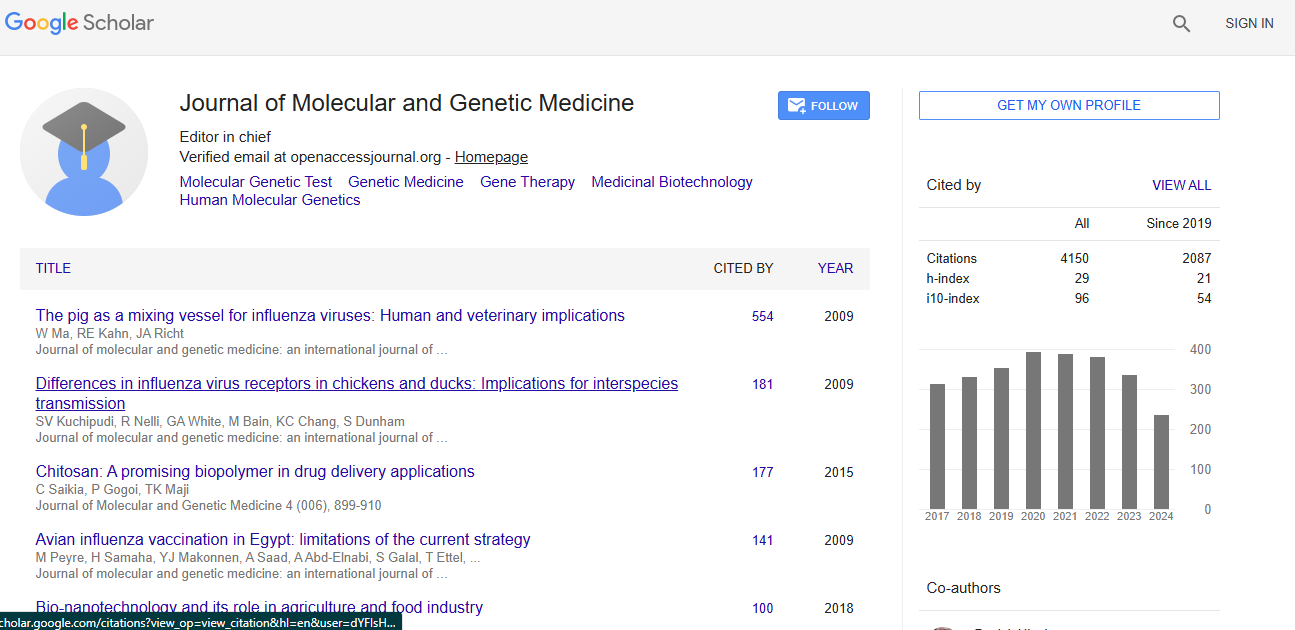
Molecular and Genetic Medicine received 3919 citations as per Google Scholar report