Perspective - (2025) Volume 13, Issue 2
Received: 01-Apr-2025, Manuscript No. jcdd-25-175441;
Editor assigned: 03-Apr-2025, Pre QC No. P-175441;
Reviewed: 17-Apr-2025, QC No. Q-175441;
Revised: 22-Apr-2025, Manuscript No. R-175441;
Published:
29-Apr-2025
, DOI: 10.37421/2329-9517.2025.13.663
Citation: Romano, Giulia. ”Comprehensive Valvular Disease:
Evolving Therapies, Patient Care.” J Cardiovasc Dis Diagn 13 (2025):663.
Copyright: © 2025 Romano G. This is an open-access article distributed under the terms of the Creative Commons Attribution License, which permits unrestricted use,
distribution and reproduction in any medium, provided the original author and source are credited.
The landscape of valvular heart disease management continues to evolve, reflecting significant advancements in diagnostic modalities, therapeutic interventions, and personalized patient care. Contemporary guidelines provide a foundational framework for practitioners. For instance, the 2021 ESC/EACTS Guidelines offer comprehensive recommendations for diagnosing and managing various valvular heart diseases, emphasizing multidisciplinary heart team decisions, appropriate timing for intervention, and the integration of transcatheter therapies into clinical practice. Key updates include refined indications for aortic stenosis, mitral regurgitation, and specific considerations for less common valve diseases, aiming to optimize patient outcomes based on the latest evidence [1].
Progressive understanding of specific conditions is crucial. An article reviews contemporary understanding of aortic stenosis (AS), highlighting advancements in its pathophysiology and evolving treatment paradigms. It discusses the increasing prevalence of transcatheter aortic valve implantation (TAVI) as a viable option for various risk profiles, alongside traditional surgical aortic valve replacement (SAVR). The focus here is on precision in diagnosis and personalized treatment strategies to improve prognosis and quality of life for patients with AS [2].
Building upon guidelines, expert consensus documents offer practical guidance. For example, the 2023 ACC/AHA Joint Expert Consensus Decision Pathway for the Management of Patients With Valvular Heart Disease translates complex guideline recommendations into actionable clinical pathways. It addresses common scenarios and clinical dilemmas, particularly concerning shared decision-making, choice of intervention (surgical vs. transcatheter), and follow-up strategies, emphasizing a patient-centered approach [3].
The application of transcatheter therapies extends beyond traditional indications. A study provides crucial insights into the effectiveness and safety of transcatheter tricuspid valve intervention for patients with severe tricuspid regurgitation (TR), a condition historically challenging to treat surgically. Based on registry data, this work elucidates patient selection criteria, procedural outcomes, and the evolving role of these novel therapies in improving symptoms and prognosis for a high-risk population. The findings highlight the potential for expanding treatment options beyond medical management [4].
Further, underlying predispositions are increasingly recognized. A review explores the genetic underpinnings of various valvular heart diseases, including congenital conditions like bicuspid aortic valve and hereditary forms of mitral valve prolapse or calcific valve disease. It discusses how genetic predispositions influence disease development, progression, and potential targets for novel therapeutic strategies, underscoring the importance of understanding the genetic landscape for personalized risk assessment and tailored management approaches [5].
Complications associated with valvular disease also warrant dedicated guidance. The 2023 ESC Guidelines provide updated recommendations for the diagnosis, treatment, and prevention of endocarditis, a severe complication often affecting patients with pre-existing valvular heart disease. These guidelines cover diagnostic imaging modalities, antibiotic regimens, indications for surgical intervention, and strategies for managing complex cases, highlighting the critical role of prompt diagnosis and a multidisciplinary team approach to improve outcomes in this challenging infection [6].
Specific demographics require tailored approaches. An article focuses on the unique challenges and considerations for women of childbearing age with valvular heart disease. It addresses topics such as contraception, pregnancy management, and the impact of valve lesions on maternal and fetal outcomes, emphasizing preconception counseling, meticulous risk stratification, and a collaborative approach between specialists [7].
Globally, certain valvular pathologies remain a significant health burden. A comprehensive overview addresses rheumatic heart disease (RHD), detailing its global burden, pathophysiology, and ongoing efforts for prevention and control. It highlights that RHD, though declining in developed nations, remains a significant cause of morbidity and mortality in low- and middle-income countries, discussing diagnostic criteria, medical and surgical management strategies, and the imperative for public health interventions [8].
The complexity often extends to multiple affected valves. A review specifically addresses the complex clinical scenario of multiple valve disease, a common finding in many patients, drawing insights from the 2021 ESC/EACTS Guidelines. It outlines diagnostic strategies, risk stratification, and the intricate decision-making process required when multiple valves are affected, emphasizing the need for a holistic assessment rather than isolated valve management [9].
Additionally, comorbidities are common. A review explores the frequent co-occurrence of arrhythmias, particularly atrial fibrillation, in patients with valvular heart disease and its impact on outcomes. It delves into the underlying mechanisms, diagnostic approaches, and management strategies for arrhythmias in this specific population, emphasizing integrated care to balance arrhythmia-specific treatments with optimal management of the underlying valvular pathology [10].
Valvular heart disease represents a significant global health challenge, with its management continually evolving through advanced research and clinical practice. Current guidelines, such as those from the ESC/EACTS and ACC/AHA, provide comprehensive frameworks for diagnosis and treatment, advocating for multidisciplinary heart team involvement and precise intervention timing [1, 3]. These recommendations are crucial for conditions like aortic stenosis, mitral regurgitation, and other less common valve pathologies, guiding clinicians towards optimal patient outcomes by integrating the latest evidence and considering patient-centered approaches [1, 3]. The emphasis on shared decision-making and personalized treatment strategies ensures that choices between surgical and transcatheter interventions are made thoughtfully, reflecting individual patient risk profiles and preferences [3].
Aortic stenosis, in particular, has seen substantial shifts in its therapeutic landscape. Understanding its pathophysiology has deepened, leading to expanded treatment options. Transcatheter Aortic Valve Implantation (TAVI) has gained considerable traction as a viable alternative to traditional Surgical Aortic Valve Replacement (SAVR) for a wide range of patient risk profiles [2]. This progression highlights a broader trend towards less invasive procedures, which often offer quicker recovery times and are suitable for patients who might be deemed high-risk for open-heart surgery. Beyond aortic valves, similar advancements are emerging for other valves. For instance, transcatheter tricuspid valve intervention is showing promise for patients with severe tricuspid regurgitation, a condition historically difficult to manage surgically. Insights from registries like TRISCEND reveal promising patient selection criteria and procedural outcomes, expanding the horizon of treatment options for this high-risk population [4].
The underlying causes and complexities of valvular heart disease are diverse, encompassing genetic predispositions and acquired conditions. Genetic factors are increasingly recognized for their role in disease development and progression, from congenital anomalies like bicuspid aortic valve to hereditary forms of mitral valve prolapse or calcific valve disease [5]. A deeper understanding of these genetic underpinnings is paving the way for personalized risk assessment and the development of targeted therapeutic strategies. However, acquired conditions like rheumatic heart disease continue to be a major concern globally. While its prevalence is declining in developed nations, rheumatic heart disease still imposes a substantial burden of morbidity and mortality in low- and middle-income countries. Effective public health interventions and robust management strategies, encompassing both medical and surgical approaches, are imperative to mitigate its impact [8].
Managing patients with valvular heart disease often involves addressing co-existing conditions and specific demographic considerations. Women of childbearing age with valvular heart disease face unique challenges regarding contraception, pregnancy management, and the impact of valve lesions on both maternal and fetal outcomes [7]. Preconception counseling, meticulous risk stratification, and a collaborative care approach involving cardiologists, obstetricians, and cardiac surgeons are essential to ensure safe and effective care for this vulnerable group [7]. Furthermore, the co-occurrence of arrhythmias, particularly atrial fibrillation, is a frequent complication in patients with valvular heart disease, significantly impacting outcomes [10]. Integrated care, balancing arrhythmia-specific treatments with optimal management of the underlying valvular pathology, is critical for improving overall cardiovascular health and preventing further complications [10].
Finally, severe complications like endocarditis necessitate rigorous management. Updated guidelines provide comprehensive recommendations for the diagnosis, treatment, and prevention of endocarditis, which often affects patients with pre-existing valvular heart disease [6]. These guidelines cover crucial aspects such as diagnostic imaging, antibiotic regimens, indications for surgical intervention, and strategies for complex cases, emphasizing the need for prompt diagnosis and a multidisciplinary team approach to improve patient prognosis [6]. The presence of multiple valve disease further complicates clinical decision-making, requiring a holistic assessment rather than an isolated valve focus to balance intervention efficacy and procedural risk effectively [9]. The continuous evolution in understanding, diagnosing, and treating these conditions underscores the dynamic nature of cardiology and the ongoing commitment to enhancing patient care and quality of life.
Comprehensive management of valvular heart disease emphasizes multidisciplinary heart team decisions, appropriate intervention timing, and integrating transcatheter therapies into clinical practice. Guidelines provide detailed recommendations for diagnosing and managing various conditions, including refined indications for aortic stenosis, mitral regurgitation, and specific considerations for less common valve diseases. New insights into aortic stenosis highlight advancements in pathophysiology and evolving treatment paradigms, particularly the increasing prevalence of transcatheter aortic valve implantation (TAVI) alongside traditional surgical approaches. Expert consensus documents translate complex guideline recommendations into actionable clinical pathways, addressing common dilemmas like shared decision-making and choice of intervention, always prioritizing a patient-centered approach. Novel therapies are expanding, with crucial insights into the effectiveness and safety of transcatheter tricuspid valve intervention for severe tricuspid regurgitation, offering potential for improving symptoms and prognosis in high-risk populations. Understanding the genetic underpinnings of valvular heart disease, including congenital conditions and hereditary forms, is also becoming vital for personalized risk assessment and tailored management. Specific patient groups require focused attention, such as women of childbearing age, necessitating preconception counseling, meticulous risk stratification, and collaborative care during pregnancy. The global burden of rheumatic heart disease, while declining in developed nations, remains a significant concern in lower-income countries, demanding ongoing prevention and control efforts. Complex scenarios like multiple valve disease or the co-occurrence of arrhythmias, especially atrial fibrillation, demand integrated care, balancing arrhythmia-specific treatments with optimal management of the underlying valvular pathology to improve overall cardiovascular health. Furthermore, managing severe complications like endocarditis requires updated recommendations on diagnostics, antibiotic regimens, and surgical interventions.
Indexed at, Google Scholar, Crossref
Indexed at, Google Scholar, Crossref
Indexed at, Google Scholar, Crossref
Indexed at, Google Scholar, Crossref
Indexed at, Google Scholar, Crossref
Indexed at, Google Scholar, Crossref
Indexed at, Google Scholar, Crossref
Indexed at, Google Scholar, Crossref
Indexed at, Google Scholar, Crossref
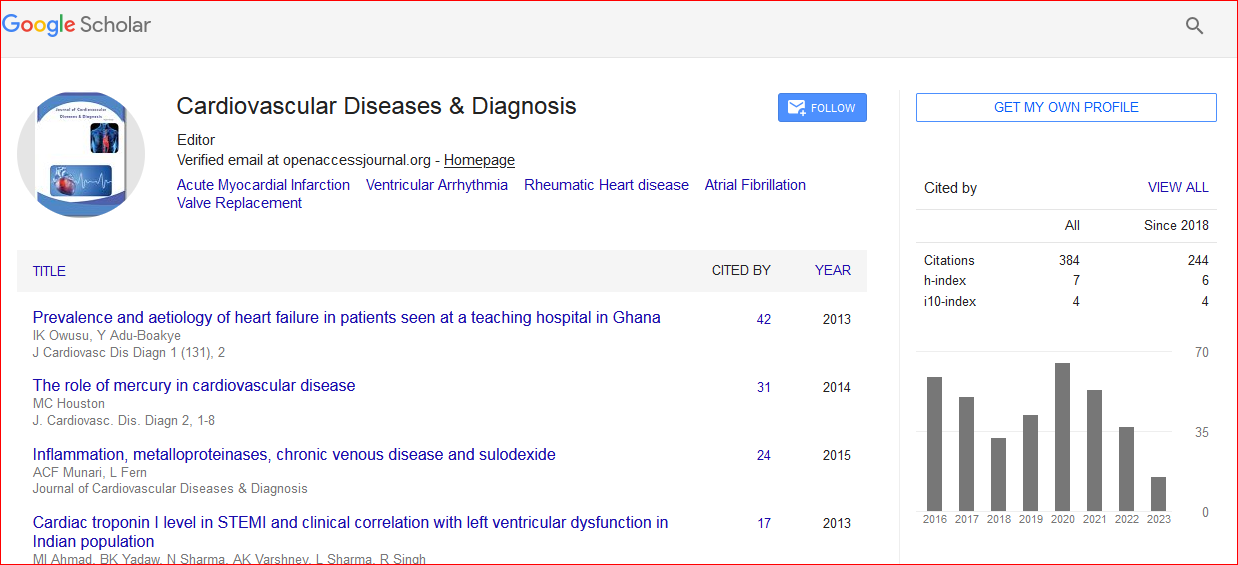
Cardiovascular Diseases & Diagnosis received 427 citations as per Google Scholar report