Short Communication - (2025) Volume 10, Issue 5
Received: 01-Oct-2025, Manuscript No. jcct-26-183274;
Editor assigned: 03-Oct-2025, Pre QC No. P-183274;
Reviewed: 17-Oct-2025, QC No. Q-183274;
Revised: 22-Oct-2025, Manuscript No. R-183274;
Published:
29-Oct-2025
, DOI: 10.37421/2577-0535.2025.9.337
Citation: Tanaka, Hiroshi. ”Real-World Oncology CER: Decisions, Policy, and Practice.” J Cancer Clin Trials 10 (2025):337.
Copyright: © 2025 Tanaka H. This is an open-access article distributed under the terms of the Creative Commons Attribution License, which permits unrestricted use, distribution and reproduction in any medium, provided the original author and source are credited.
Comparative effectiveness research (CER) in oncology is paramount for rigorously comparing various treatment modalities, diagnostic techniques, and care delivery strategies within real-world clinical settings. This research paradigm is instrumental in informing evidence-based clinical decision-making and shaping healthcare policy by discerning which interventions yield the most favorable outcomes for distinct patient cohorts, taking into account a spectrum of factors beyond mere efficacy, such as safety profiles, economic implications, and patient-reported experiences. The 'Journal of Cancer Clinical Trials' stands as a significant platform for disseminating such critical research, thereby fostering a more nuanced and comprehensive understanding of cancer care delivery. [1] The integration of real-world data (RWD) and its subsequent synthesis into real-world evidence (RWE) is fundamental to the advancement of CER in the oncology domain. Diverse sources of RWD, encompassing electronic health records, insurance claims databases, and patient registries, offer invaluable insights into the performance of treatments outside the tightly controlled environments of traditional clinical trials. The systematic collation of this data into RWE enables a more holistic evaluation of treatment efficacy and effectiveness, thereby guiding both clinical practice and the trajectory of drug development. [2] A significant challenge inherent in CER for oncology is the navigation of patient heterogeneity. Marked variations in genetic profiles, the presence of comorbidities, lifestyle influences, and individual treatment preferences collectively signify that a singular, universally applicable treatment approach is frequently inadequate. Consequently, CER methodologies are progressively evolving to embrace the principles of precision medicine, with the overarching aim of identifying interventions that demonstrate optimal effectiveness within specific patient subgroups, ultimately refining treatment selection and enhancing patient outcomes. [3] The cost-effectiveness of cancer treatments constitutes a critical dimension of CER. A thorough evaluation that extends beyond the assessment of clinical outcomes to encompass the economic value proposition of different interventions is essential for healthcare systems to make judicious decisions regarding resource allocation. CER studies that judiciously incorporate economic analyses are adept at identifying treatments that provide the most favorable value for expenditure, thereby contributing to the long-term sustainability of cancer care services. [4] Patient-reported outcomes (PROs) are increasingly acknowledged as indispensable endpoints within CER endeavors in oncology. The systematic capture of patients' subjective experiences concerning symptoms, quality of life, and functional status offers a vital perspective on treatment benefits that surpasses conventional clinical metrics. The integration of PROs into CER studies facilitates a more comprehensive and patient-centered assessment of treatment effectiveness. [5] The meticulous design of CER trials in oncology necessitates careful consideration of methodological nuances. Factors such as the judicious selection of comparators, the definition of appropriate outcome measures, the establishment of precise patient selection criteria, and the formulation of robust statistical analysis plans are all critical for the generation of reliable and broadly generalizable evidence. The adoption of innovative trial designs, including adaptive and pragmatic trial frameworks, is actively enhancing both the efficiency and the clinical relevance of CER. [6] Ethical considerations play a paramount role in the execution of CER for oncology. Safeguarding patient safety, ensuring the process of informed consent is thoroughly understood and executed, and promoting equitable access to treatments are fundamental ethical imperatives. CER studies must invariably be conducted with a commitment to transparency and scientific rigor to maintain public trust and uphold the highest ethical standards in cancer research. [7] The effective translation of CER findings into tangible clinical practice and impactful health policy represents a crucial, albeit often challenging, subsequent step. Bridging the perceived gap between research evidence and its practical implementation necessitates the development and deployment of effective dissemination strategies, the establishment of clear clinical guidelines, and robust engagement with all relevant stakeholders. Ultimately, CER endeavors are directed towards generating actionable insights that can directly contribute to the improvement of patient care and the enhanced performance of health systems. [8] The role of regulatory agencies in overseeing CER for oncology is undergoing a period of significant evolution. Agencies such as the Food and Drug Administration (FDA) are increasingly leveraging real-world evidence to inform their regulatory decision-making processes, which include post-market surveillance activities and the evaluation of label expansions for existing therapies. CER plays a vital role in generating the requisite real-world evidence, thereby ensuring that approved cancer treatments consistently meet rigorous standards of efficacy and safety. [9] Leveraging sophisticated advanced statistical methodologies is indispensable for conducting robust CER in the field of oncology. Techniques such as propensity score matching, inverse probability of treatment weighting, and causal inference models are routinely employed to effectively minimize bias and meticulously account for potential confounding factors when analyzing observational data. These advanced statistical methods significantly enhance the overall validity and interpretability of real-world evidence derived from CER studies. [10]
Comparative effectiveness research (CER) in oncology is crucial for comparing different treatments, diagnostic methods, or care delivery strategies in real-world settings. This approach helps inform clinical decision-making and healthcare policy by assessing which interventions offer the best outcomes for specific patient populations, considering factors beyond efficacy, such as safety, cost, and patient-reported outcomes. The 'Journal of Cancer Clinical Trials' is a relevant venue for publishing such research, contributing to a more nuanced understanding of cancer care. [1] The integration of real-world data (RWD) and real-world evidence (RWE) is fundamental to advancing CER in oncology. RWD sources, such as electronic health records, insurance claims, and patient registries, provide insights into how treatments perform outside the controlled environment of clinical trials. Synthesizing this data into RWE allows for a more comprehensive evaluation of treatment effectiveness, guiding clinical practice and drug development. [2] Navigating patient heterogeneity is a key challenge in CER for oncology. Differences in genetic profiles, comorbidities, lifestyle, and treatment preferences mean that a 'one-size-fits-all' approach is often insufficient. CER methodologies are evolving to incorporate precision medicine principles, aiming to identify which interventions are most effective for specific subgroups of patients, thereby optimizing treatment selection and improving outcomes. [3] The cost-effectiveness of cancer treatments is a critical component of CER. Evaluating not only clinical outcomes but also the economic value of interventions helps healthcare systems make informed decisions about resource allocation. CER studies that incorporate economic analyses can identify treatments that offer the best value for money, ensuring sustainability in cancer care. [4] Patient-reported outcomes (PROs) are increasingly recognized as essential endpoints in CER for oncology. Capturing patients' experiences with symptoms, quality of life, and functional status provides a crucial perspective on treatment benefit that goes beyond traditional clinical measures. Incorporating PROs into CER trials leads to a more holistic assessment of treatment effectiveness. [5] The design of CER trials in oncology requires careful consideration of methodology. Factors such as choice of comparators, outcome measures, patient selection criteria, and statistical analysis plans are critical for generating reliable and generalizable evidence. Innovative trial designs, including adaptive trials and pragmatic trials, are being employed to enhance the efficiency and relevance of CER. [6] Ethical considerations are paramount in CER for oncology. Ensuring patient safety, informed consent, and equitable access to treatments are fundamental. CER studies must be conducted with transparency and rigor to maintain public trust and uphold ethical standards in cancer care research. [7] The translation of CER findings into clinical practice and policy is a crucial step. Bridging the gap between research evidence and implementation requires effective dissemination strategies, guideline development, and stakeholder engagement. CER aims to provide actionable insights that can directly improve patient care and health system performance. [8] The role of regulatory agencies in CER for oncology is evolving. Agencies like the FDA are increasingly utilizing real-world evidence to support regulatory decision-making, including post-market surveillance and label expansions. CER plays a vital role in generating this evidence, ensuring that approved treatments meet rigorous standards of effectiveness and safety. [9] Leveraging advanced statistical methods is essential for robust CER in oncology. Techniques such as propensity score matching, inverse probability of treatment weighting, and causal inference models are employed to minimize bias and account for confounding factors when analyzing observational data. These methods enhance the validity of real-world evidence generated from CER. [10]
Comparative effectiveness research (CER) in oncology is vital for comparing treatments, diagnostics, and care strategies in real-world settings to inform clinical decisions and healthcare policy. It relies on real-world data (RWD) and evidence (RWE) to provide a comprehensive evaluation of treatment effectiveness. Addressing patient heterogeneity through precision medicine approaches and considering patient-reported outcomes (PROs) are key challenges and advancements. Economic evaluations are crucial for cost-effectiveness, while methodological rigor in trial design is essential for reliable findings. Ethical considerations, including patient safety and equitable access, are paramount. Translating research into practice and policy requires effective dissemination and stakeholder engagement. Regulatory agencies are increasingly using RWE, and advanced statistical methods are employed to ensure the validity of CER findings.
None
None
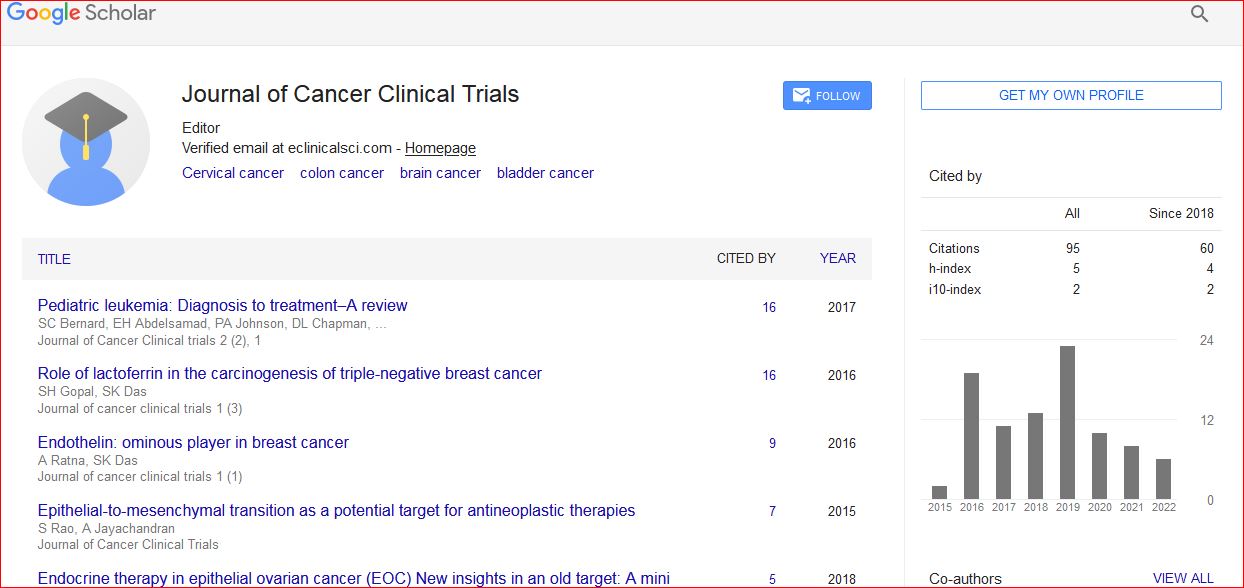
Journal of Cancer Clinical Trials received 95 citations as per Google Scholar report