Commentary - (2025) Volume 14, Issue 6
Received: 31-Oct-2025, Manuscript No. jmmd-26-184712;
Editor assigned: 03-Nov-2025, Pre QC No. P-184712;
Reviewed: 17-Nov-2025, QC No. Q-184712;
Revised: 21-Nov-2025, Manuscript No. R-184712;
Published:
29-Nov-2025
, DOI: 10.37421/2161-0703.2025.14.556
Citation: Roth, Benjamin. ”Combating Surgical Site Infections: A Multifaceted Approach.” J Med Microb Diagn 14 (2025):556.
Copyright: © 2025 Roth B. This is an open-access article distributed under the terms of the Creative Commons Attribution License, which permits unrestricted use, distribution and reproduction in any medium, provided the original author and source are credited.
Surgical site infections (SSIs) remain a significant concern in healthcare, posing challenges to patient recovery and increasing healthcare costs. The evolving nature of microbial resistance further complicates the management of these infections, necessitating a continuous understanding of current trends and effective interventions. This review aims to synthesize recent research on SSIs, focusing on the microbial landscape, resistance patterns, and management strategies. The microbial profile of SSIs is dynamic, with an increasing prevalence of multidrug-resistant organisms (MDROs) observed in recent studies. Accurate and timely identification of pathogens and their susceptibility is paramount for guiding appropriate antibiotic therapy and improving patient outcomes, underscoring the importance of robust diagnostic approaches and surveillance systems. [1] Understanding the specific bacterial pathogens responsible for SSIs and their associated antibiotic resistance profiles is critical for effective treatment strategies. Research highlights common etiologies, including Gram-positive and Gram-negative bacteria, and emphasizes the challenges presented by resistance mechanisms such as MRSA and ESBLs. The use of local antibiograms is crucial for informed empirical treatment choices. [2] A growing concern in healthcare settings, including SSIs, is the emergence of carbapenem-resistant Enterobacteriaceae (CRE). Studies investigating the prevalence of CRE in SSIs, associated risk factors, and clinical outcomes underscore the urgent need for enhanced infection prevention strategies and stewardship programs to combat these highly resistant pathogens. [3] While bacteria are the most frequent cause of SSIs, fungal pathogens can also lead to severe infections, particularly in immunocompromised individuals. A review of fungal etiologies in SSIs highlights diagnostic challenges and available treatment options, emphasizing the importance of considering fungal causes in non-healing or persistent surgical wounds. [4] The intricate relationship between the gut microbiome and host immunity is increasingly recognized for its influence on susceptibility to infections, including SSIs. Emerging research suggests that alterations in the gut microbial community, or dysbiosis, may predispose individuals to pathogenic overgrowth and infection, warranting further investigation into microbiome-based interventions. [5] Microbial surveillance of SSIs within specific surgical specialties reveals distinct variations in common pathogens and resistance patterns compared to general SSI data. This highlights the necessity for specialty-specific surveillance and tailored infection control protocols to address the unique challenges encountered in different surgical disciplines. [6] The well-established role of biofilms in the pathogenesis of chronic and recurrent SSIs is a significant area of focus. Research into the mechanisms of biofilm formation by bacteria on surgical implants and tissues explains the persistence of these difficult-to-eradicate infections and explores potential prevention and treatment strategies. [7] The development of rapid diagnostic methods for identifying SSI pathogens is essential for prompt clinical intervention. Advances in novel molecular diagnostic techniques show promise in directly detecting common bacteria and resistance genes from surgical specimens, thereby improving diagnostic speed and accuracy. [8] Synthesizing current evidence on antimicrobial efficacy against specific multidrug-resistant organisms causing SSIs is crucial for optimizing treatment. Systematic reviews and meta-analyses provide valuable insights for clinicians in selecting appropriate therapies based on pathogen susceptibility profiles, aiming to enhance treatment outcomes and mitigate further resistance development. [9] Finally, the impact of antibiotic stewardship programs (ASPs) on the prevalence and resistance patterns of SSI pathogens is a critical area of study. Evaluations of various ASP interventions demonstrate their effectiveness in reducing resistant SSIs and promoting judicious antibiotic use within surgical settings. [10]
The escalating challenge of surgical site infections (SSIs) necessitates a deep understanding of the underlying microbial culprits and their evolving resistance patterns. Recent research has shed light on the changing landscape of SSIs, emphasizing the growing threat posed by multidrug-resistant organisms (MDROs). Timely and accurate microbial identification, coupled with susceptibility testing, is paramount for tailoring effective antibiotic therapies and ultimately improving patient outcomes. This underscores the need for continuous surveillance and robust infection control measures to monitor and combat emerging resistance. [1] Effective management of SSIs hinges on a thorough comprehension of the specific bacterial pathogens involved and their antibiotic resistance profiles. Studies have detailed the common etiologies of SSIs, distinguishing between Gram-positive and Gram-negative bacteria, while also addressing the formidable challenges presented by resistance mechanisms such as Methicillin-resistant Staphylococcus aureus (MRSA) and Extended-Spectrum Beta-Lactamases (ESBLs). The utility of local antibiograms in guiding empirical treatment decisions is strongly advocated. [2] Carbapenem-resistant Enterobacteriaceae (CRE) represent a significant and growing threat within healthcare environments, including their increasing involvement in SSIs. Investigations into the prevalence of CRE in SSIs, identification of associated risk factors, and assessment of clinical outcomes highlight the critical importance of implementing stringent infection prevention strategies and robust stewardship programs to curb the dissemination of these highly resilient pathogens. [3] While bacterial infections are more prevalent, fungal pathogens can also contribute to severe SSIs, particularly in patients with compromised immune systems. A comprehensive review of fungal etiologies in SSIs has elucidated the spectrum of organisms involved, the diagnostic hurdles encountered, and the available therapeutic interventions. This highlights the necessity of considering fungal causes in surgical wounds that fail to heal or persist despite initial treatment. [4] The gut microbiome's profound influence on host immunity and its susceptibility to infections are subjects of increasing scientific interest, with potential implications for SSI development. Preliminary research suggests that disruptions in the commensal microbial community, known as dysbiosis, may create an environment conducive to pathogenic overgrowth and infection, pointing towards the need for further exploration of microbiome-based interventions. [5] Specialized analyses of SSI microbial profiles within specific surgical disciplines reveal distinct variations in prevailing pathogens and resistance trends when compared to more general SSI data. This observation underscores the imperative for developing and implementing surveillance programs tailored to individual surgical specialties and for designing infection control protocols that address the unique challenges inherent in different surgical fields. [6] The established role of biofilms in the pathogenesis of chronic and recurrent SSIs is a critical consideration in infection management. Research continues to unravel the complex mechanisms by which bacteria colonize surgical implants and tissues, forming biofilms that render infections persistent and notoriously difficult to eradicate. The identification of effective strategies for preventing and treating these biofilm-related SSIs remains a key research priority. [7] The advent and refinement of rapid diagnostic methods for identifying SSI pathogens are crucial for enabling timely and decisive clinical action. Emerging molecular diagnostic techniques are demonstrating significant potential in their ability to directly detect common bacterial species and key resistance genes from surgical specimens, thereby expediting the diagnostic process and enhancing its overall accuracy. [8] A systematic review and meta-analysis of the current evidence base provides a critical synthesis of the efficacy of various antimicrobial agents used in treating SSIs caused by specific multidrug-resistant organisms. These comprehensive analyses offer invaluable guidance to clinicians, aiding them in the selection of the most appropriate therapies based on detailed pathogen and susceptibility profiles, with the ultimate goals of optimizing treatment outcomes and minimizing the further emergence of antimicrobial resistance. [9] Evaluating the impact of antibiotic stewardship programs (ASPs) on the incidence and resistance patterns of SSI pathogens is a key area of research. Studies examining the effectiveness of diverse ASP interventions, such as prospective audit and feedback mechanisms and formulary restrictions, have shown promising results in reducing the occurrence of resistant SSIs and fostering more judicious use of antibiotics within surgical care settings. [10]
Surgical site infections (SSIs) are a growing concern, particularly due to the increasing prevalence of multidrug-resistant organisms (MDROs). Effective management requires accurate and timely identification of pathogens and their resistance profiles, guiding antibiotic therapy and infection control measures. Bacterial pathogens, including Gram-positive and Gram-negative bacteria with resistance mechanisms like MRSA and ESBLs, are common etiologies, while carbapenem-resistant Enterobacteriaceae (CRE) pose a significant threat. Fungal infections and biofilm formation also contribute to SSI severity and persistence. The gut microbiome's role in SSI susceptibility is an emerging area of research. Tailored surveillance and infection control for specific surgical specialties are crucial. Advances in rapid diagnostics are improving identification speed and accuracy. Antimicrobial stewardship programs (ASPs) play a vital role in reducing resistant SSIs and promoting judicious antibiotic use. Overall, a multifaceted approach combining diagnostics, targeted therapies, infection control, and stewardship is essential for combating SSIs.
None
None
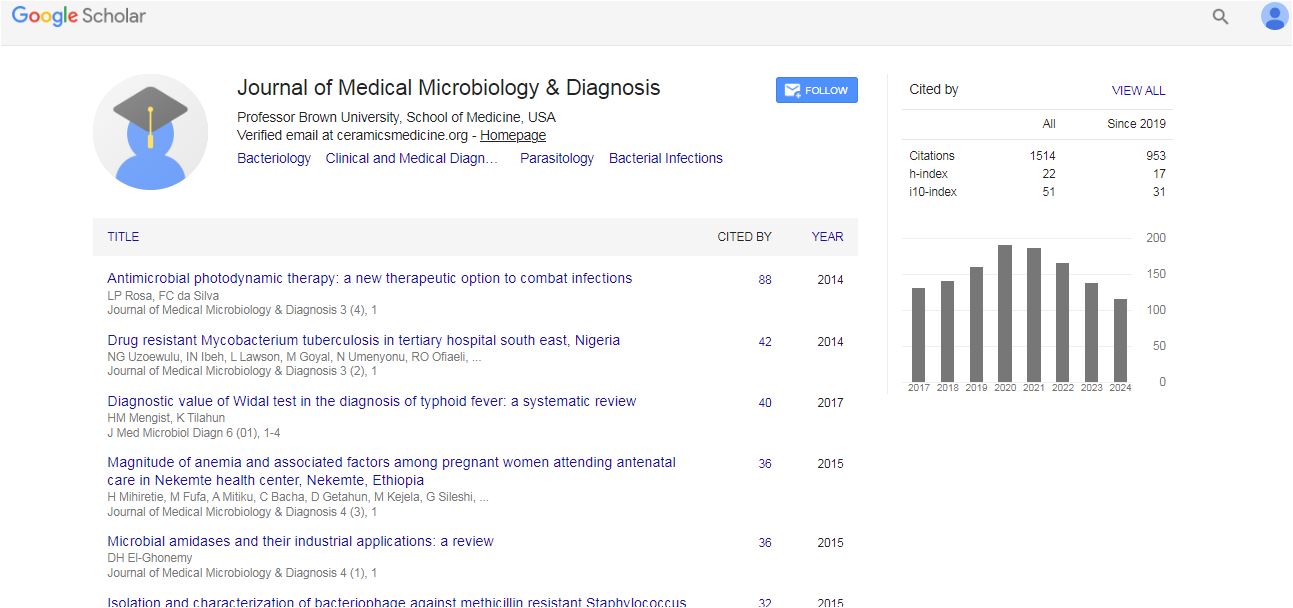
Medical Microbiology & Diagnosis received 14 citations as per Google Scholar report