Short Communication - (2025) Volume 14, Issue 4
Received: 01-Jul-2025, Manuscript No. jmmd-26-184687;
Editor assigned: 03-Jul-2025, Pre QC No. P-184687;
Reviewed: 17-Jul-2025, QC No. Q-184687;
Revised: 22-Jul-2025, Manuscript No. R-184687;
Published:
29-Jul-2025
, DOI: 10.37421/2161-0703.2025.14.531
Citation: Tanaka, Yuki. ”Combating MRSA: Surveillance, Diagnostics, and Collaboration.” J Med Microb Diagn 14 (2025):531.
Copyright: © 2025 Tanaka Y. This is an open-access article distributed under the terms of the Creative Commons Attribution License, which permits unrestricted use, distribution and reproduction in any medium, provided the original author and source are credited.
The current landscape of Methicillin-resistant Staphylococcus aureus (MRSA) surveillance necessitates a clear distinction between community-associated (CA-MRSA) and healthcare-associated (HA-MRSA) strains, although increasing overlap presents challenges in differentiation. Molecular epidemiology plays a crucial role in tracking transmission pathways, highlighting the need for enhanced diagnostic capabilities and coordinated surveillance efforts across different settings to effectively control MRSA spread and mitigate resistance [1].
The genetic diversity and evolutionary dynamics of MRSA in large urban hospital systems over extended periods have been investigated, identifying key genomic markers associated with both hospital-acquired and community-acquired lineages. This underscores the increasing complexity of MRSA epidemiology and emphasizes the importance of whole-genome sequencing for accurate strain tracking and informed infection control strategies [2].
The effectiveness of various diagnostic methods for MRSA detection in outpatient settings, including rapid antigen tests and PCR, has been examined. Comparisons of sensitivity, specificity, and turnaround times reveal the challenges of MRSA identification in community healthcare environments with potentially limited resources. The advocacy for accessible and rapid diagnostic tools to facilitate timely treatment and prevent further transmission is a significant aspect of this research [3].
A systematic review of the global epidemiology of CA-MRSA and HA-MRSA provides an updated overview of prevalence rates, key risk factors, and emerging resistance mechanisms. This review identifies geographical hotspots and highlights the impact of international travel on MRSA dissemination, underscoring the ongoing need for standardized surveillance protocols and international collaboration to combat MRSA effectively [4].
Research on the molecular characterization of MRSA isolates from patients with skin and soft tissue infections in Japanese community settings details prevalent clonal complexes and the carriage of virulence factors and resistance genes. This study emphasizes the importance of understanding local MRSA epidemiology to guide empirical treatment decisions in primary care [5].
The evaluation of active surveillance cultures for MRSA in preventing hospital-acquired infections analyzes data from large healthcare facilities. It examines the impact of screening high-risk patients on MRSA colonization and infection rates, discussing the cost-effectiveness and utility of active surveillance as part of a comprehensive infection control program [6].
The role of mobile health technologies and digital platforms in enhancing MRSA surveillance efforts is explored. This includes how data integration from various sources, such as electronic health records and patient-reported outcomes, can improve real-time monitoring and outbreak detection. The potential of these technologies to bridge the gap between community and hospital surveillance is a key consideration [7].
The prevalence and genetic characteristics of MRSA in healthcare workers within hospital settings have been investigated. This research assesses the potential for healthcare personnel to act as vectors for MRSA transmission between patients and the community, highlighting the importance of infection control practices and decolonization strategies for healthcare workers to prevent MRSA spread [8].
Laboratory-based MRSA surveillance, including discussions on challenges and advancements, is reviewed. The role of phenotypic and genotypic methods, such as PCR and whole-genome sequencing, in accurately identifying MRSA and tracking its resistance patterns is examined. The need for standardized laboratory practices and robust data reporting to support public health initiatives is emphasized [9].
Finally, the public health implications of MRSA in non-healthcare settings, such as schools and athletic facilities, are explored. This includes the potential for transmission in these environments and the importance of education and hygiene interventions. The call for broader surveillance strategies encompassing community settings to better understand and control MRSA is a critical conclusion [10].
The current understanding of Methicillin-resistant Staphylococcus aureus (MRSA) surveillance is significantly shaped by studies that differentiate between community-associated (CA-MRSA) and healthcare-associated (HA-MRSA) strains. However, an increasing overlap between these categories complicates precise differentiation, necessitating advanced molecular epidemiology techniques to effectively track transmission pathways. The integration of enhanced diagnostic capabilities and coordinated surveillance across both community and healthcare settings is paramount for controlling MRSA spread and mitigating antibiotic resistance [1].
Investigations into the genetic diversity and evolutionary trajectories of MRSA within extensive urban hospital networks over a decade have identified critical genomic markers that distinguish between hospital-acquired and community-acquired MRSA lineages. This growing complexity in MRSA epidemiology underscores the indispensable role of whole-genome sequencing in achieving accurate strain identification and formulating effective infection control strategies [2].
Research has focused on evaluating the performance of diverse diagnostic methodologies for MRSA detection in outpatient environments. This includes rapid antigen tests and polymerase chain reaction (PCR) assays, with a comparative analysis of their sensitivity, specificity, and turnaround times. The findings highlight the inherent difficulties in identifying MRSA within community healthcare settings, where resource limitations can be a significant factor. Consequently, there is a strong advocacy for the development and implementation of accessible, rapid diagnostic tools to ensure prompt treatment and curtail further transmission [3].
A comprehensive systematic review has been conducted to examine the global epidemiology of both CA-MRSA and HA-MRSA. This review offers an updated perspective on prevalence rates, identifies principal risk factors, and outlines emerging resistance mechanisms. It further pinpoints geographical hotspots for MRSA prevalence and underscores the influence of international travel on its dissemination. The review strongly emphasizes the persistent requirement for standardized surveillance protocols and robust international collaboration to effectively combat MRSA on a global scale [4].
Studies have presented detailed molecular characterizations of MRSA isolates obtained from patients presenting with skin and soft tissue infections in community settings in Japan. These studies enumerate the prevalent MRSA clonal complexes and catalog the presence of virulence factors and resistance genes. A key takeaway from this research is the critical importance of understanding localized MRSA epidemiology to inform and guide empirical treatment decisions made in primary healthcare settings [5].
This paper evaluates the efficacy of active surveillance cultures in the prevention of hospital-acquired MRSA infections. The analysis draws upon data from a large healthcare facility, specifically examining how the screening of high-risk patient populations impacts MRSA colonization and infection rates. The authors delve into the cost-effectiveness and overall utility of implementing active surveillance as an integral component of a comprehensive infection control program [6].
The article explores the integration and impact of mobile health technologies and digital platforms on improving MRSA surveillance systems. It discusses how the amalgamation of data from diverse sources, including electronic health records and patient-reported outcomes, can significantly enhance real-time monitoring capabilities and the detection of outbreaks. A notable aspect of this discussion is the potential of these advanced technologies to effectively bridge the surveillance gap between community and hospital settings [7].
The research investigates the prevalence and detailed genetic characteristics of MRSA isolates found among healthcare workers within hospital environments. This study aims to assess the likelihood of healthcare personnel acting as carriers and vectors for MRSA transmission between patients and the wider community. The findings strongly advocate for the reinforcement of infection control practices and the implementation of decolonization strategies for healthcare workers as essential measures to prevent the further spread of MRSA [8].
A review of laboratory-based MRSA surveillance examines both the existing challenges and the recent advancements in the field. It elaborates on the crucial roles of phenotypic and genotypic methodologies, including PCR and whole-genome sequencing, in achieving accurate MRSA identification and meticulously tracking its evolving resistance patterns. The authors stress the imperative for standardized laboratory practices and the establishment of robust data reporting mechanisms to effectively support vital public health initiatives [9].
This paper delves into the public health ramifications of MRSA prevalence in non-healthcare environments, such as educational institutions and athletic facilities. It discusses the potential pathways for MRSA transmission within these settings and emphasizes the critical importance of targeted education and rigorous hygiene interventions. The authors issue a strong call for the expansion of surveillance strategies to encompass a broader range of community settings, thereby enabling a more comprehensive understanding and effective control of MRSA [10].
This collection of research addresses the multifaceted issue of Methicillin-resistant Staphylococcus aureus (MRSA) surveillance and control. Studies highlight the importance of distinguishing between community-associated and healthcare-associated strains, the utility of molecular epidemiology and whole-genome sequencing for tracking transmission, and the need for rapid and accessible diagnostic tools. Global and local epidemiological data are presented, along with evaluations of active surveillance cultures and the impact of healthcare worker carriage. Advancements in mobile health technologies and laboratory surveillance methods are discussed, as is the significance of monitoring MRSA in non-healthcare settings. The overarching theme emphasizes the need for coordinated, comprehensive strategies involving enhanced diagnostics, robust surveillance, and interdisciplinary collaboration to combat MRSA effectively.
None
None
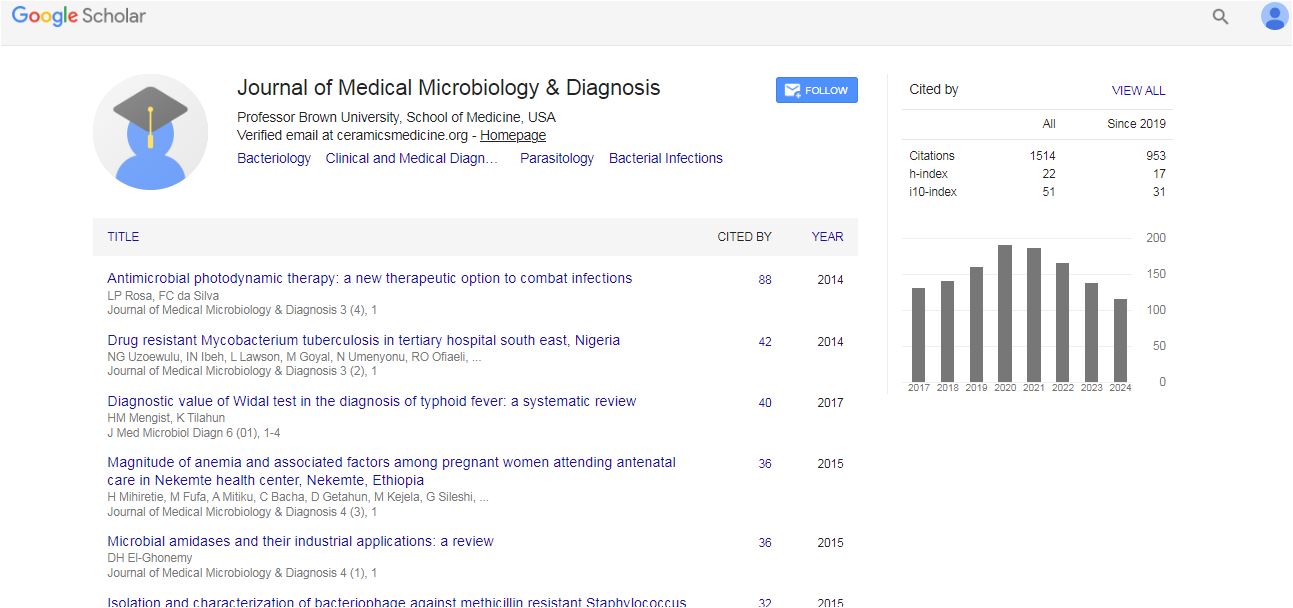
Medical Microbiology & Diagnosis received 14 citations as per Google Scholar report