Short Communication - (2025) Volume 14, Issue 3
Received: 01-May-2025, Manuscript No. mcce-26-190172;
Editor assigned: 05-May-2025, Pre QC No. P-190172;
Reviewed: 19-May-2025, QC No. Q-190172;
Revised: 22-May-2025, Manuscript No. R-190172;
Published:
29-May-2025
, DOI: 10.37421/2470-6965.2025.14.407
Citation: Alvarez, Sofia. ”Combating Malaria Resistance: Multifaceted Global Strategies.” Malar Contr Elimination 14 (2025):407.
Copyright: © 2025 Alvarez S. This is an open-access article distributed under the terms of the Creative Commons Attribution License, which permits unrestricted use, distribution and reproduction in any medium, provided the original author and source are credited.
The global fight against malaria is facing an escalating and formidable challenge: the emergence and spread of drug-resistant parasites. This growing threat jeopardizes decades of progress and necessitates a comprehensive and adaptive approach to malaria control efforts, particularly in regions where the disease is endemic. The development of resistance to antimalarial drugs is a complex phenomenon driven by multiple factors, including the selection pressure exerted by widespread drug use and the inherent capacity of the parasite to evolve. Effective strategies must therefore be multifaceted, addressing not only the parasites themselves but also the vectors that transmit them and the human behaviors that influence transmission and treatment outcomes. This article aims to synthesize current knowledge and highlight critical areas for intervention in combating this pervasive issue. The emergence and spread of drug-resistant malaria parasites pose a significant threat to global malaria control efforts, particularly in endemic regions. This article examines the multifaceted strategies required to combat this growing challenge. It highlights the critical importance of robust surveillance systems to detect resistance early, alongside sustained investment in novel antimalarial drug development. Furthermore, it emphasizes the need for optimized drug treatment regimens, adherence monitoring, and integrated vector management to reduce the overall transmission pressure, thereby slowing the selection and spread of resistant strains. The authors underscore the necessity of international collaboration and strengthened health systems to effectively implement these measures and prevent a resurgence of malaria. [1] This study investigates the molecular mechanisms underlying artemisinin resistance in Plasmodium falciparum parasites collected from a key West African malaria hotspot. The research identifies specific mutations in the Kelch13 (K13) propeller domain that are strongly associated with reduced parasite clearance rates following artemisinin-based combination therapy (ACT). It provides crucial data on the prevalence and geographic distribution of these resistance markers, informing targeted surveillance and intervention strategies. The findings suggest that localized resistance may already be compromising ACT efficacy, necessitating proactive measures. [2] The effectiveness of current malaria elimination programs is increasingly challenged by the spread of drug-resistant parasites. This paper reviews the landscape of antimalarial drug resistance, focusing on the drivers and consequences of resistance to artemisinins and partner drugs. It emphasizes the interconnectedness of resistance mechanisms and the importance of maintaining high-quality diagnostics and prompt treatment. The authors advocate for a multi-pronged approach that includes robust pharmacovigilance, accelerated development of new drugs, and intensified vector control to safeguard progress towards malaria elimination. [3] This research assesses the impact of insecticide resistance in Anopheles mosquitoes on malaria transmission in a rural region of Southeast Asia. The study analyzes the prevalence of common resistance mechanisms, such as target-site resistance (e.g., kdr mutations) and metabolic resistance (e.g., enhanced detoxification enzymes), in mosquito populations. It correlates these findings with increased malaria case incidence and reduced efficacy of pyrethroid-based vector control interventions. The paper strongly recommends the judicious rotation of insecticides with different modes of action and the integration of other vector control tools. [4] The development and deployment of new antimalarial drugs are paramount in the fight against drug resistance. This article provides an overview of the current antimalarial drug pipeline, highlighting promising compounds in various stages of clinical development. It discusses the challenges and opportunities in discovering and developing drugs with novel mechanisms of action to overcome existing resistance. The authors emphasize the critical role of public-private partnerships and innovative financing mechanisms in accelerating the availability of these life-saving medications. [5] Genomic surveillance of Plasmodium falciparum is emerging as a powerful tool for tracking the evolution and spread of drug resistance. This paper presents a framework for integrating genomic data into national malaria control programs. It demonstrates how whole-genome sequencing can identify emerging resistance mutations, trace parasite lineages, and assess the impact of interventions. The authors highlight the importance of establishing robust bioinformatic pipelines and capacity building in endemic countries to effectively utilize this technology. [6] The role of adherence to antimalarial treatment in preventing the emergence and spread of drug resistance is often underestimated. This study evaluates adherence rates to artemisinin-based combination therapies (ACTs) in a diverse cohort of patients in sub-Saharan Africa. It identifies key factors associated with poor adherence, including cost, side effects, and limited health literacy. The findings underscore the necessity of patient education, improved drug delivery systems, and community engagement strategies to enhance adherence and thereby bolster treatment efficacy and reduce resistance selection pressure. [7] Integrated vector management (IVM) is a crucial component in reducing malaria transmission and, consequently, the selective pressure for drug resistance. This review synthesizes evidence on the effectiveness of various IVM strategies, including insecticide-treated nets (ITNs), indoor residual spraying (IRS), and larval source management (LSM). It discusses how these interventions, when implemented synergistically, can significantly lower the parasite reservoir. The authors emphasize the importance of adapting IVM strategies to local epidemiological and entomological contexts. [8] The advent of rapid diagnostic tests (RDTs) has revolutionized malaria case management, enabling timely diagnosis and treatment. This study investigates the performance of various RDTs in detecting Plasmodium falciparum infections in regions with a high prevalence of drug-resistant strains. It assesses the sensitivity and specificity of RDTs for detecting parasites with reduced susceptibility to artemisinins and other antimalarials. The authors highlight the importance of using validated RDTs and maintaining quality assurance systems to ensure accurate diagnosis and appropriate treatment, thereby combating resistance. [9] This article explores the complex interplay between climate change and the spread of antimalarial drug resistance. It examines how changing temperature and rainfall patterns can influence mosquito vector ecology, parasite development, and human behavior, potentially exacerbating resistance. The authors discuss the need for adaptive malaria control strategies that account for climate variability and the increasing risk of drug resistance. They call for integrated approaches that address both climate change mitigation and malaria control. [10]
The escalating threat of drug-resistant malaria parasites necessitates a comprehensive global response, as outlined by Garcia-Lopez et al. [1], emphasizing robust surveillance, novel drug development, optimized treatment regimens, adherence monitoring, and integrated vector management. These strategies are crucial for slowing the selection and spread of resistant strains and preventing a resurgence of malaria, requiring international collaboration and strengthened health systems. [1] Research into the molecular underpinnings of resistance is vital for targeted interventions. Adu-Boahen et al. [2] identify specific Kelch13 (K13) propeller domain mutations in Plasmodium falciparum from West Africa that are strongly associated with artemisinin resistance, providing critical data on prevalence and distribution to inform surveillance and intervention strategies, as localized resistance may already be compromising artemisinin-based combination therapy (ACT) efficacy. [2] Petrova et al. [3] provide a broad overview of antimalarial drug resistance, focusing on artemisinins and partner drugs, highlighting the interconnectedness of resistance mechanisms and the importance of quality diagnostics and prompt treatment. Their review advocates for a multi-pronged approach involving pharmacovigilance, new drug development, and intensified vector control to protect progress towards malaria elimination. [3] Vector resistance to insecticides also significantly impacts malaria transmission. Wei et al. [4] assess insecticide resistance in Anopheles mosquitoes in Southeast Asia, analyzing resistance mechanisms like kdr mutations and enhanced detoxification enzymes, correlating them with increased malaria incidence and reduced efficacy of pyrethroid-based control. They recommend judicious insecticide rotation and integrated vector control tools. [4] The pipeline for new antimalarial drugs is critical for overcoming existing resistance. Jones et al. [5] offer an overview of the current drug pipeline, detailing promising compounds in clinical development and discussing the challenges and opportunities in discovering drugs with novel mechanisms of action. They stress the importance of public-private partnerships and innovative financing to accelerate the availability of new treatments. [5] Genomic surveillance offers a powerful means to track drug resistance evolution and spread. Kim et al. [6] propose a framework for integrating genomic data into national malaria control programs, demonstrating how whole-genome sequencing can identify resistance mutations, trace parasite lineages, and assess intervention impacts. They underscore the need for robust bioinformatic pipelines and capacity building. [6] Patient adherence to antimalarial treatment plays a crucial, often underestimated, role in preventing resistance. Khan et al. [7] evaluate adherence to ACTs in sub-Saharan Africa, identifying factors like cost, side effects, and limited health literacy that contribute to poor adherence. They emphasize patient education, improved drug delivery, and community engagement to enhance adherence and reduce resistance selection. [7] Integrated Vector Management (IVM) is recognized as a key strategy for reducing malaria transmission and subsequent drug resistance pressure. Garcia et al. [8] review the effectiveness of various IVM strategies, including ITNs, IRS, and LSM, demonstrating their synergistic impact on lowering parasite reservoirs and stressing the importance of adapting these strategies to local contexts. [8] The role of accurate diagnostics is paramount in managing malaria, especially in the face of resistance. Gonzalez et al. [9] examine the performance of rapid diagnostic tests (RDTs) in detecting drug-resistant Plasmodium falciparum, assessing their sensitivity and specificity for parasites with reduced susceptibility to common antimalarials. They stress the need for validated RDTs and quality assurance for accurate diagnosis and treatment. [9] Environmental factors, such as climate change, can exacerbate the spread of antimalarial drug resistance. Ramirez et al. [10] explore the interplay between climate change and drug resistance, examining how altered temperature and rainfall patterns affect vector ecology, parasite development, and human behavior. They advocate for adaptive control strategies that integrate climate change mitigation with malaria control efforts. [10]
The escalating threat of antimalarial drug resistance requires multifaceted strategies including robust surveillance for early detection, sustained investment in novel drug development, and optimized treatment regimens. Integrated vector management is crucial for reducing transmission pressure, thereby slowing resistance. Genomic surveillance and high-quality diagnostics are emerging as powerful tools. Patient adherence to treatment and the development of new drugs with novel mechanisms are paramount. International collaboration and strengthened health systems are essential for effective implementation. Climate change also presents a growing challenge, necessitating adaptive control strategies. Addressing these interconnected issues is vital to safeguard progress in malaria control and elimination efforts globally.
None
None
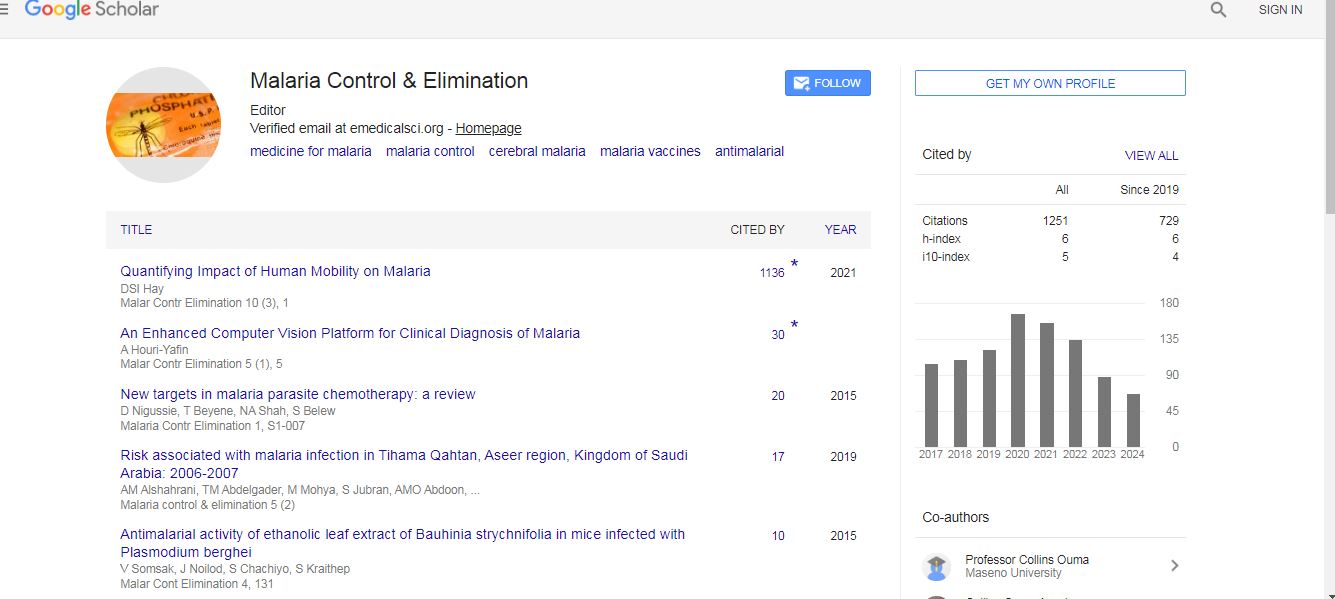
Malaria Control & Elimination received 1187 citations as per Google Scholar report