Perspective - (2025) Volume 14, Issue 6
Received: 31-Oct-2025, Manuscript No. jmmd-26-184714;
Editor assigned: 03-Nov-2025, Pre QC No. P-184714;
Reviewed: 17-Nov-2025, QC No. Q-184714;
Revised: 21-Nov-2025, Manuscript No. R-184714;
Published:
29-Nov-2025
, DOI: 10.37421/2161-0703.2025.14.558
Citation: Musa, Ibrahim. ”Combating Healthcare-Associated Infections: A Multi-Faceted Approach.” J Med Microb Diagn 14 (2025):558.
Copyright: © 2025 Musa I. This is an open-access article distributed under the terms of the Creative Commons Attribution License, which permits unrestricted use, distribution and reproduction in any medium, provided the original author and source are credited.
Healthcare-associated infections (HAIs) represent a pervasive and critical challenge within global healthcare systems, necessitating a thorough understanding of their origins and effective mitigation strategies [1].
These infections not only compromise patient safety and prolong recovery but also impose a significant burden on healthcare resources and infrastructure [1].
The increasing prevalence of multidrug-resistant organisms (MDROs) further complicates the landscape of HAIs, demanding targeted and robust interventions to curb their emergence and transmission within clinical settings, particularly in intensive care units where vulnerable patients are concentrated [2].
Central to the control of HAIs is the consistent and correct practice of hand hygiene, a fundamental yet often overlooked measure that significantly reduces pathogen transmission between patients and healthcare providers [3].
Numerous interventions have been explored to enhance adherence, including the provision of alcohol-based hand rubs and education on proper washing techniques, alongside addressing the barriers that impede compliance among healthcare professionals [3].
The healthcare environment itself plays a crucial role in the dissemination of infectious agents, making effective environmental cleaning and disinfection protocols indispensable for preventing HAI spread, especially for pathogens capable of prolonged survival on surfaces [4].
Specific types of HAIs, such as catheter-associated urinary tract infections (CAUTIs), are common and require dedicated prevention efforts focused on reducing the risks associated with urinary catheter use [5].
These efforts involve judicious catheterization, sterile insertion techniques, and vigilant catheter care, alongside prompt removal when no longer medically necessary [5].
Surgical site infections (SSIs) pose a significant threat post-operatively, with multifactorial risk factors spanning patient characteristics, surgical procedures, and perioperative management, all of which must be addressed through comprehensive prevention strategies [6].
Central line-associated bloodstream infections (CLABSIs) are a leading cause of morbidity and mortality among hospitalized patients, necessitating rigorous adherence to evidence-based prevention bundles during catheter insertion and maintenance [7].
Similarly, ventilator-associated pneumonia (VAP) represents a serious complication in mechanically ventilated individuals, with prevention strategies focusing on maintaining airway defenses, preventing aspiration, and timely extubation [8].
The growing threat of antimicrobial resistance (AMR) critically exacerbates the challenge of HAIs, leading to treatment failures and prolonged hospitalizations, underscoring the urgent need for effective antimicrobial stewardship [9].
Given the complexity of HAIs, the role of continuous education and training for healthcare professionals is paramount in reinforcing best practices for infection prevention [10].
Structured educational interventions have been shown to significantly improve healthcare workers' knowledge, attitudes, and adherence to recommended practices, ultimately contributing to a reduction in HAI rates [10].
Therefore, a multifaceted approach integrating enhanced surveillance, stringent infection control measures, optimized antimicrobial use, environmental hygiene, and comprehensive staff education is essential for effectively combating the persistent threat of HAIs in healthcare settings [1].
Healthcare-associated infections (HAIs) continue to present a formidable challenge in healthcare environments worldwide, necessitating a deep dive into the factors that predispose patients to these infections and the strategies available for their prevention [1].
Patient-specific vulnerabilities, such as weakened immune systems and co-existing medical conditions, are significant contributors, alongside issues related to healthcare providers like insufficient hand hygiene and lapses in aseptic techniques [1].
Furthermore, environmental factors, including contaminated medical equipment and inadequate sanitation, play a crucial role in the transmission pathways of HAIs [1].
The emergence and spread of multidrug-resistant organisms (MDROs) are a primary driver of HAIs, particularly within intensive care units, where prolonged hospital stays, extensive use of broad-spectrum antibiotics, and invasive devices increase susceptibility [2].
Effective prevention requires aggressive decolonization protocols, strict adherence to contact precautions, and well-implemented antimicrobial stewardship programs designed to optimize antibiotic prescribing practices and monitor for resistance trends [2].
Hand hygiene stands as the cornerstone of HAI prevention, with interventions focused on the effectiveness of alcohol-based hand rubs and soap-and-water washing in mitigating pathogen transmission [3].
Identifying and overcoming barriers to adherence among healthcare professionals, such as time constraints and lack of accessible facilities, is critical for improving compliance and ensuring this fundamental practice is consistently applied [3].
Environmental cleaning and disinfection are vital in healthcare settings to prevent the spread of HAIs, especially from pathogens that can persist on surfaces for extended periods [4].
The efficacy of various cleaning agents and disinfection protocols against common HAI-causing microorganisms is continuously assessed, emphasizing the importance of thoroughness, particularly for high-touch surfaces, and adherence to correct disinfectant dwell times [4].
Catheter-associated urinary tract infections (CAUTIs) are a common type of HAI, influenced by factors such as the duration of catheter use, improper insertion techniques, and inadequate catheter care [5].
Prevention strategies are evidence-based and focus on judicious use of indwelling urinary catheters, employing sterile insertion techniques, and maintaining regular catheter care, with an emphasis on timely removal [5].
Surgical site infections (SSIs) are a major concern post-operatively, contributing to increased patient morbidity and mortality. Their development is influenced by a complex interplay of patient characteristics, operative factors, and the quality of perioperative care, necessitating comprehensive prevention measures [6].
These include appropriate antibiotic prophylaxis, meticulous surgical techniques, patient optimization before surgery, and effective wound management protocols [6].
Central line-associated bloodstream infections (CLABSIs) are a leading cause of morbidity and mortality in hospitalized patients and are associated with various risk factors including catheter type, insertion site, duration of use, and care practices [7].
Prevention bundles that incorporate maximal sterile barrier precautions during insertion, consistent hand hygiene, proper skin antisepsis, and minimizing unnecessary line use are crucial for reducing CLABSI rates [7].
Ventilator-associated pneumonia (VAP) poses a significant risk to mechanically ventilated patients, leading to increased mortality and healthcare costs [8].
Key prevention strategies aim to enhance airway defenses, prevent aspiration of secretions, and reduce microbial colonization, including elevating the head of the bed, providing regular oral care with antiseptics, utilizing subglottic secretion drainage, and facilitating timely weaning from mechanical ventilation [8].
Antimicrobial resistance (AMR) significantly amplifies the challenge of HAIs by leading to treatment failures and extended hospital stays [9].
Understanding the intricate relationship between AMR and HAIs requires implementing robust antimicrobial stewardship programs that focus on appropriate antibiotic selection, dosing, and duration to preserve the efficacy of existing antimicrobials and slow the emergence of new resistance mechanisms [9].
Finally, the continuous education and training of healthcare professionals are indispensable for effective HAI prevention [10].
Structured educational programs have demonstrably improved healthcare workers' knowledge, attitudes, and practices related to infection prevention, leading to better adherence to recommended protocols and a subsequent reduction in HAI incidence [10].
Healthcare-associated infections (HAIs) remain a significant global challenge, driven by patient vulnerabilities, healthcare provider practices, and environmental factors. Multidrug-resistant organisms (MDROs) exacerbate HAIs, particularly in intensive care settings, necessitating aggressive prevention strategies including antimicrobial stewardship and strict precautions. Hand hygiene is a fundamental preventive measure, with efforts focused on improving adherence by addressing barriers. Environmental cleaning and disinfection are critical for reducing pathogen transmission on surfaces. Specific HAIs like CAUTIs, SSIs, CLABSIs, and VAP have distinct risk factors and require targeted prevention bundles. Antimicrobial resistance (AMR) further complicates HAI management, highlighting the importance of antimicrobial stewardship. Continuous education and training of healthcare professionals are essential for reinforcing infection prevention practices and reducing HAI rates. A comprehensive, multi-faceted approach is required for effective HAI control.
None
None
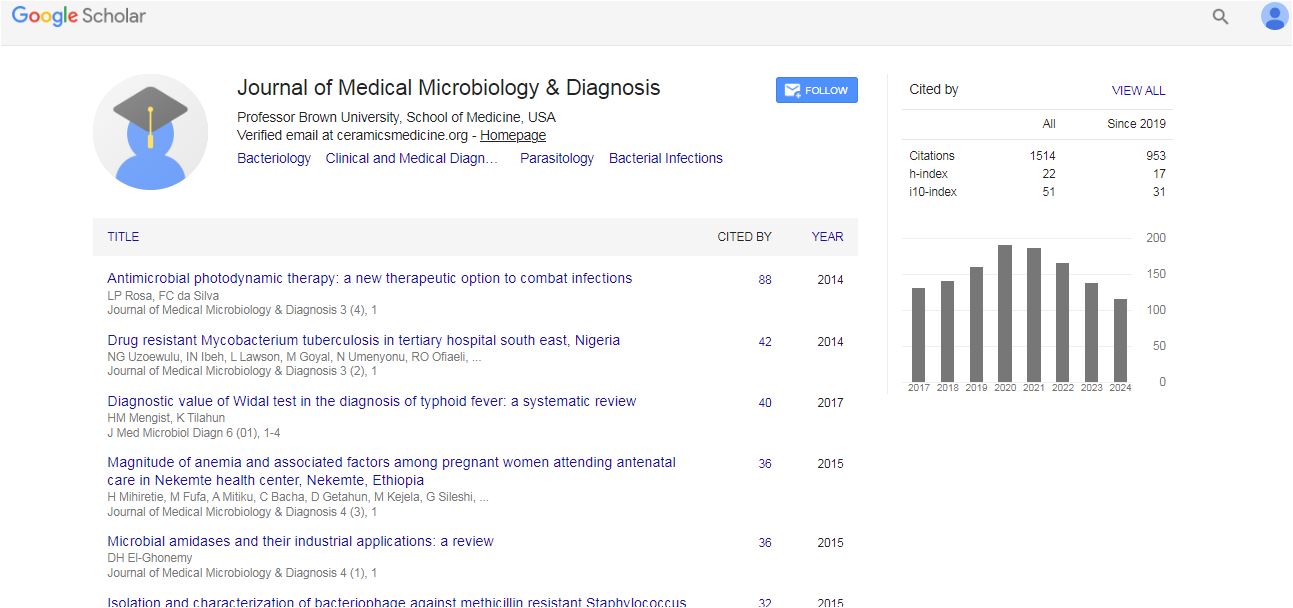
Medical Microbiology & Diagnosis received 14 citations as per Google Scholar report