Commentary - (2025) Volume 13, Issue 3
Received: 02-Jun-2025, Manuscript No. jcdd-25-176784;
Editor assigned: 04-Jun-2025, Pre QC No. P-176784;
Reviewed: 18-Jun-2025, QC No. Q-176784;
Revised: 23-Jun-2025, Manuscript No. R-176784;
Published:
30-Jun-2025
, DOI: 10.37421/2329-9517.2025.13.671
Citation: Mahmoud, Hassan. ”CMR and AI: Revolutionizing Cardiac
Diagnostics.” J Cardiovasc Dis Diagn 13 (2025):671.
Copyright: © 2025 Mahmoud H. This is an open-access article distributed under the terms of the Creative Commons Attribution License, which permits unrestricted use,
distribution and reproduction in any medium, provided the original author and source are credited.
Cardiovascular Magnetic Resonance (CMR) has certainly emerged as a cornerstone in comprehensive myocardial tissue characterization. This critical imaging modality offers profound insights into various cardiac conditions. It employs sophisticated techniques like T1 and T2 mapping, extracellular volume quantification, and late gadolinium enhancement. These methods are invaluable for diagnosing and prognosticating a spectrum of myocardial diseases, from inflammatory conditions to complex infiltrative cardiomyopathies[1].
Moving past tissue characterization alone, CMRâ??s role has expanded significantly in evaluating valvular heart disease. What this really means is, it provides a comprehensive assessment of valve morphology, the severity of hemodynamic impact, and the ventricular response to valvular dysfunction. This detailed information often surpasses traditional echocardiography, proving crucial for patient management and precise surgical planning[2].
A significant advancement in cardiovascular imaging comes from integrating Artificial Intelligence (AI) into cardiac MRI. AI applications enhance various stages, from optimizing image acquisition and reconstruction to performing intricate quantitative analyses. The ultimate goal here is to boost diagnostic accuracy, streamline clinical workflows, and pave the way for more personalized medicine approaches in cardiac imaging[3].
When it comes to cardiomyopathies, cardiac MRI holds an indispensable position within a multimodality imaging framework. It offers unique insights into myocardial tissue composition, identifying areas of fibrosis, and meticulously assessing ventricular function. These precise details are vital for guiding accurate prognoses and formulating tailored therapeutic strategies for patients with diverse cardiomyopathies[4].
Patients with congenital heart disease (CHD) also benefit greatly from CMR. It has seen substantial advancements, demonstrating superior capability for detailed anatomical assessment, precise quantification of blood flow dynamics, and thorough evaluation of ventricular function. These insights are fundamental for the long-term management and meticulous planning of interventions in CHD patients[5].
Accurately diagnosing myocarditis often relies heavily on the current state-of-the-art use of cardiac MRI. The modality employs modified Lake Louise criteria alongside advanced tissue characterization techniques, including T1 and T2 mapping and Late Gadolinium Enhancement (LGE). These tools enable the accurate detection of inflammation and injury, thereby guiding appropriate clinical management and prognosis for individuals suspected of having myocarditis[6].
Stress Cardiac Magnetic Resonance Imaging (CMR) proves a powerful tool for detecting myocardial ischemia and assessing myocardial viability. It incorporates various pharmacological stress protocols and offers the distinct advantage of providing both functional and perfusion assessments without exposing patients to ionizing radiation. This makes stress CMR an exceedingly valuable instrument for risk stratification in patients with coronary artery disease[7].
The emerging field of cardio-oncology finds cardiac MRI playing a critical role, especially in monitoring cardiac function and detecting tissue changes in cancer patients undergoing potentially cardiotoxic therapies. The non-invasive nature of CMR allows for the early detection of myocardial injury and detailed tissue characterization. This is instrumental in risk stratification and developing management strategies to mitigate treatment-related cardiovascular complications[8].
Understanding complex cardiovascular hemodynamics is significantly enhanced by 4D flow Cardiovascular Magnetic Resonance. This advanced technique provides extensive volumetric and time-resolved information about blood flow, detailing its technical principles and a wide array of clinical applications. It proves particularly useful for assessing complex cardiovascular conditions with intricate flow patterns[9].
Crucially, Cardiac Magnetic Resonance Imaging is absolutely vital in the diagnosis, risk stratification, and management of hypertrophic cardiomyopathy (HCM). CMR offers the unique ability to precisely delineate myocardial hypertrophy, identify myocardial fibrosis through late gadolinium enhancement, and accurately assess dynamic left ventricular outflow tract obstruction. These capabilities are indispensable for delivering optimal patient care in HCM[10].
Cardiovascular Magnetic Resonance (CMR) stands as a truly pivotal imaging modality, providing unparalleled insights into cardiac health and disease. It consistently demonstrates excellence in comprehensive myocardial tissue characterization, utilizing a suite of sophisticated techniques. This means methods like T1 and T2 mapping offer quantitative assessment of tissue properties, while extracellular volume quantification becomes essential for detecting diffuse myocardial pathology. Crucially, late gadolinium enhancement (LGE) proves invaluable for precisely identifying and quantifying areas of myocardial fibrosis, a key biomarker in numerous cardiac conditions. Collectively, these advanced methods facilitate accurate diagnosis and precise prognostication of a wide spectrum of myocardial diseases, from various inflammatory conditions to complex infiltrative cardiomyopathies. This detailed tissue information is instrumental in guiding targeted therapeutic interventions and ultimately enhancing patient outcomes[1].
Letâ??s look at how CMR spans broadly across the diagnosis and management of specific cardiac pathologies. For instance, in valvular heart disease, CMR offers a uniquely detailed and comprehensive assessment of valve morphology, the precise severity of hemodynamic impact, and the subsequent response of the ventricles to valvular dysfunction. This rich, quantitative information frequently complements or even surpasses the diagnostic capabilities of conventional echocardiography, proving essential for effective patient management and precise surgical planning[2]. Similarly, when dealing with suspected myocarditis, cardiac MRI has cemented its position as the state-of-the-art diagnostic tool. It meticulously applies modified Lake Louise criteria in conjunction with advanced tissue characterization techniques, including T1 and T2 mapping and Late Gadolinium Enhancement (LGE), enabling accurate detection of inflammation and injury. This detailed understanding directly informs appropriate clinical management and prognosis for affected individuals[6].
Considering diverse cardiomyopathies, cardiac MRI takes on an indispensable role as part of a multimodality imaging strategy. It provides unique and deep insights into myocardial tissue composition, the extent and pattern of fibrosis, and the nuanced assessment of ventricular function. All of these factors are critically important for deriving accurate prognoses and formulating individualized therapeutic strategies[4]. And then thereâ??s hypertrophic cardiomyopathy (HCM), where CMR proves absolutely vital in guiding diagnosis, informing risk stratification, and optimizing management protocols. It possesses the unique ability to precisely delineate myocardial hypertrophy, detect myocardial fibrosis through late gadolinium enhancement, and accurately assess dynamic left ventricular outflow tract obstruction. These capabilities are indispensable for delivering optimal and personalized patient care in HCM[10].
Several specialized applications further underscore CMRâ??s remarkable versatility and clinical impact. In the challenging domain of congenital heart disease (CHD), CMR has undergone substantial advancements. It now offers superior capabilities for exquisitely detailed anatomical assessment, precise and quantitative evaluation of blood flow dynamics, and thorough functional assessment of ventricular performance. These robust capabilities are paramount for the long-term management and meticulous planning of interventions in CHD patients, ensuring comprehensive and enduring care[5]. Another key area is cardio-oncology, where cardiac MRI plays an increasingly critical role. It is employed for vigilantly monitoring cardiac function and detecting subtle tissue changes in cancer patients undergoing potentially cardiotoxic therapies. Its non-invasive ability to detect early myocardial injury and precisely characterize tissue changes proves instrumental in comprehensive risk stratification and in formulating proactive management strategies aimed at mitigating treatment-related cardiovascular complications[8]. Stress Cardiac Magnetic Resonance Imaging (CMR) represents another profoundly valuable application, proving highly effective in detecting myocardial ischemia and accurately assessing myocardial viability. By employing various pharmacological stress protocols, stress CMR uniquely provides both functional and perfusion assessments without exposing patients to ionizing radiation, thereby establishing itself as an exceedingly powerful tool for comprehensive risk stratification in individuals presenting with coronary artery disease[7].
Continuous technological innovations are consistently pushing the boundaries of cardiac MRIâ??s diagnostic and prognostic capabilities. The strategic integration of Artificial Intelligence (AI) into various cardiac MRI workflows is fundamentally transforming the imaging landscape. AI applications are enhancing every stage, from optimizing image acquisition parameters and improving reconstruction algorithms to performing intricate quantitative analyses with remarkable efficiency and precision. This sophisticated application of AI is explicitly aimed at significantly improving diagnostic accuracy, streamlining complex clinical processes, and ultimately facilitating personalized medicine approaches within cardiovascular imaging[3]. Another groundbreaking advanced technique, 4D flow Cardiovascular Magnetic Resonance, provides uniquely comprehensive volumetric and time-resolved information regarding blood flow patterns. This dynamic capability is absolutely essential for profoundly enhancing the detailed assessment of complex cardiovascular hemodynamics across a wide array of cardiac conditions, offering an unprecedented, dynamic view of blood movement within the heart and great vessels. Such detailed flow information is critical for understanding intricate cardiac function and pathology[9].
Cardiovascular Magnetic Resonance (CMR) plays a critical role in comprehensive myocardial tissue characterization, using advanced techniques like T1 and T2 mapping, extracellular volume quantification, and late gadolinium enhancement to diagnose and prognosticate various myocardial diseases. Its utility extends to evaluating valvular heart disease, assessing morphology, hemodynamics, and ventricular response, offering insights beyond traditional echocardiography. Artificial Intelligence (AI) applications are transforming cardiac MRI, enhancing image acquisition, reconstruction, and quantitative analysis for improved diagnostic accuracy and personalized medicine. CMR is an indispensable part of multimodality imaging for cardiomyopathies, providing unique insights into tissue composition, fibrosis, and ventricular function. Significant advancements make CMR superior for anatomical assessment, blood flow quantification, and ventricular function evaluation in congenital heart disease. For myocarditis diagnosis, it leverages modified Lake Louise criteria and advanced tissue characterization. Stress Cardiac Magnetic Resonance Imaging is valuable for detecting myocardial ischemia and viability, offering functional and perfusion assessments without ionizing radiation. In cardio-oncology, CMR is crucial for monitoring cardiac function and tissue changes during cardiotoxic therapies. Advanced 4D flow Cardiovascular Magnetic Resonance provides comprehensive volumetric and time-resolved blood flow information, enhancing the assessment of complex cardiovascular hemodynamics. Finally, cardiac MRI is vital in hypertrophic cardiomyopathy for diagnosis, risk stratification, and management.
Indexed at, Google Scholar, Crossref
Indexed at, Google Scholar, Crossref
Indexed at, Google Scholar, Crossref
Indexed at, Google Scholar, Crossref
Indexed at, Google Scholar, Crossref
Indexed at, Google Scholar, Crossref
Indexed at, Google Scholar, Crossref
Indexed at, Google Scholar, Crossref
Indexed at, Google Scholar, Crossref
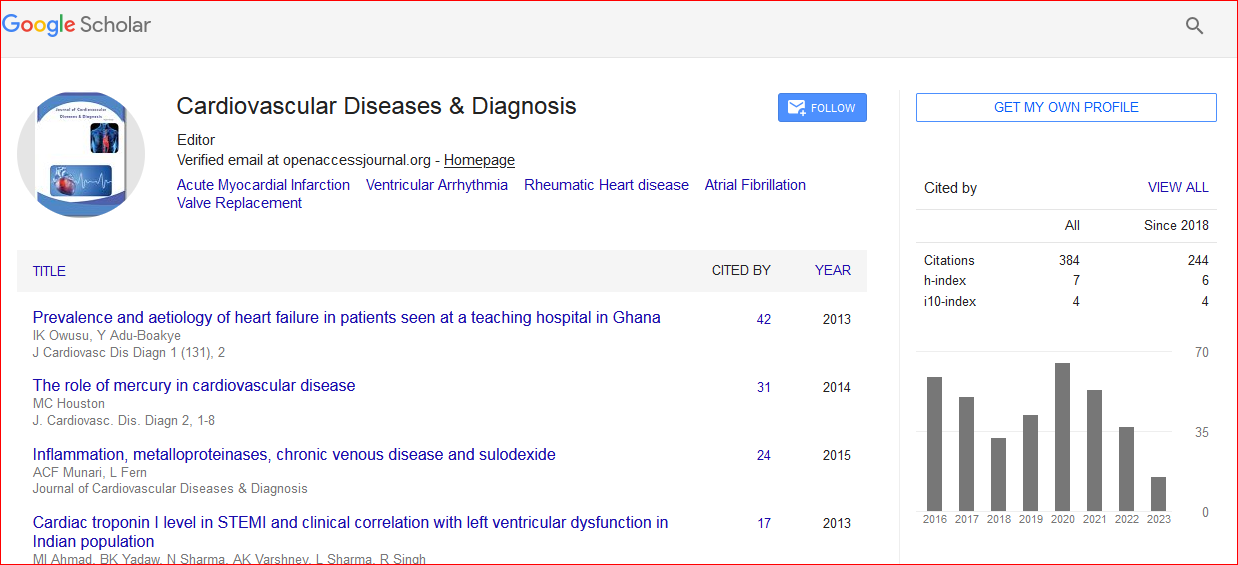
Cardiovascular Diseases & Diagnosis received 427 citations as per Google Scholar report