Commentary - (2025) Volume 18, Issue 3
Received: 30-Apr-2025, Manuscript No. jscb-25-176388;
Editor assigned: 02-May-2025, Pre QC No. P-176388;
Reviewed: 16-May-2025, QC No. Q-176388;
Revised: 23-May-2025, Manuscript No. R-176388;
Published:
30-May-2025
, DOI: 10.37421/0974-7230.2025.18.583
Citation: Takahashi, Kenji. ”Cloud Computing: Security, Sustainability, Integration, Applications.” J Comput Sci Syst Biol 18 (2025):583.
Copyright: © 2025 Takahashi K. This is an open-access article distributed under the terms of the Creative Commons Attribution License, which permits unrestricted use, distribution and reproduction in any medium, provided the original author and source are credited.
This paper breaks down the security challenges facing cloud computing, offering a wide-ranging overview of current threats and proposed solutions. It covers everything from data breaches to compliance issues, giving a solid foundation for understanding cloud security [1].
We're talking about making cloud computing more energy-efficient here. This review dives into the challenges of power consumption and explores various solutions, from resource management to virtual machine scheduling, pointing out future research directions for a greener cloud [2].
This article explores the integration of Edge Computing with cloud computing. It categorizes existing approaches, highlights key challenges like latency and resource constraints, and points out where more research is needed to make these combined systems truly effective [3].
Here's a look at how Blockchain technology is being used to enhance cloud computing. The paper reviews various blockchain-based solutions aimed at improving security, transparency, and data integrity in cloud environments, covering its application across different cloud services [4].
This paper tackles the important subject of green cloud computing. It's about minimizing energy consumption and carbon footprints in cloud data centers, reviewing strategies for sustainable operation and highlighting the environmental impact of cloud services [5].
This article explores cloud computing's role in healthcare. It looks at how cloud technology can improve data management, accessibility, and collaboration in medical settings, while also addressing critical concerns like patient data privacy and regulatory compliance [6].
Here's a survey that covers the major security challenges in cloud computing and the various solutions being developed to counter them. It offers a broad perspective on protecting cloud environments from different types of attacks and vulnerabilities [7].
This systematic review looks into how Fog Computing is used alongside cloud computing. It examines the architectural models, applications, and performance benefits of combining these two paradigms, addressing how they can work together to improve distributed systems [8].
Resource management is key in cloud computing, and this survey gives a thorough look at the topic. It covers various techniques for allocating and managing resources like CPU, memory, and storage to ensure efficiency, performance, and cost-effectiveness in cloud environments [9].
This paper explores how Blockchain can provide secure data sharing in cloud computing. It systematically reviews existing blockchain-based solutions, identifying their strengths and weaknesses in ensuring data integrity, confidentiality, and access control in the cloud [10].
Cloud computing forms a foundational part of modern digital infrastructure, bringing with it both immense opportunities and complex challenges across various domains. A primary concern consistently addressed in the literature is cloud security, with comprehensive reviews breaking down the extensive security challenges, current threats, and proposed solutions. These discussions cover everything from preventing significant data breaches to navigating complex compliance issues, providing a robust understanding of cloud security fundamentals [1]. Further surveys offer a broad perspective on protecting cloud environments, detailing major security challenges and the diverse solutions being developed to counter different types of attacks and vulnerabilities [7]. In a forward-looking approach, the integration of Blockchain technology is actively explored to enhance cloud computing environments, specifically by improving overall security, transparency, and data integrity across various cloud services [4]. This includes systematic reviews of existing Blockchain-based solutions, which identify their strengths and weaknesses in ensuring secure data sharing, maintaining integrity, confidentiality, and access control within the cloud [10].
Another significant and increasingly critical area of focus is making cloud computing operations more energy-efficient and environmentally sustainable. Research systematically reviews the challenges of power consumption, exploring diverse solutions ranging from sophisticated resource management techniques to intelligent virtual machine scheduling. This work often points out crucial future research directions aimed at fostering a greener cloud infrastructure [2]. Directly related, the concept of green cloud computing is extensively examined, with an emphasis on minimizing energy consumption and reducing carbon footprints in expansive cloud data centers. These reviews detail strategies for sustainable operation and highlight the broader environmental impact of cloud services, advocating for greater sustainability in cloud environments [5].
The evolution of cloud computing also involves its strategic integration with other distributed computing paradigms. For instance, the integration of Edge Computing with cloud computing is a burgeoning field, where existing approaches are categorized, and key challenges like latency and resource constraints are meticulously highlighted. Such analyses indicate where more focused research is needed to make these combined systems truly effective and responsive [3]. Similarly, systematic reviews investigate how Fog Computing is effectively utilized alongside cloud computing. They examine various architectural models, practical applications, and the performance benefits that arise from combining these two paradigms, ultimately addressing how they can collaborate to significantly improve distributed systems [8].
Beyond its foundational technological aspects, cloud computing has transformative applications in specialized sectors. Its integral role in healthcare is widely discussed, looking at how cloud technology can profoundly improve data management, accessibility, and collaborative efforts within medical settings. Importantly, these discussions concurrently address critical concerns such as stringent patient data privacy requirements and complex regulatory compliance unique to the healthcare industry [6]. Complementing these specialized applications, the overarching topic of resource management remains pivotal for optimizing cloud computing operations. Comprehensive surveys delve into various techniques for efficiently allocating and managing vital resources like CPU, memory, and storage, all with the aim of ensuring maximal efficiency, superior performance, and significant cost-effectiveness across diverse cloud environments [9].
This data provides a comprehensive overview of current research trends in cloud computing, highlighting critical areas of development and concern. A major focus is cloud security, with papers detailing diverse threats from data breaches to compliance issues, and exploring solutions including the use of Blockchain technology to enhance data integrity and access control. Alongside security, energy efficiency and green cloud computing are emphasized, with reviews addressing power consumption challenges, sustainable operation strategies, and carbon footprint reduction in data centers. The integration of cloud computing with other distributed paradigms like Edge Computing and Fog Computing is also a significant theme. Research explores architectural models, applications, and challenges such as latency, aiming to create more effective combined systems. Furthermore, the dataset covers specialized applications, such as cloud computing's role in healthcare for improved data management and collaboration, while rigorously addressing patient data privacy and regulatory compliance. Effective resource management is also central to cloud operations, with surveys detailing techniques for optimizing CPU, memory, and storage allocation for efficiency and cost-effectiveness. Overall, the collection reflects a dynamic research landscape focused on enhancing security, sustainability, integration, and performance across various cloud computing applications.
None
None
Abdullah MA, Mazin A, Ali MA. "Cloud computing security: A comprehensive review".J King Saud Univ Comput Inf Sci 35 (2023):101625.
Indexed at, Google Scholar, Crossref
Omar C, Bassem Z, Ahmed MK. "A systematic review on energy efficiency in cloud computing: Challenges, solutions, and future directions".J Parallel Distrib Comput 183 (2024):104780.
Indexed at, Google Scholar, Crossref
Kshitij KS, Prachi S, S. LAD. "Edge computing integrated with cloud computing: A review, taxonomy, and open issues".Comput Netw 228 (2023):109723.
Indexed at, Google Scholar, Crossref
Abdullah MA, Mazin A, Ali MA. "Blockchain for cloud computing: A comprehensive review".J King Saud Univ Comput Inf Sci 35 (2023):101430.
Indexed at, Google Scholar, Crossref
A. MA, A. MA, M. A. "Green cloud computing: A comprehensive review of energy efficiency, carbon footprint, and sustainability in cloud environments".Sustainable Comput Inform Syst 37 (2023):100874.
Indexed at, Google Scholar, Crossref
Manisha B, Sachin K, Sudip C. "Cloud computing for healthcare: A review".J Netw Comput Appl 213 (2023):103598.
Indexed at, Google Scholar, Crossref
Farhan A, Riffat J, Mudassar R. "A survey on cloud computing security challenges and solutions".Future Gener Comput Syst 129 (2022):107-123.
Indexed at, Google Scholar, Crossref
Saru K, M. BMK, M. B. "Fog computing with cloud computing: A systematic review".Comput Commun 202 (2023):147-160.
Indexed at, Google Scholar, Crossref
Priyanka K, Sanjay KD, S. SC. "Resource management in cloud computing: A comprehensive survey".J Netw Comput Appl 205 (2022):103441.
Indexed at, Google Scholar, Crossref
Ankit P, Sachin K, Rajesh S. "A systematic review of blockchain-based solutions for secure data sharing in cloud computing".Comput Netw 240 (2024):109981.
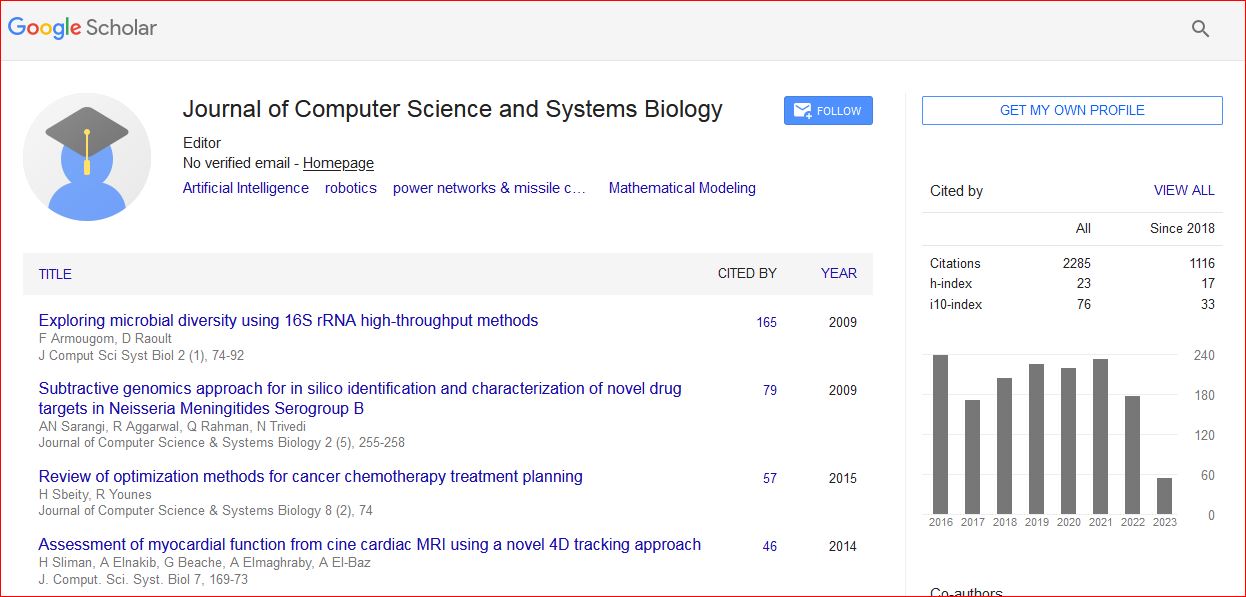
Journal of Computer Science & Systems Biology received 2279 citations as per Google Scholar report