Brief Report - (2025) Volume 16, Issue 4
Received: 01-Jul-2025, Manuscript No. hycr-25-174939;
Editor assigned: 03-Jul-2025, Pre QC No. P-174939;
Reviewed: 17-Jul-2025, QC No. Q-174939;
Revised: 22-Jul-2025, Manuscript No. R-174939;
Published:
29-Jul-2025
, DOI: 10.37421/2157-7587.2025.16.606
Citation: Holm, Darius K.. ”Climate-Adaptive Urban Flood Resilience Strategies.” Hydrol Current Res 16 (2025):606.
Copyright: © 2025 Holm K. Darius This is an open-access article distributed under the terms of the Creative Commons Attribution License, which permits unrestricted use,
distribution and reproduction in any medium, provided the original author and source are credited.
This systematic review provides an overview of urban flood risk management strategies in the face of climate change, highlighting key challenges like increasing flood frequency and intensity, and exploring opportunities through nature-based solutions and integrated urban planning. It emphasizes the need for adaptive and resilient approaches to mitigate future flood impacts in urban environments [1].
This systematic review explores the landscape of community-based flood risk management, identifying common challenges such as limited resources, institutional barriers, and lack of sustained engagement. It also highlights opportunities presented by empowering local communities, fostering participatory decision-making, and integrating indigenous knowledge for more effective and sustainable flood resilience [2].
This comprehensive review examines recent advancements in flash flood early warning systems, emphasizing improvements in hydrological modeling, remote sensing technologies, and data assimilation techniques. It discusses the critical role of these systems in reducing flood-related casualties and economic losses, while also pointing out challenges in system implementation and communication effectiveness [3].
This review provides a historical and contemporary perspective on flood damage assessment methods, ranging from direct physical damage models to indirect economic impact analyses. It evaluates the strengths and limitations of various approaches, advocating for integrated methodologies that incorporate socio-economic factors and climate change uncertainties for more robust damage estimations [4].
This systematic review synthesizes the current understanding of nature-based solutions (NBS) for flood risk reduction, showcasing their effectiveness across various scales, from urban green spaces to large-scale wetland restoration. It highlights the co-benefits of NBS, such as biodiversity enhancement and water quality improvement, while also discussing challenges in their implementation and monitoring [5].
This systematic review delves into the evolving landscape of flood insurance in the context of climate change, identifying significant challenges like increasing actuarial complexity, affordability issues, and coverage gaps. It also explores opportunities for innovative insurance products, risk-sharing mechanisms, and their integration with broader climate adaptation policies to enhance societal resilience against floods [6].
This review provides an overview of recent advancements in hydrological modeling techniques used for flood forecasting, including the integration of machine learning and remote sensing data. It highlights critical challenges such as data scarcity, model uncertainties, and computational demands, emphasizing the need for robust and efficient models to improve the accuracy and timeliness of flood predictions [7].
This systematic review investigates diverse methods for assessing social vulnerability to floods and identifies key influencing factors, including socio-economic status, demographic characteristics, and access to resources. It underscores the importance of a nuanced understanding of social disparities to develop equitable and effective flood risk reduction strategies that address the needs of the most vulnerable populations [8].
This systematic review evaluates the effectiveness of green infrastructure (GI) in mitigating urban floods, showcasing its capacity to reduce stormwater runoff, enhance infiltration, and improve water quality. It addresses key implementation challenges, such as land availability, public perception, and integration into existing urban planning frameworks, advocating for policy support to expand GI adoption [9].
This global review synthesizes evidence on the attribution of observed flood changes to both climate change and human activities, revealing complex interactions. It highlights that while climate change influences extreme precipitation, human alterations like land-use change, deforestation, and river modifications significantly modulate flood frequency and magnitude, necessitating integrated management approaches [10].
Urban areas worldwide face increasing flood risks due to climate change, characterized by heightened frequency and intensity of events. Strategic urban flood risk management is essential, focusing on adaptive and resilient approaches to mitigate future impacts [1]. A key component of this involves nature-based solutions (NBS) for flood risk reduction, which have proven effective across scales, from localized green spaces to extensive wetland restoration. These solutions not only reduce flood risks but also offer co-benefits like biodiversity enhancement and improved water quality, though their implementation and monitoring present distinct challenges [5]. Complementary to NBS, green infrastructure (GI) plays a vital role in urban flood mitigation, effectively reducing stormwater runoff, enhancing infiltration, and improving water quality. Expanding GI adoption requires addressing hurdles such as land availability, public perception, and integration into existing urban planning frameworks, often necessitating strong policy support [9].
Effective flood resilience also depends heavily on community-based flood risk management. However, this approach frequently encounters challenges such as limited resources, institutional barriers, and difficulties in sustaining engagement. Opportunities lie in empowering local communities, promoting participatory decision-making, and integrating indigenous knowledge, which can lead to more effective and sustainable outcomes [2]. Understanding social vulnerability to floods is equally critical, involving the assessment of diverse influencing factors including socio-economic status, demographic characteristics, and access to vital resources. A nuanced understanding of these social disparities is necessary to develop equitable and effective flood risk reduction strategies tailored to the needs of the most vulnerable populations [8].
Technological advancements are transforming flood preparedness, particularly in flash flood early warning systems. Improvements in hydrological modeling, remote sensing technologies, and data assimilation techniques are critical for reducing casualties and economic losses, despite ongoing challenges in system implementation and communication effectiveness [3]. Further supporting this, ongoing advancements in hydrological modeling techniques are vital for flood forecasting, including the integration of machine learning and remote sensing data. Overcoming challenges like data scarcity, model uncertainties, and computational demands is essential to developing robust and efficient models that enhance the accuracy and timeliness of flood predictions [7].
Comprehensive flood damage assessment methods are crucial, with reviews spanning historical and contemporary perspectives, from direct physical damage models to indirect economic impact analyses. Integrated methodologies are advocated to incorporate socio-economic factors and climate change uncertainties for more reliable damage estimations [4]. The financial aspects of flood risk management are also evolving, with systematic reviews delving into flood insurance within a changing climate. Significant challenges include increasing actuarial complexity, affordability issues, and coverage gaps. Yet, there are opportunities for innovative insurance products, new risk-sharing mechanisms, and their integration with broader climate adaptation policies to build greater societal resilience against floods [6].
Finally, a global perspective reveals that observed flood changes are a result of complex interactions between climate change and human activities. While climate change influences extreme precipitation patterns, human alterations such as land-use change, deforestation, and river modifications significantly modulate flood frequency and magnitude. This complexity underscores the necessity for truly integrated management approaches that consider both natural and anthropogenic drivers of flood risk [10].
This body of research collectively examines the multifaceted challenges and opportunities in flood risk management, particularly in the context of climate change and human activities. It highlights the growing need for adaptive and resilient strategies in urban environments, where increasing flood frequency and intensity demand innovative solutions like nature-based approaches and integrated urban planning. Community-based flood risk management is emphasized as a critical component, though it faces issues like resource limitations and institutional barriers; empowering local communities and integrating indigenous knowledge offers a path forward. Technological advancements are central to improving flood preparedness, with comprehensive reviews of flash flood early warning systems leveraging hydrological modeling and remote sensing, alongside explorations of advanced hydrological modeling for forecasting, which must overcome data scarcity and computational hurdles. Furthermore, the literature addresses methodologies for assessing flood damage, advocating for integrated approaches that account for socio-economic factors and climate uncertainties. The role of green infrastructure in urban flood mitigation is recognized for its ability to reduce runoff and enhance water quality, even while facing implementation challenges. The social dimension is explored through studies on social vulnerability to floods, stressing the importance of understanding disparities to develop equitable risk reduction. Finally, the evolving landscape of flood insurance is reviewed, pointing out complexities and opportunities for new products that bolster societal resilience. These studies underscore the urgent need for holistic, integrated management approaches to mitigate flood impacts.
None
None
Indexed at, Google Scholar, Crossref
Indexed at, Google Scholar, Crossref
Indexed at, Google Scholar, Crossref
Indexed at, Google Scholar, Crossref
Indexed at, Google Scholar, Crossref
Indexed at, Google Scholar, Crossref
Indexed at, Google Scholar, Crossref
Indexed at, Google Scholar, Crossref
Indexed at, Google Scholar, Crossref
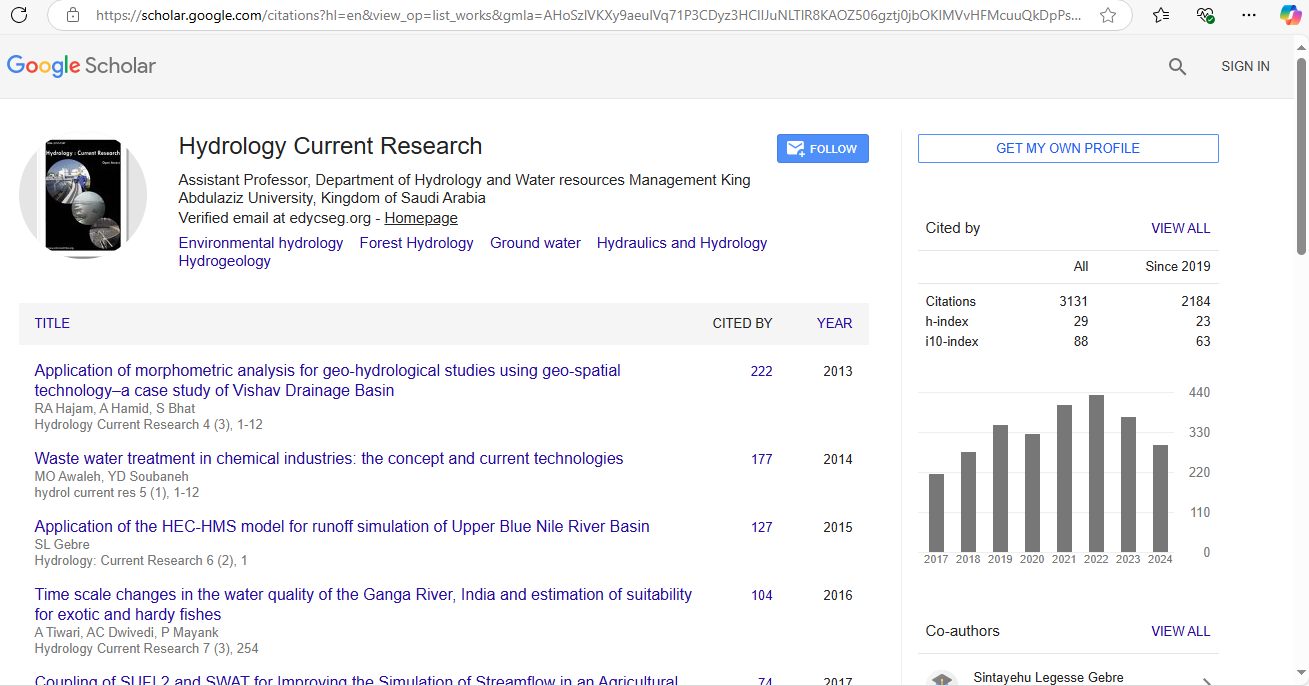
Hydrology: Current Research received 2843 citations as per Google Scholar report