Commentary - (2025) Volume 15, Issue 5
Received: 01-Sep-2025, Manuscript No. jtese-26-184248;
Editor assigned: 03-Sep-2025, Pre QC No. P-184248;
Reviewed: 17-Sep-2025, QC No. Q-184248;
Revised: 22-Sep-2025, Manuscript No. R-184248;
Published:
29-Sep-2025
, DOI: 10.37421/2165-8064.2025.15.672
Citation: Novak, Petra. ”Circular Textiles: Innovations, Challenges, and a Holistic Future.” J Textile Sci Eng 15 (2025):672.
Copyright: © 2025 Novak P. This is an open-access article distributed under the terms of the Creative Commons Attribution License, which permits unrestricted use, distribution and reproduction in any medium, provided the original author and source are credited.
The textile industry is undergoing a significant transformation driven by the imperative to adopt circular economy principles, moving away from linear 'take-make-dispose' models towards systems that minimize waste and maximize resource utilization. This paradigm shift is crucial for addressing the substantial environmental footprint of textile production and consumption, including resource depletion, pollution, and greenhouse gas emissions. The circular economy in textiles encompasses a range of strategies aimed at keeping materials in use for as long as possible. Key among these are design for longevity, which emphasizes the creation of durable and repairable garments, and material innovation geared towards enhancing recyclability. Furthermore, the development and implementation of advanced recycling technologies are paramount for processing post-consumer textile waste back into valuable raw materials. The economic and environmental benefits of embracing circularity in the textile sector are manifold. These include a significant reduction in landfill waste, a decrease in the consumption of virgin resources such as water and energy, and the emergence of novel business models centered around reuse, repair, and recycling. Such benefits contribute to both ecological sustainability and economic resilience. However, the widespread adoption of these circular approaches is not without its challenges. Scaling up the necessary infrastructure for efficient collection and sorting of textile waste remains a major hurdle. This requires substantial investment and coordinated efforts across the value chain, from consumers to manufacturers and recyclers. Consumer behavior also plays a critical role in the success of circular economy initiatives. Shifting consumer mindsets from fast fashion to a more conscious consumption pattern, characterized by preferences for sustainable products and engagement with circular options, is essential. Education and clear communication are vital tools in driving this behavioral change. Advanced recycling technologies, particularly chemical recycling, are showing great promise in handling complex textile waste streams, such as blended fabrics. These methods aim to break down materials into their constituent monomers, which can then be repolymerized to create virgin-quality materials, effectively closing the loop and reducing reliance on petrochemical feedstocks. The role of consumers extends beyond purchasing decisions to encompass their disposal behaviors. Understanding the factors that influence their engagement with circular fashion, such as perceived value and accessibility, allows for the development of targeted strategies to foster greater participation in circular systems. Material flow analysis provides a quantitative framework for understanding the complex pathways of textile materials through their lifecycle. By modeling these flows, researchers can identify critical bottlenecks and opportunities for waste reduction and resource recovery, thereby informing the development of more effective circular economy strategies. The technical and economic feasibility of different recycling methods, such as mechanical recycling for cotton-rich waste, are also being rigorously investigated. Advancements in pre-treatment and processing technologies are crucial for improving the quality of recycled fibers and expanding their application in new textile products. Ultimately, the transition to a circular economy in the textile industry requires a holistic approach that integrates innovative design, advanced recycling, robust collection systems, supportive business models, and engaged consumers. Addressing these multifaceted aspects is key to achieving a more sustainable and resource-efficient future for the sector.
The textile industry is increasingly exploring and adopting circular economy principles to mitigate its environmental impact. This involves a fundamental shift from linear production and consumption patterns to more sustainable, closed-loop systems that prioritize resource efficiency and waste reduction. Key strategies being investigated include designing products for longevity and ease of disassembly, innovating materials to enhance recyclability, and developing advanced recycling technologies to process post-consumer waste effectively. The economic and environmental advantages of implementing circular economy models in the textile sector are significant. These benefits range from substantial reductions in waste sent to landfills and lower consumption of natural resources to the creation of new business opportunities and revenue streams. Such a transition is vital for fostering a more sustainable and resilient industry. Despite the clear benefits, the practical implementation of circular economy approaches faces several hurdles. A primary challenge is the development of scalable infrastructure for collecting and sorting textile waste. This requires significant investment in logistics, technology, and processing capabilities to handle the volume and diversity of discarded textiles. Consumer engagement is another critical factor influencing the success of circular economy initiatives. Understanding consumer attitudes, purchasing habits, and disposal behaviors is essential for designing effective strategies that encourage participation in circular practices. Awareness campaigns, accessible circular options, and perceived value play a crucial role in driving consumer adoption. Chemical recycling is emerging as a promising technology for processing complex textile waste, particularly polyester blends. By depolymerizing these materials, it becomes possible to recover high-purity monomers that can be re-polymerized into virgin-quality polyester, thereby closing the material loop and reducing the dependence on new petrochemical resources. Consumer behavior, encompassing both purchasing choices and end-of-life disposal habits, is central to the functioning of a circular textile economy. Identifying the drivers and barriers to consumer adoption of sustainable fashion and circular options allows for the development of targeted interventions to promote more responsible consumption patterns. Material flow analysis offers a quantitative method for assessing and optimizing circularity within the textile value chain. By modeling the movement of materials from production through to end-of-life, these analyses can pinpoint inefficiencies, identify waste reduction opportunities, and provide data-driven insights for strategic planning. Mechanical recycling, particularly for cotton-rich textile waste, is also being refined to improve its viability. Research into different pre-treatment methods and recycling processes aims to enhance the quality of recycled fibers, making them suitable for reintegration into new textile products and thus promoting resource recovery. The development of circular textile products often involves innovative design strategies focused on modularity and ease of disassembly. These approaches facilitate repair, reuse, and efficient recycling, ultimately leading to a reduced environmental footprint throughout the product lifecycle. Life cycle assessment (LCA) is being employed to evaluate the environmental impacts of various textile waste management strategies. These studies consistently show that recycling and material recovery offer significant environmental advantages over landfilling or incineration, reinforcing the importance of circular approaches.
The textile industry is actively transitioning towards circular economy principles to address environmental concerns. This involves strategies like designing for longevity, material innovation for recyclability, and implementing advanced recycling technologies, including chemical and mechanical processes. The benefits include reduced waste, lower resource consumption, and new business models, though challenges like scaling collection infrastructure and influencing consumer behavior persist. Material flow analysis and life cycle assessments support these efforts by quantifying impacts and identifying opportunities. Digital technologies are also playing a role in enhancing traceability and efficiency. Ultimately, a holistic approach integrating design, technology, infrastructure, and consumer engagement is crucial for a sustainable textile sector.
None
None
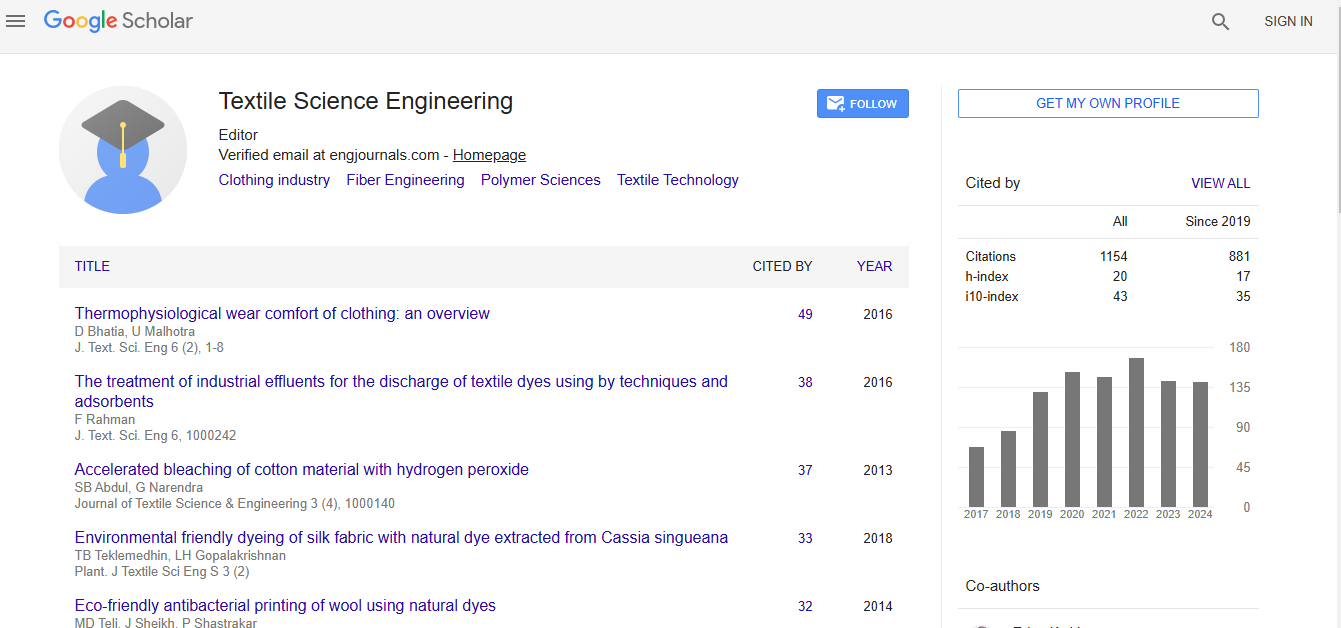
Journal of Textile Science & Engineering received 1008 citations as per Google Scholar report