Short Communication - (2025) Volume 17, Issue 2
Received: 01-Apr-2025, Manuscript No. jbabm-26-182330;
Editor assigned: 03-Apr-2025, Pre QC No. P-182330;
Reviewed: 17-Apr-2025, QC No. Q-182330;
Revised: 22-Apr-2025, Manuscript No. R-182330;
Published:
29-Apr-2025
, DOI: 10.37421/1948-593X.2025.17.488
Citation: Nair, Priya. ”Chromatography: Essential Biomedical Analysis Techniques.” J Bioanal Biomed 17 (2025):488.
Copyright: © 2025 Nair P .This is an open-access article distributed under the terms of the Creative Commons Attribution License, which permits unrestricted use, distribution and reproduction in any medium, provided the original author and source are credited.
Chromatographic techniques stand as fundamental pillars within the biomedical sciences, providing unparalleled resolution for dissecting and analyzing intricate biological mixtures. Their utility permeates diverse scientific domains, from foundational research in molecular biology and biochemistry to vital clinical diagnostics, the dynamic field of drug discovery, and the precise monitoring of therapeutic interventions. Specifically, techniques such as High-Performance Liquid Chromatography (HPLC) and Gas Chromatography (GC) are routinely harnessed for the accurate quantification of biomarkers, the definitive identification of pathogens, and the comprehensive profiling of metabolites within biological systems. The synergistic combination of chromatography with Mass Spectrometry (MS), exemplified by LC-MS and GC-MS, bestows exquisite levels of sensitivity and specificity, enabling the detection of even trace quantities of analytes. This capability is paramount for early disease detection and the advancement of personalized medicine, while ongoing progress in miniaturization and automation is steadily broadening their accessibility for point-of-care diagnostics and high-throughput screening initiatives [1].
Liquid chromatography-mass spectrometry (LC-MS) has profoundly transformed the landscape of proteomics, facilitating the identification and quantification of a vast spectrum of proteins present in biological samples. This powerful technology is instrumental in unraveling complex disease mechanisms, pinpointing novel therapeutic targets, and establishing reliable biomarkers for disease diagnosis and prognosis. The remarkable sensitivity and specificity inherent to LC-MS allow for the accurate detection of low-abundance proteins and critical post-translational modifications, which frequently play pivotal roles in cellular signaling pathways and the pathogenesis of diseases. Continuous advancements in instrumentation and sophisticated data analysis software are consistently expanding the scope and depth of proteomic investigations, offering deeper insights into biological processes [2].
The development and widespread application of chiral chromatography are of utmost importance within the pharmaceutical industry, specifically for the critical task of separating enantiomers. These stereoisomers, often possessing distinct pharmacological activities and toxicological profiles, necessitate careful differentiation. Ensuring the enantiomeric purity of chiral drug substances is not merely a stringent regulatory requirement but a fundamental prerequisite for safeguarding patient safety and ensuring therapeutic efficacy. A diverse array of chiral stationary phases and meticulously optimized mobile phase additives has been devised to achieve high-resolution separations, and research in this domain continues to thrive with the design of novel chiral selectors and efficient high-throughput enantioseparation methods [3].
Ion chromatography (IC) plays an indispensable role in the comprehensive analysis of both inorganic and organic ions across a wide range of biomedical matrices, encompassing biological fluids and sophisticated pharmaceutical formulations. Its capacity to accurately quantify trace levels of both anions and cations is essential for critical applications such as monitoring electrolyte balance in patients, rigorously assessing the purity of pharmaceutical products, and identifying potentially harmful environmental contaminants within healthcare settings. Modern IC systems are characterized by their enhanced sensitivity, significantly reduced analysis times, and remarkably improved accuracy, cementing their status as indispensable tools for clinical chemistry laboratories and environmental health assessments [4].
Gas chromatography (GC) when coupled with mass spectrometry (GC-MS), stands as a foundational technique for the meticulous analysis of volatile and semi-volatile compounds found within biological samples. Its applications are remarkably diverse, ranging from the identification of drug metabolites and potent toxicants to the detailed metabolic profiling of microorganisms and the sensitive detection of disease biomarkers present in breath and urine. The inherent high resolution and exceptional sensitivity of GC-MS enable the thorough characterization of even the most complex mixtures, thereby providing invaluable insights into physiological states and pathological conditions. Ongoing advancements in column technology and detector sensitivity continue to broaden its extensive utility across various analytical challenges [5].
Affinity chromatography (AC) represents a highly selective separation technique that capitalizes on the specific and reversible interactions occurring between a target analyte and a ligand precisely immobilized onto a stationary phase. Within the realm of biomedical sciences, AC finds extensive application in the purification of vital biomolecules, including proteins and antibodies. This purification process is absolutely crucial for the successful development of therapeutic agents and for enabling fundamental research. The inherent ability of AC to isolate target molecules from complex biological mixtures with exceptional purity and high yield renders it an indispensable tool for numerous downstream applications, such as large-scale drug manufacturing and the development of highly specific diagnostic assays [6].
Hydrophilic interaction liquid chromatography (HILIC) has rapidly emerged as a potent complementary technique to the more traditional reversed-phase liquid chromatography (RPLC), particularly for the effective separation of polar and hydrophilic compounds. These types of compounds are frequently encountered in burgeoning fields like metabolomics and glycomics. The unique retention mechanism characteristic of HILIC allows for the efficient and comprehensive analysis of crucial biomolecules such as carbohydrates, amino acids, and other polar metabolites, which often exhibit poor retention characteristics in RPLC. The continuous development of novel HILIC stationary phases and refined methodologies has substantially enhanced the capability to accurately profile and quantify these critical biological molecules [7].
Supercritical fluid chromatography (SFC) presents itself as an environmentally conscious and highly efficient alternative to conventional HPLC, particularly for the separation of a broad spectrum of compounds. This includes challenging separations involving chiral molecules and complex natural products. A significant advantage of SFC is its utilization of supercritical CO2 as the primary mobile phase solvent, which considerably reduces the consumption of organic solvents and simplifies the subsequent recovery of the separated samples. Consequently, SFC is experiencing increasing adoption within the pharmaceutical and natural product analysis sectors, owing to its notable speed, excellent resolution, and inherent scalability [8].
Capillary electrophoresis (CE), along with its hyphenated variants such as capillary electrophoresis-mass spectrometry (CE-MS), offers a powerful suite of tools for the precise separation and meticulous analysis of charged biomolecules. This includes critical classes of molecules like peptides, proteins, and nucleic acids. CE is distinguished by its high separation efficiency and its requirement for minimal sample consumption, making it exceptionally well-suited for the analysis of precious or limited biological samples. Its application is rapidly expanding in areas such as biomarker discovery and the rigorous quality control of biopharmaceutical products [9].
Thin-layer chromatography (TLC) and its more advanced iteration, high-performance thin-layer chromatography (HPTLC), continue to hold significant relevance in the field of biomedical analysis. Their enduring utility stems from their inherent simplicity, cost-effectiveness, and suitability for rapid screening and qualitative analysis of a diverse range of compounds. This includes the analysis of herbal medicines, pharmaceutical drugs, and natural products. Recent advancements in stationary phase technology, sophisticated visualization techniques, and automated sample application methodologies have substantially enhanced their quantitative capabilities and overall analytical performance, thereby solidifying their value for quality control processes and initial investigative studies [10].
Chromatographic techniques represent indispensable tools within the biomedical sciences, providing unparalleled resolution for the separation and analysis of complex biological mixtures. Their applications span from fundamental research in molecular biology and biochemistry to clinical diagnostics, drug discovery, and therapeutic drug monitoring. Techniques like High-Performance Liquid Chromatography (HPLC) and Gas Chromatography (GC) are routinely employed for quantifying biomarkers, identifying pathogens, and profiling metabolites. Mass Spectrometry (MS) coupled with chromatography (LC-MS, GC-MS) provides exquisite sensitivity and specificity, enabling the detection of trace amounts of analytes crucial for early disease detection and personalized medicine. Advances in miniaturization and automation are further expanding their reach in point-of-care diagnostics and high-throughput screening [1].
Liquid chromatography-mass spectrometry (LC-MS) has revolutionized the field of proteomics by enabling the identification and quantification of a vast number of proteins in biological samples. This technology is critical for understanding disease mechanisms, identifying novel drug targets, and developing biomarkers for disease diagnosis and prognosis. The high sensitivity and specificity of LC-MS allow for the detection of low-abundance proteins and post-translational modifications that are often involved in cellular signaling and disease pathways. Advances in instrument design and data analysis software continue to enhance the scope and depth of proteomic studies [2].
The development and application of chiral chromatography are paramount in the pharmaceutical industry for separating enantiomers, which often exhibit distinct pharmacological and toxicological profiles. Ensuring the enantiomeric purity of chiral drugs is a regulatory requirement and crucial for patient safety and therapeutic efficacy. Various chiral stationary phases and mobile phase additives have been developed to achieve high resolution separations. This field continues to evolve with the design of new chiral selectors and methods for high-throughput enantioseparation [3].
Ion chromatography (IC) plays a vital role in the analysis of inorganic and organic ions in various biomedical matrices, including biological fluids and pharmaceutical formulations. Its ability to quantify trace levels of anions and cations is essential for monitoring electrolyte balance, assessing drug purity, and detecting environmental contaminants in healthcare settings. Modern IC systems offer enhanced sensitivity, reduced analysis times, and improved accuracy, making them indispensable for clinical chemistry and environmental health assessments [4].
Gas chromatography (GC) coupled with mass spectrometry (GC-MS) is a cornerstone for the analysis of volatile and semi-volatile compounds in biological samples. Its applications range from the identification of drug metabolites and toxicants to the metabolic profiling of microorganisms and the detection of disease biomarkers in breath and urine. The high resolution and sensitivity of GC-MS enable the comprehensive characterization of complex mixtures, providing critical insights into physiological and pathological states. Continuous advancements in column technology and detector sensitivity are further expanding its utility [5].
Affinity chromatography (AC) is a highly selective separation technique based on specific reversible interactions between an analyte and a ligand immobilized on a stationary phase. In biomedical sciences, AC is extensively used for the purification of proteins, antibodies, and other biomolecules, which is crucial for therapeutic development and research. Its ability to isolate target molecules from complex biological mixtures with high purity and yield makes it an indispensable tool for downstream applications such as drug manufacturing and diagnostic assay development [6].
Hydrophilic interaction liquid chromatography (HILIC) has emerged as a powerful complementary technique to reversed-phase liquid chromatography (RPLC) for the separation of polar and hydrophilic compounds often encountered in metabolomics and glycomics. Its unique retention mechanism allows for the effective analysis of carbohydrates, amino acids, and other polar metabolites that are poorly retained in RPLC. The development of novel HILIC stationary phases and methods has significantly advanced the ability to profile and quantify these critical biomolecules [7].
Supercritical fluid chromatography (SFC) offers an environmentally friendly and efficient alternative to HPLC for the separation of a wide range of compounds, including chiral molecules and natural products. Its use of supercritical CO2 as the primary mobile phase solvent reduces organic solvent consumption and simplifies sample recovery. SFC is increasingly being adopted in pharmaceutical and natural product analysis due to its speed, resolution, and scalability [8].
Capillary electrophoresis (CE) and its hyphenated techniques with mass spectrometry (CE-MS) provide powerful tools for the separation and analysis of charged biomolecules, including peptides, proteins, and nucleic acids. CE offers high separation efficiency and minimal sample consumption, making it suitable for analyzing precious or limited samples. Its application in biomarker discovery and quality control of biopharmaceuticals is growing rapidly [9].
Thin-layer chromatography (TLC) and high-performance thin-layer chromatography (HPTLC) remain relevant in biomedical analysis due to their simplicity, cost-effectiveness, and suitability for rapid screening and qualitative analysis of various compounds, including herbal medicines, drugs, and natural products. Advancements in stationary phases, visualization techniques, and automated sample application have enhanced their quantitative capabilities and analytical performance, making them valuable tools for quality control and initial investigations [10].
Chromatographic techniques are essential in biomedical sciences for separating and analyzing complex biological mixtures, with applications ranging from basic research to clinical diagnostics and drug discovery. High-Performance Liquid Chromatography (HPLC), Gas Chromatography (GC), and their hyphenations with Mass Spectrometry (MS) like LC-MS and GC-MS are crucial for biomarker quantification, pathogen identification, and metabolite profiling, enabling early disease detection and personalized medicine. Chiral chromatography is vital in pharmaceuticals for enantiomer separation, ensuring drug safety and efficacy. Ion chromatography (IC) analyzes ions in biological fluids and pharmaceuticals for monitoring electrolytes and assessing drug purity. Affinity chromatography (AC) purifies biomolecules like proteins and antibodies for therapeutic development. Hydrophilic interaction liquid chromatography (HILIC) complements reversed-phase techniques for separating polar compounds in metabolomics. Supercritical fluid chromatography (SFC) provides an eco-friendly alternative for separating diverse compounds. Capillary electrophoresis (CE) and CE-MS are powerful for analyzing charged biomolecules like peptides and nucleic acids. Thin-layer chromatography (TLC) and HPTLC remain valuable for their simplicity and cost-effectiveness in qualitative analysis and screening.
None
None
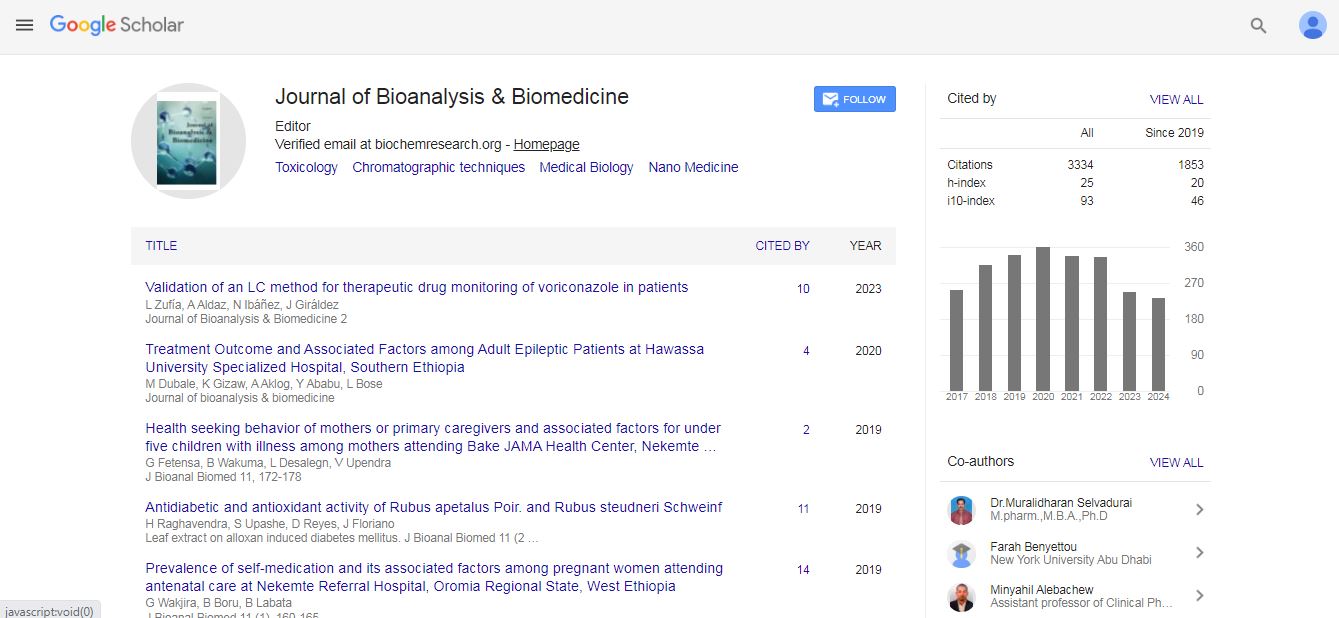
Journal of Bioanalysis & Biomedicine received 3099 citations as per Google Scholar report