Commentary - (2025) Volume 12, Issue 6
Received: 01-Dec-2025, Manuscript No. jreac-26-185812;
Editor assigned: 03-Dec-2025, Pre QC No. P-185812;
Reviewed: 17-Dec-2025, QC No. Q-185812;
Revised: 22-Dec-2025, Manuscript No. R-185812;
Published:
29-Dec-2025
, DOI: 10.37421/2380-2391.2025.12.461
Citation: Haddad, Yara. ”Chemometrics in Environmental Science: Data Analysis.” J Environ Anal Chem 12 (2025):461.
Copyright: © 2025 Haddad Y. This is an open-access article distributed under the terms of the Creative Commons Attribution License, which permits unrestricted use,
distribution and reproduction in any medium, provided the original author and source are credited.
The field of environmental science and monitoring has been significantly advanced by the application of sophisticated analytical techniques, particularly chemometrics and multivariate data analysis. These methodologies are indispensable for unraveling the intricate chemical compositions of diverse environmental matrices. They provide powerful tools for identifying the origins of pollution, understanding the complex pathways through which contaminants move and persist, and accurately assessing the ecological risks associated with them across various environmental compartments such as water, soil, and air [1].
The practical implementation of these techniques often involves handling large, high-dimensional datasets that are frequently burdened by noise and inherent variability. Identifying the sources of heavy metal pollution in urban river sediments, for instance, has been greatly facilitated by the application of principal component analysis (PCA) and partial least squares discriminant analysis (PLS-DA) [2].
These methods enable a reduction in data dimensionality, allowing for effective differentiation between anthropogenic inputs and natural geological sources, which is critical for designing targeted remediation efforts. Water quality assessment in complex ecosystems, such as coastal lagoons, also benefits immensely from multivariate statistical approaches. Techniques like hierarchical cluster analysis (HCA) and PCA are employed to characterize both spatial and temporal variations in water quality parameters. This allows for the identification of distinct pollution patterns and their potential sources, thereby guiding the development of effective water management policies tailored to the specific needs of these sensitive environments [3].
In the realm of atmospheric science, the analysis of trace metal concentrations in airborne particulate matter, including PM2.5 and PM10, has been revolutionized by chemometric methods. PCA and PLS regression have proven effective in linking air quality data to potential emission sources, offering a quantitative understanding of pollutant contributions and informing the development of robust air pollution control strategies for urban and coastal areas [4].
Further advancements in understanding urban atmospheric pollution involve the chemical fingerprinting of aerosols. A combination of PCA and positive matrix factorization (PMF) has emerged as a crucial approach for identifying the origin and transformations of pollutants within complex urban atmospheres, contributing significantly to improved air quality management [5].
The pervasive issue of microplastic pollution in marine environments is being addressed through chemometric approaches. Techniques such as PCA and HCA are instrumental in categorizing microplastic samples based on their polymer types and potential sources. This aids in elucidating plastic pollution pathways and understanding their multifaceted impacts on marine ecosystems [6].
Assessing and managing groundwater quality, a vital resource, has been greatly enhanced by the application of PCA. This technique is effective in identifying the dominant factors influencing groundwater chemistry by analyzing comprehensive datasets of hydrochemical parameters. It simplifies complex groundwater data, facilitating a more accurate assessment and management of this critical natural resource [7].
Soil contamination by organic pollutants presents another challenge that multivariate statistical methods are well-equipped to address. PCA and PLS-DA have been applied to analyze the distribution of these pollutants, providing a robust framework for understanding their complex interactions and sources. This understanding is fundamental for effective soil remediation and risk assessment [8].
The integration of advanced chemometric tools with spectroscopic data represents a significant stride towards rapid and non-destructive analysis of complex environmental samples. This approach holds immense potential for real-time monitoring and the early detection of environmental contaminants, paving the way for proactive environmental protection [9].
Overall, multivariate statistical methods, including PCA, HCA, and PLS, are pivotal in the comprehensive assessment of air quality. They provide robust tools for identifying pollution sources, analyzing spatio-temporal patterns, and understanding the influence of meteorological factors on air pollution levels, offering a holistic approach to air quality management and research [10].
The critical role of chemometrics and multivariate analysis in deciphering the complex chemical composition of environmental matrices is explored. These techniques are essential for identifying pollution sources, understanding contaminant fate and transport, and assessing ecological risks in diverse environments such as water, soil, and air, focusing on practical applications and challenges in handling high-dimensional and noisy environmental data [1].
The application of principal component analysis (PCA) and partial least squares discriminant analysis (PLS-DA) to identify the sources of heavy metal pollution in urban river sediments is detailed. By reducing the dimensionality of complex elemental data, these methods effectively distinguish between anthropogenic and natural sources, providing valuable insights for targeted remediation strategies [2].
The utility of hierarchical cluster analysis (HCA) and PCA for characterizing the spatial and temporal variations of water quality in a coastal lagoon is showcased. These multivariate approaches help in identifying distinct pollution patterns and potential sources influencing the lagoon's ecosystem, guiding effective water management policies [3].
The research employs chemometric methods, specifically PCA and PLS regression, to analyze trace metal concentrations in airborne particulate matter. The study effectively links air quality data to potential emission sources, providing a quantitative understanding of pollutant contributions and informing air pollution control strategies [4].
The chemical fingerprinting of atmospheric aerosols using a combination of PCA and positive matrix factorization (PMF) is investigated. This approach is crucial for identifying the origin and transformations of pollutants in complex urban atmospheres, contributing to more effective air quality management [5].
The study applies chemometric techniques to analyze the composition of microplastics in marine environments. PCA and HCA are used to categorize microplastic samples based on their polymer types and potential sources, aiding in the understanding of plastic pollution pathways and impacts [6].
The effectiveness of PCA in identifying dominant factors influencing groundwater quality is demonstrated. By analyzing a comprehensive dataset of hydrochemical parameters, the study simplifies complex groundwater chemistry, enabling better assessment and management of this vital resource [7].
This paper focuses on using multivariate statistical methods, including PCA and PLS-DA, to analyze organic pollutant distributions in soils. It provides a framework for understanding the complex interactions and sources of these contaminants, crucial for soil remediation and risk assessment [8].
The integration of advanced chemometric tools with spectroscopic data for the rapid and non-destructive analysis of complex environmental samples is explored. It emphasizes the potential of these methods for real-time monitoring and early detection of contaminants [9].
A comprehensive review of multivariate statistical methods applied to the assessment of air quality is presented. It covers techniques like PCA, HCA, and PLS, illustrating their utility in identifying pollution sources, analyzing spatial-temporal patterns, and understanding the impact of meteorological factors on air pollution [10].
This collection of studies highlights the critical role of chemometrics and multivariate statistical analysis in environmental science. Techniques like Principal Component Analysis (PCA), Partial Least Squares Discriminant Analysis (PLS-DA), and Hierarchical Cluster Analysis (HCA) are widely applied to analyze complex environmental data from various matrices including water, soil, air, and marine environments. These methods are instrumental in identifying pollution sources, understanding contaminant fate and transport, and assessing ecological risks. Specific applications include source apportionment of heavy metals in river sediments, characterization of water quality in lagoons, trace metal analysis in airborne particulate matter, chemical fingerprinting of atmospheric aerosols and marine microplastics, assessment of groundwater quality, and analysis of organic pollutants in soil. The integration of these techniques with spectroscopic data enables rapid, non-destructive analysis and real-time monitoring of environmental contaminants, contributing to more effective environmental management and pollution control strategies.
None
None
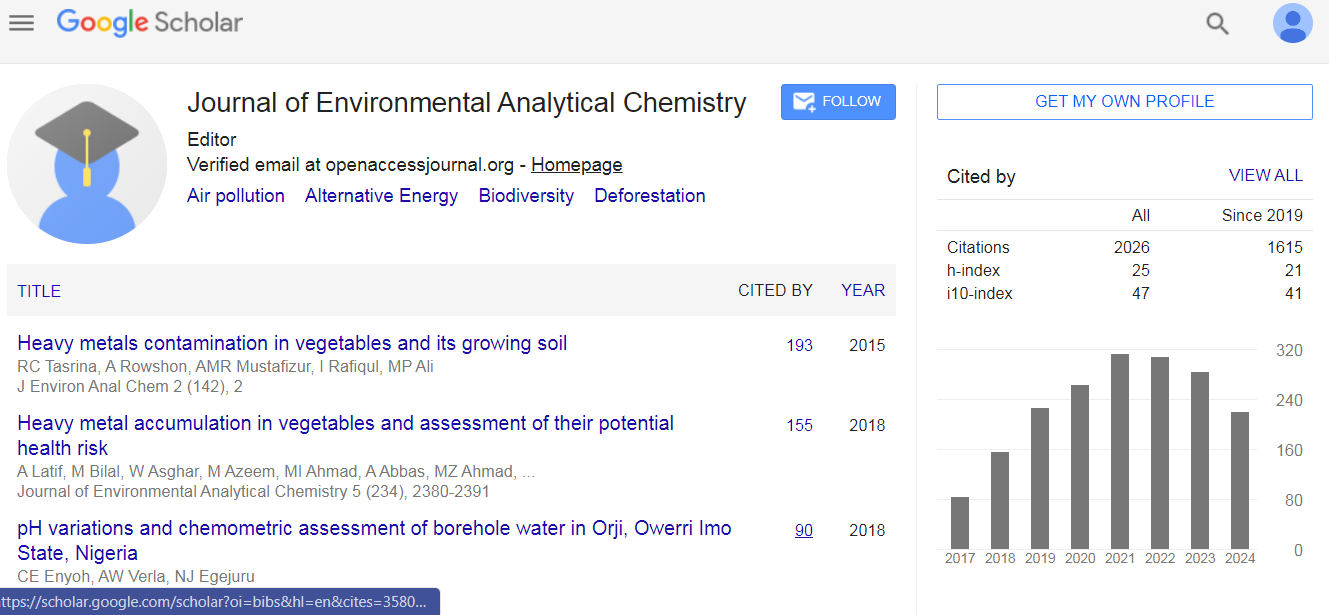
Journal of Environmental Analytical Chemistry received 1781 citations as per Google Scholar report