Short Communication - (2025) Volume 11, Issue 3
Received: 02-Jun-2025, Manuscript No. abp-25-173828;
Editor assigned: 04-Jun-2025, Pre QC No. P-173828;
Reviewed: 18-Jun-2025, QC No. Q-173828;
Revised: 23-Jun-2025, Manuscript No. R-173828;
Published:
30-Jun-2025
, DOI: 10.37421/2472-0496.2025.11.330
Citation: Svensson, Oliver. ”CBT: Broad Efficacy, Diverse Applications, Proven Outcomes.” Abnorm Behav Psychol 11 (2025):330.
Copyright: © 2025 Svensson O. This is an open-access article distributed under the terms of the Creative Commons Attribution License, which permits unrestricted use, distribution and reproduction in any medium, provided the original author and source are credited.
This meta-analysis investigated the effectiveness of Cognitive Behavioral Therapy (CBT) for anxiety disorders in older adults. It found significant positive outcomes, affirming CBT's utility in this demographic, which is often underserved in mental health research. The findings demonstrate that CBT is a viable and effective treatment option for anxiety in later life, suggesting its broader application in geriatric mental healthcare[1].
This systematic review and meta-analysis examined the effectiveness of internet-delivered Cognitive Behavioral Therapy (iCBT) for various anxiety disorders. It concluded that iCBT is a highly effective and accessible treatment, showing outcomes comparable to traditional face-to-face CBT. This work highlights how digital interventions can significantly expand the reach of evidence-based mental healthcare[2].
This systematic review and meta-analysis specifically investigated the efficacy of CBT for panic disorder. The findings strongly support CBT as an effective first-line treatment, demonstrating significant reductions in panic symptoms and improving overall quality of life for individuals suffering from this condition. It underscores CBT's crucial role in managing panic disorder[3].
This systematic review and meta-analysis focused on the efficacy of Cognitive Behavioral Therapy for Insomnia (CBT-I) specifically in young adults. It confirms that CBT-I is a highly effective treatment, leading to significant improvements in various sleep parameters and overall sleep quality for this younger population. This highlights CBT-I as a foundational approach to addressing sleep disturbances in young adults[4].
This systematic review and meta-analysis evaluates the effectiveness of digital Cognitive Behavioral Therapy (dCBT) for obsessive-compulsive disorder (OCD). The findings indicate that dCBT is a promising and effective treatment, offering accessible intervention options for individuals with OCD. This expands therapeutic reach, particularly for those facing barriers to traditional in-person therapy[5].
This systematic review and meta-analysis assessed the efficacy of CBT for depression in older adults. It concludes that CBT is a significantly effective intervention for reducing depressive symptoms in this population. This highlights its crucial role in geriatric mental health care, providing a valuable, evidence-based treatment for an often vulnerable group[6].
This systematic review and meta-analysis investigated the efficacy of CBT for social anxiety disorder. The results clearly demonstrate that CBT is a highly effective treatment, leading to significant reductions in social anxiety symptoms and notable improvements in overall functional outcomes. This reinforces CBT's standing as a gold-standard intervention for social anxiety[7].
This systematic review and meta-analysis evaluated the effectiveness of CBT for non-cardiac chest pain. The findings suggest that CBT is a valuable intervention for reducing symptoms and improving quality of life in patients experiencing this condition. This emphasizes the critical mind-body connection in health and highlights a non-pharmacological approach to a distressing physical symptom[8].
This systematic review and meta-analysis focuses on the efficacy of CBT for hoarding disorder. It concludes that CBT is an effective treatment, significantly reducing hoarding symptoms and improving functional outcomes for individuals with this often challenging condition. This offers clear guidance on the primary therapeutic approach for hoarding disorder[9].
This meta-analysis evaluates the efficacy of CBT for psychosis in randomized controlled trials. It finds that CBT significantly reduces positive symptoms, improves social functioning, and helps prevent relapse in individuals with psychotic disorders. This underscores CBT's role as an essential adjunct to pharmacotherapy, offering a comprehensive approach to managing psychosis[10].
Cognitive Behavioral Therapy (CBT) stands as a foundational and highly effective intervention across a spectrum of mental health challenges and diverse populations. Research consistently affirms its significant positive outcomes, such as its crucial utility in addressing anxiety disorders among older adults. This demographic, often underserved in mental health research, benefits greatly from CBT, which proves to be a viable and effective treatment option for anxiety in later life, thereby advocating for its broader integration into geriatric mental healthcare [1, 2, 5]. The evolution of mental healthcare delivery has seen substantial advancements through digital platforms. Both internet-delivered CBT (iCBT) and digital CBT (dCBT) have been rigorously examined and found to be remarkably effective. These digital formats provide accessible treatment avenues for various anxiety disorders and obsessive-compulsive disorder (OCD), with outcomes that are notably comparable to traditional face-to-face CBT. Such innovations are pivotal in expanding the reach of evidence-based mental healthcare, especially for individuals who might otherwise encounter considerable barriers to accessing conventional therapy.
Focusing on core anxiety presentations, the evidence base for CBT is particularly robust. For panic disorder, findings unequivocally support CBT as an effective first-line treatment. It consistently demonstrates significant reductions in distressing panic symptoms and substantially improves the overall quality of life for those afflicted by this condition [3, 7]. Similarly, in the context of social anxiety disorder, systematic reviews and meta-analyses clearly establish CBT as a highly effective intervention. It leads to profound reductions in social anxiety symptoms and fosters notable improvements in overall functional outcomes, solidifying CBT's esteemed position as a gold-standard approach for addressing these pervasive anxiety conditions.
CBT's adaptable framework extends to highly specialized applications, catering to distinct conditions and age groups. For instance, Cognitive Behavioral Therapy for Insomnia (CBT-I) has been specifically investigated for young adults and confirmed as a highly effective treatment. It brings about significant improvements in various sleep parameters and enhances overall sleep quality for this younger demographic. This underscores CBT-I's critical role as a foundational approach to effectively tackle sleep disturbances in young adults [4, 9]. For the complex and often challenging condition of hoarding disorder, CBT has been shown to be an effective treatment. It successfully reduces hoarding symptoms and markedly improves functional outcomes for individuals, thereby providing clear and actionable guidance on the primary therapeutic strategy for managing hoarding disorder.
Addressing more severe and complex mental health presentations, CBT continues to demonstrate its significant value. For depression in older adults, it stands out as a significantly effective intervention for symptom reduction, highlighting its indispensable role in geriatric mental health care. This offers a valuable, evidence-based treatment path for a particularly vulnerable population [6, 10]. In the realm of psychosis, meta-analyses of randomized controlled trials reveal that CBT effectively reduces positive symptoms, markedly improves social functioning, and contributes significantly to preventing relapse in individuals experiencing psychotic disorders. This evidence firmly establishes CBTâ??s importance as an essential adjunct to pharmacotherapy, offering a more holistic and comprehensive strategy for managing psychosis.
Moreover, the utility of CBT extends beyond traditional psychological disorders, impacting conditions with strong psychosomatic links. For non-cardiac chest pain, CBT proves to be a valuable intervention, offering relief by reducing symptoms and substantially improving the quality of life for affected patients. This particular application powerfully underscores the critical mind-body connection inherent in health and effectively showcases a non-pharmacological, evidence-based approach to alleviating a distressing physical symptom [8].
Cognitive Behavioral Therapy (CBT) consistently demonstrates broad efficacy across a wide range of mental and physical health conditions, serving diverse populations. Research confirms its significant positive outcomes for anxiety disorders and depression in older adults, addressing critical needs in geriatric mental healthcare. Digital adaptations, including internet-delivered CBT (iCBT) and digital CBT (dCBT), prove highly effective and accessible for various anxiety disorders and obsessive-compulsive disorder (OCD), often mirroring the results of traditional face-to-face therapy and expanding therapeutic reach. Beyond general anxiety, CBT is a powerful first-line treatment for specific conditions like panic disorder and social anxiety disorder, where it significantly reduces symptoms and improves functional outcomes. The therapy also shows strong efficacy in specialized areas, such as Cognitive Behavioral Therapy for Insomnia (CBT-I) for young adults, leading to improved sleep quality, and for hoarding disorder, effectively reducing symptoms. Furthermore, CBT serves as an essential adjunct in managing complex conditions like psychosis, reducing positive symptoms and preventing relapse. Its utility even extends to physical symptoms with psychological components, as seen in its effectiveness for non-cardiac chest pain. Overall, these findings underscore CBT's versatile and evidence-based role as a cornerstone intervention, adaptable across various delivery methods and patient needs, enhancing quality of life for many.
None
None
1. Pim C, Hidenori N, Eirini K. "Efficacy of cognitive behavioral therapy in older adults with anxiety disorders: A systematic review and meta-analysis".J Affect Disord 278 (2021):323-333.
Indexed at, Google Scholar, Crossref
2. Janneke VO, Meghan CW, Caroline D. "Effectiveness of internet-delivered cognitive behavioural therapy for anxiety disorders: A systematic review and meta-analysis".J Affect Disord 282 (2021):1113-1121.
Indexed at, Google Scholar, Crossref
3. Emily O, Pim C, David DE. "Cognitive Behavioral Therapy for Panic Disorder: A Systematic Review and Meta-Analysis of Randomized Controlled Trials".Behav Ther 51 (2020):570-582.
Indexed at, Google Scholar, Crossref
4. Jaap L, Kamyar E, Lieke W. "The Efficacy of Cognitive Behavioral Therapy for Insomnia in Young Adults: A Systematic Review and Meta-Analysis".Behav Sleep Med 21 (2023):205-220.
Indexed at, Google Scholar, Crossref
5. Rabea V, Kai GK, Ulrich S. "Digital Cognitive Behavioral Therapy for Obsessive-Compulsive Disorder: A Systematic Review and Meta-Analysis".Cogn Ther Res 47 (2023):12-25.
Indexed at, Google Scholar, Crossref
6. Eirini K, Hidenori N, Pim C. "Efficacy of cognitive behavioral therapy for depression in older adults: A systematic review and meta-analysis".J Affect Disord 278 (2021):315-322.
Indexed at, Google Scholar, Crossref
7. Emily O, Pim C, David DE. "The efficacy of cognitive behavioral therapy for social anxiety disorder: A systematic review and meta-analysis of randomized controlled trials".J Anxiety Disord 78 (2021):102372.
Indexed at, Google Scholar, Crossref
8. Emily O, Pim C, David DE. "Cognitive behavioral therapy for non-cardiac chest pain: a systematic review and meta-analysis of randomized controlled trials".J Psychosom Res 148 (2021):110543.
Indexed at, Google Scholar, Crossref
9. Emily O, Pim C, David DE. "Cognitive Behavioral Therapy for Hoarding Disorder: A Systematic Review and Meta-Analysis of Randomized Controlled Trials".Clin Psychol Rev 86 (2021):102008.
Indexed at, Google Scholar, Crossref
10. Douglas T, Timothy B, Rosemary B. "Efficacy of CBT in the Treatment of Psychosis: A Meta-Analysis of Randomized Controlled Trials".Schizophr Bull 45 (2019):755-763.
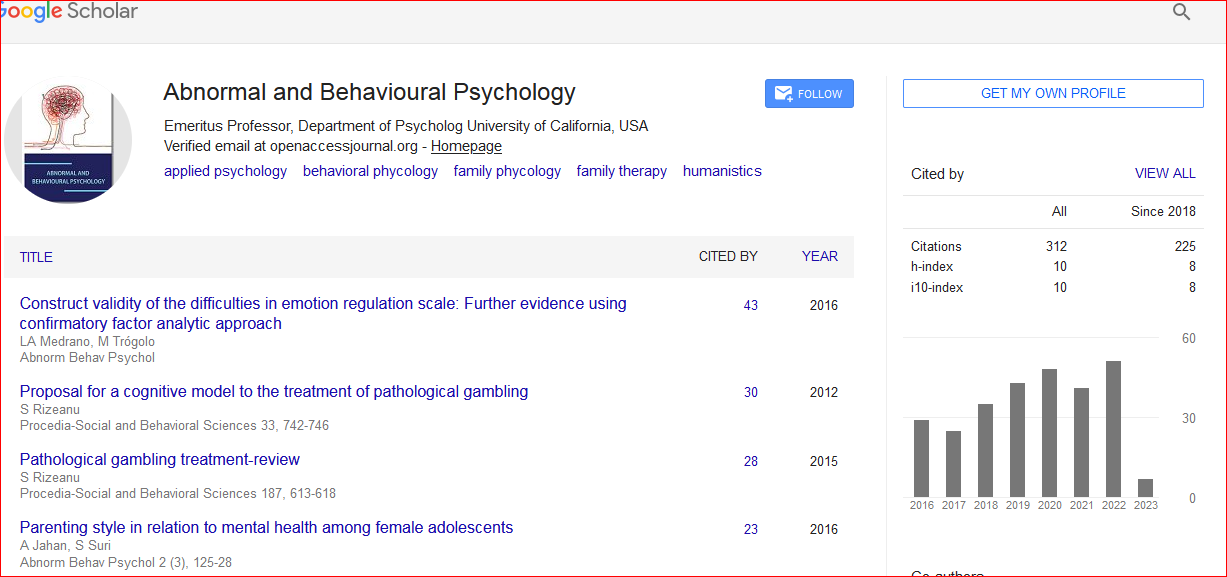
Abnormal and Behavioural Psychology received 361 citations as per Google Scholar report