Perspective - (2025) Volume 13, Issue 6
Received: 01-Dec-2025, Manuscript No. jcdd-25-177699;
Editor assigned: 03-Dec-2025, Pre QC No. P-177699;
Reviewed: 17-Dec-2025, QC No. Q-177699;
Revised: 22-Dec-2025, Manuscript No. R-177699;
Published:
29-Dec-2025
, DOI: 10.37421/2329-9517.2025.13.705
Citation: Zahra, Fatima. ”Cardiovascular Aging: Multimorbidity,
Frailty, Management.” J Cardiovasc Dis Diagn 13 (2025):705.
Copyright: © 2025 Zahra F. This is an open-access article distributed under the terms of the Creative Commons Attribution License, which permits unrestricted use, distribution
and reproduction in any medium, provided the original author and source are credited.
The cardiovascular system undergoes profound transformations with advanced age, leading to distinct physiological changes that elevate an older adult's susceptibility to a myriad of heart diseases. Understanding these intricate alterations, alongside their underlying molecular and cellular mechanisms, holds critical clinical implications for effective diagnosis and the subsequent management of these conditions [1].
Cardiovascular Disease (CVD) in older adults stands as a formidable public health challenge, demanding a comprehensive overview of current diagnostic and therapeutic strategies. Beyond present practices, researchers are actively pinpointing critical areas for future investigation and clinical innovation within the specialized field of geriatric cardiology, all geared towards refining care pathways for this demographic [2].
A key complicating factor in this population is the pervasive issue of multimorbidity, defined as the simultaneous presence of multiple chronic diseases. This phenomenon significantly compounds the challenge of achieving diagnostic accuracy, devising appropriate treatment plans, and executing effective overall patient management [6].
For example, the specific management of atrial fibrillation in older adults becomes remarkably intricate when multimorbidity is present, directly affecting diagnostic clarity, the ability to accurately stratify risk, and the successful implementation of treatment strategies [7].
Furthermore, the concept of frailty plays a pivotal role in the cardiovascular health landscape of older adults. This clinical syndrome, characterized by a reduced physiological reserve and heightened vulnerability to stressors, profoundly influences how cardiovascular diseases present, their likely prognosis, and the ultimate outcomes of treatment. Experts strongly advocate for a holistic assessment approach that meticulously considers the complex interplay between frailty and CVD, ensuring a more tailored and effective care plan [5].
Beyond individual patient complexities, the sheer global burden of cardiovascular diseases among older adults is staggering. Extensive epidemiological studies consistently reveal significant disparities in both the incidence and mortality rates across diverse geographical regions, highlighting a worldwide challenge [4].
What this really means is that specific cardiovascular conditions require highly nuanced and tailored management strategies when affecting the elderly. Take heart failure, for instance; its treatment protocols must be meticulously optimized for older adults, carefully accounting for their unique clinical characteristics, their existing spectrum of multimorbidity, and their functional status. Authoritative scientific statements from leading organizations offer invaluable guidance to navigate these inherent complexities and improve patient outcomes [3].
In a similar vein, the contemporary management of hypertension in older adults demands specific insights that acknowledge the unique physiological shifts associated with aging and the frequent coexistence of various comorbidities. These factors invariably shape treatment decisions and drug selection [10].
Let's break it down: the natural, progressive process of aging intrinsically impacts the cardiovascular system, setting the stage for the development of various diseases. A deep understanding of the molecular and cellular mechanisms that underpin this age-related cardiac decline is not just academic; it is fundamentally important for informing evidence-based clinical practice and guiding the development of truly targeted interventions [8].
Given these multifaceted challenges, geriatric cardiology is not static; it is a dynamic field that continually evolves. Significant opportunities exist to innovate and implement integrated care models specifically designed to address the intricate, often interconnected needs of older adults grappling with heart disease. The overarching goal is to significantly improve patient outcomes, enhance their quality of life, and ensure more comprehensive, coordinated care [9].
This holistic perspective encompassing age-related physiological changes, the prevalence of specific diseases, and the complicating factors such as multimorbidity and frailty, is absolutely fundamental to advancing and optimizing healthcare in this critical demographic.
Aging profoundly influences the cardiovascular system, leading to physiological changes that significantly increase susceptibility to various heart diseases in older adults. These alterations are not merely superficial; they involve complex molecular and cellular mechanisms underpinning age-related cardiac decline. Understanding these processes is critical for addressing the heightened risk of conditions like heart failure and coronary artery disease in the elderly, and has direct implications for clinical practice and disease management [1, 8]. The scope of cardiovascular disease in this demographic is extensive, necessitating a thorough review of current diagnostic tools and therapeutic approaches. Moreover, the field of geriatric cardiology is actively identifying key areas for future research and clinical development to better serve this unique patient population [2].
The global impact of cardiovascular diseases in older adults is a significant concern, with comprehensive analyses revealing a substantial worldwide burden. These studies also highlight pronounced disparities in incidence and mortality rates across different regions, underscoring the need for tailored public health interventions and healthcare strategies [4]. One of the most challenging aspects of managing cardiovascular conditions in older patients is the pervasive issue of multimorbidity. This common scenario, where multiple chronic health conditions coexist, complicates everything from diagnostic accuracy to the selection of appropriate therapeutic regimens and overall patient management. The presence of multiple illnesses often leads to complex drug interactions, increased side effects, and a more intricate clinical course [6].
Consider, for example, atrial fibrillation, a prevalent arrhythmia in older adults. Here, multimorbidity presents a particularly acute challenge. It significantly complicates accurate diagnosis, effective risk stratification for stroke and other complications, and the successful implementation of treatment strategies. Clinicians must carefully weigh the benefits and risks of interventions in the context of a patient's entire health profile, not just their cardiac status [7]. Another critical factor that impacts cardiovascular outcomes in older adults is frailty. Characterized by reduced physiological reserve and increased vulnerability to adverse health outcomes, frailty profoundly influences how cardiovascular diseases manifest, their prognosis, and the efficacy of various treatments. A holistic assessment approach, which integrates an evaluation of frailty alongside traditional cardiovascular risk factors, is therefore strongly advocated to optimize care [5].
Managing specific cardiovascular conditions in older adults often requires a departure from standard protocols, demanding individualized attention. Heart failure, for instance, requires specialized management strategies that account for the unique clinical characteristics of older adults, their co-existing multimorbidity, and their overall functional status. Scientific statements, such as those from the American Heart Association, provide essential guidance to navigate these complexities and improve treatment outcomes [3]. Similarly, hypertension, a widespread condition, demands a contemporary clinical update for older adults. Treatment decisions must consider the distinct physiological changes associated with aging, such as arterial stiffening, and the presence of various comorbidities that can influence drug tolerability and efficacy. This nuanced approach ensures safe and effective blood pressure control [10].
Ultimately, geriatric cardiology faces both persistent challenges and considerable opportunities. The field advocates for the development and adoption of integrated care models that can holistically address the complex and often interconnected needs of older adults living with heart disease. By fostering better coordination between different specialists and emphasizing patient-centered care, there is immense potential to significantly improve patient outcomes, enhance quality of life, and bridge existing gaps in care for this growing demographic [9]. This integrated perspective is crucial for effective diagnosis, treatment, and long-term management of cardiovascular health in an an aging population.
The cardiovascular system undergoes significant physiological changes with aging, leading to increased susceptibility to various heart diseases in older adults. These alterations and their underlying molecular mechanisms have crucial clinical implications for diagnosis and management. A comprehensive overview of cardiovascular diseases in older adults addresses current diagnostic and therapeutic approaches, while also outlining critical areas for future research and clinical development in geriatric cardiology. The global burden of cardiovascular diseases in the elderly population is substantial, with analyses revealing disparities in incidence and mortality across different regions. Managing heart conditions in this age group is complex due to prevalent multimorbidity and frailty. Frailty impacts disease presentation, prognosis, and treatment outcomes, advocating for holistic assessment approaches. Multimorbidity further complicates diagnostic accuracy, treatment complexity, and overall patient management in older patients with cardiovascular disease, particularly evident in conditions like atrial fibrillation where it challenges diagnosis, risk stratification, and effective treatment strategies. Specific guidance exists for managing heart failure in older adults, emphasizing consideration of unique clinical characteristics, multimorbidity, and functional status to optimize treatment. Additionally, hypertension management requires contemporary insights into physiological changes and potential comorbidities influencing treatment decisions in this age group. Geriatric cardiology faces ongoing challenges but presents significant opportunities for integrated care models to improve outcomes by addressing the complex needs of older adults with heart disease.
Indexed at, Google Scholar, Crossref
Indexed at, Google Scholar, Crossref
Indexed at, Google Scholar, Crossref
Indexed at, Google Scholar, Crossref
Indexed at, Google Scholar, Crossref
Indexed at, Google Scholar, Crossref
Indexed at, Google Scholar, Crossref
Indexed at, Google Scholar, Crossref
Indexed at, Google Scholar, Crossref
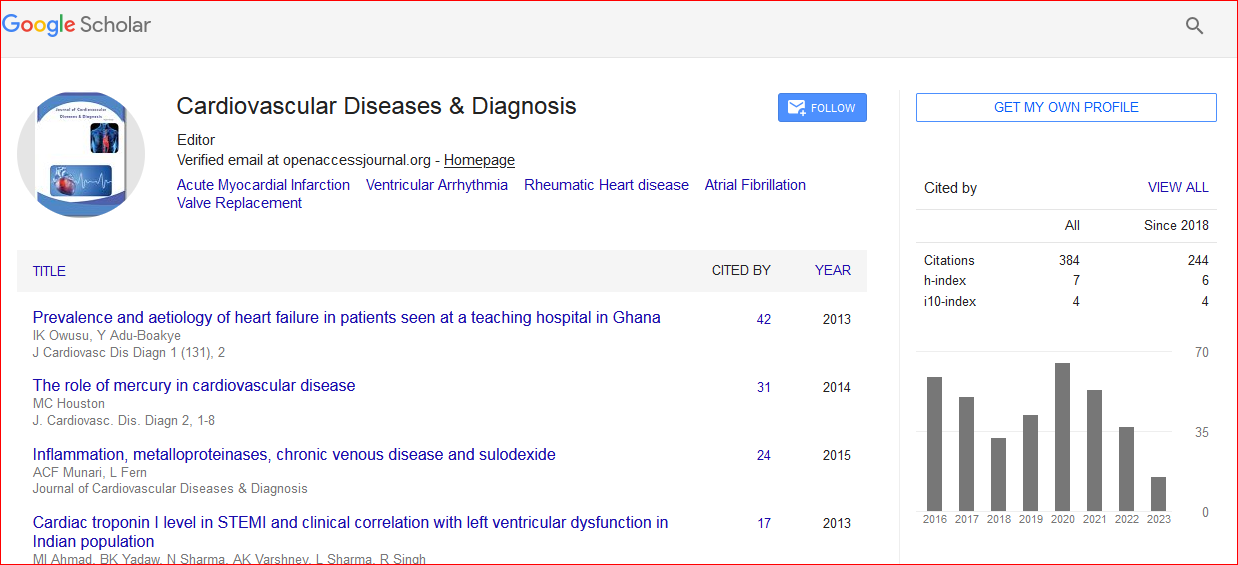
Cardiovascular Diseases & Diagnosis received 427 citations as per Google Scholar report