Opinion - (2025) Volume 13, Issue 3
Received: 02-Jun-2025, Manuscript No. jcdd-25-176792;
Editor assigned: 04-Jun-2025, Pre QC No. P-176792;
Reviewed: 18-Jun-2025, QC No. Q-176792;
Revised: 23-Jun-2025, Manuscript No. R-176792;
Published:
30-Jun-2025
, DOI: 10.37421/2329-9517.2025.13.674
Citation: Marina Costa. ”Cardiac Biomarkers: Crucial for Diagnosis
and Management.” J Cardiovasc Dis Diagn 13 (2025):674.
Copyright: © 2025 C. Marina This is an open-access article distributed under the terms of the Creative Commons Attribution License, which permits unrestricted use,
distribution and reproduction in any medium, provided the original author and source are credited.
High-sensitivity cardiac troponins (hs-cTn) have significantly advanced acute coronary syndrome (ACS) diagnosis. The key insight here is their ability to detect myocardial injury at very low concentrations, allowing for earlier, more accurate rule-in and rule-out of ACS than traditional assays. This improves emergency department workflow and patient management, reducing diagnostic delays and inappropriate admissions. Integrating these assays requires careful consideration of their increased sensitivity and appropriate clinical context [1].
Natriuretic peptides, like B-type natriuretic peptide (BNP) and N-terminal pro-B-type natriuretic peptide (NT-proBNP), are fundamental in diagnosing and managing heart failure. What this really means is they offer crucial objective evidence of cardiac stretch and dysfunction. Elevated levels strongly indicate heart failure, help assess its severity, and provide valuable prognostic information. Serial measurements guide treatment, especially for diuretic therapy and evaluating new heart failure medications [2].
Biomarkers play a dual role in diagnosing and prognosticating acute myocardial infarction (AMI) and heart failure. Here's the thing: troponins are essential for AMI diagnosis, but other biomarkers like natriuretic peptides offer critical insights into subsequent heart failure risk and mortality post-MI. For heart failure, a panel of biomarkers beyond just BNP/NT-proBNP refines risk stratification, guiding more aggressive therapies or closer monitoring. Understanding the interplay between various biomarkers helps paint a complete picture of a patient's cardiovascular health and future risk [3].
Beyond established natriuretic peptides, a growing array of emerging biomarkers is changing how we understand and manage heart failure. Let's break it down: markers of fibrosis (like galectin-3), inflammation (like ST2 and C-reactive protein (CRP)), and myocardial stress/injury (like mid-regional pro-adrenomedullin) offer complementary information. These novel biomarkers identify different pathophysiological pathways contributing to heart failure, aiding precise phenotyping, risk stratification, and potentially guiding targeted therapies for personalized medicine in cardiology [4].
Identifying myocarditis, particularly in its acute phase, can be challenging due to varied presentations. Cardiac biomarkers like troponins are absolutely critical; elevated levels indicate myocardial injury, providing strong diagnostic support. However, troponins alone aren't specific to myocarditis. What's more, inflammatory markers like C-reactive protein (CRP) can support diagnosis and track disease activity. The real value comes from integrating these biomarker results with clinical presentation, imaging, and potentially endomyocardial biopsy, guiding treatment strategies and assessing prognosis [5].
Cardiac troponins are often elevated in sepsis, even without acute coronary syndrome, indicating sepsis-induced myocardial injury. This systematic review shows these elevations are not benign; they correlate with increased morbidity and mortality. This means while troponins don't always signal a primary cardiac event in sepsis, their presence serves as an important prognostic biomarker, identifying patients at higher risk of adverse outcomes. This understanding guides more vigilant cardiac monitoring and management in septic patients [6].
Biomarkers are becoming indispensable tools for cardiovascular risk assessment across various patient populations. This highlights their utility beyond acute conditions. What this means is that markers like high-sensitivity CRP, lipoprotein(a), and specific inflammatory markers add valuable information to traditional risk factors (like cholesterol and blood pressure) for predicting future cardiovascular events. Incorporating these biomarkers refines risk stratification, leading to personalized preventive strategies and targeted interventions for those at highest risk [7].
Combining cardiac imaging with biomarker assessment offers a powerful, synergistic approach to diagnosing and managing cardiovascular disease. Here's the thing: imaging provides structural and functional insights, while biomarkers offer real-time physiological and pathological information. For example, using echocardiography alongside natriuretic peptides enhances heart failure diagnosis, especially for preserved ejection fraction. This integrated approach allows a more comprehensive evaluation of cardiac health, identifies subtle abnormalities, and refines risk stratification, ultimately leading to more precise, effective patient care [8].
Point-of-care testing (POCT) for cardiac biomarkers transforms emergency medicine and acute care by providing rapid results. What this really means is quick turnaround times for tests like troponin and natriuretic peptides allow faster clinical decision-making, particularly in suspected acute coronary syndromes or acute heart failure. The key insight is that while POCT offers speed and convenience, maintaining analytical quality and integrating results effectively into clinical pathways are crucial for preventing misinterpretations and ensuring optimal patient outcomes. The technology continues to evolve, promising even greater accessibility and utility [9].
Sex-specific reference intervals for high-sensitivity cardiac troponins are essential for accurate diagnosis, especially in women. Here's the thing: women often have lower absolute troponin values than men, and using a universal cutoff can lead to under-diagnosis or delayed diagnosis of myocardial injury in women. This systematic review underscores the importance of implementing sex-specific thresholds to improve the sensitivity and specificity of hs-cTn assays for both men and women. Adopting these refined reference intervals is a critical step towards equitable and precise cardiac care [10].
High-sensitivity cardiac troponins (hs-cTn) have dramatically improved acute coronary syndrome (ACS) diagnosis. They detect myocardial injury even at very low concentrations, enabling earlier and more accurate rule-in and rule-out of ACS compared to traditional assays [1]. This significantly impacts emergency department operations and patient care, reducing diagnostic delays and unnecessary admissions. Here's the thing: biomarkers generally play a dual role, not just in diagnosis but also in prognosis, particularly for acute myocardial infarction (AMI) and heart failure. While troponins are indispensable for diagnosing AMI, other biomarkers offer critical insights into subsequent risks [3].
Natriuretic peptides, specifically B-type natriuretic peptide (BNP) and N-terminal pro-B-type natriuretic peptide (NT-proBNP), are fundamental in heart failure diagnosis and management. What this really means is they provide objective evidence of cardiac stretch and dysfunction. Elevated levels are strong indicators of heart failure, aid in assessing its severity, and offer valuable prognostic information. Serial measurements help guide treatment decisions, like optimizing diuretic therapy and evaluating responses to new heart failure medications [2].
Beyond these established natriuretic peptides, a growing array of emerging biomarkers is changing our understanding and management of heart failure. Let's break it down: markers of fibrosis (like galectin-3), inflammation (like ST2 and C-reactive protein (CRP)), and myocardial stress/injury (like mid-regional pro-adrenomedullin) provide complementary information. These novel biomarkers help identify different pathophysiological pathways, aiding in precise phenotyping, risk stratification, and guiding targeted therapies towards personalized cardiology [4]. Cardiac biomarkers, like troponins, are also critical for identifying myocarditis, especially in its acute phase, where elevated levels indicate myocardial injury [5]. However, troponins aren't specific to myocarditis alone, and inflammatory markers like CRP can support diagnosis and track disease activity. Integrating these results with clinical presentation, imaging, and biopsy offers the most value [5]. Similarly, cardiac troponins are frequently elevated in sepsis, even without acute coronary syndrome, indicating sepsis-induced myocardial injury, and these elevations correlate with increased morbidity and mortality. This means troponins serve as an important prognostic biomarker in septic patients, even without primary cardiac events [6].
Biomarkers are increasingly indispensable for cardiovascular risk assessment across diverse patient populations, extending their utility beyond just acute conditions. Markers such as high-sensitivity CRP, lipoprotein(a), and other inflammatory markers can significantly enhance traditional risk factors like cholesterol and blood pressure in predicting future cardiovascular events. Incorporating these biomarkers refines risk stratification, leading to more personalized preventive strategies and targeted interventions for those at highest risk [7]. Combining cardiac imaging with biomarker assessment offers a powerful synergistic approach. Here's the thing: imaging provides structural and functional insights, while biomarkers offer real-time physiological and pathological information. For instance, using echocardiography alongside natriuretic peptides improves the diagnosis of heart failure with preserved ejection fraction. This integrated approach allows for a more comprehensive evaluation, identifies subtle abnormalities, and refines risk stratification, ultimately leading to more precise patient care [8].
Point-of-care testing (POCT) for cardiac biomarkers is transforming emergency medicine and acute care by providing rapid results. What this really means is quick turnaround times for tests like troponin and natriuretic peptides enable faster clinical decision-making, particularly in suspected acute coronary syndromes or acute heart failure. While POCT offers speed and convenience, maintaining analytical quality and integrating results effectively into clinical pathways are crucial for preventing misinterpretations and ensuring optimal patient outcomes [9]. Furthermore, sex-specific reference intervals for high-sensitivity cardiac troponins are essential for accurate diagnosis. Women often have lower absolute troponin values than men; a universal cutoff can lead to under-diagnosis or delayed diagnosis of myocardial injury in women. Implementing sex-specific thresholds improves the sensitivity and specificity of hs-cTn assays for both sexes, marking a critical step towards equitable and precise cardiac care [10].
Cardiac biomarkers, including high-sensitivity troponins and natriuretic peptides, are crucial for diagnosing and managing various cardiovascular conditions. High-sensitivity troponins significantly improve the early detection and management of acute coronary syndromes by identifying myocardial injury at very low concentrations. Natriuretic peptides are fundamental for diagnosing heart failure, assessing its severity, and guiding treatment strategies based on cardiac stretch and dysfunction. Beyond these established markers, emerging biomarkers like galectin-3, ST2, and C-reactive protein (CRP) offer complementary insights into fibrosis, inflammation, and myocardial stress, facilitating more personalized heart failure management. Biomarkers are also vital in identifying myocarditis and serve as prognostic indicators in conditions like sepsis, where elevated troponins suggest increased risk. Their utility extends to general cardiovascular risk assessment, refining prediction models beyond traditional factors. Integrating biomarkers with cardiac imaging provides a comprehensive view of cardiac health, while point-of-care testing offers rapid results for quicker clinical decisions. The importance of sex-specific reference intervals for troponins is critical for accurate and equitable diagnosis, particularly in women. This comprehensive approach to biomarker utilization underscores their evolving and indispensable role in modern cardiology.
Indexed at, Google Scholar, Crossref
Indexed at, Google Scholar, Crossref
Indexed at, Google Scholar, Crossref
Indexed at, Google Scholar, Crossref
Indexed at, Google Scholar, Crossref
Indexed at, Google Scholar, Crossref
Indexed at, Google Scholar, Crossref
Indexed at, Google Scholar, Crossref
Indexed at, Google Scholar, Crossref
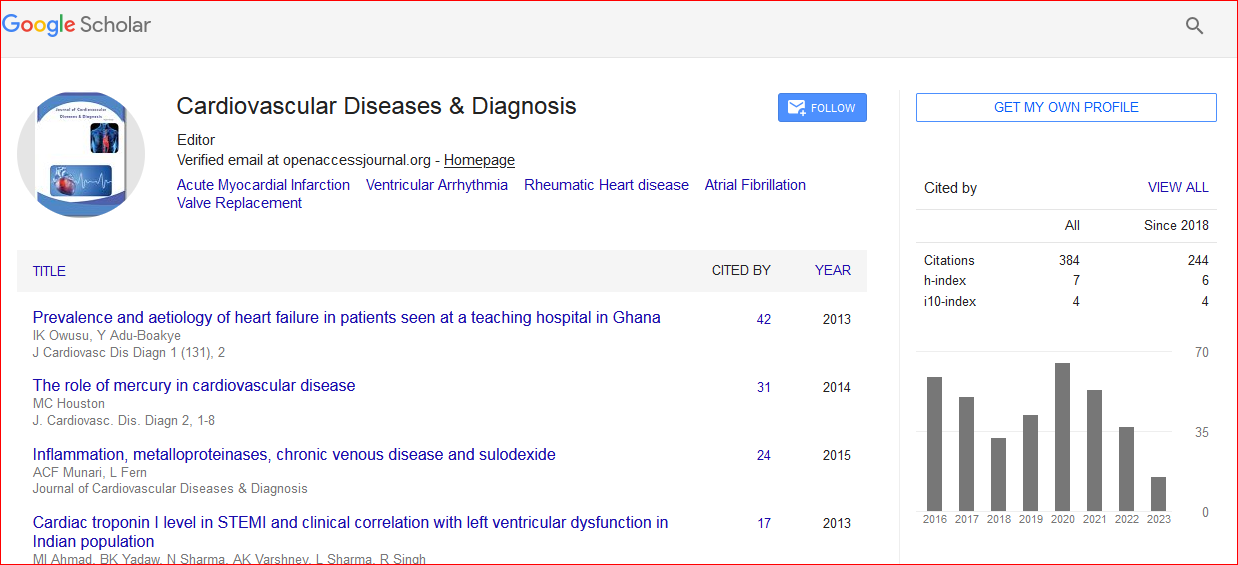
Cardiovascular Diseases & Diagnosis received 427 citations as per Google Scholar report