Commentary - (2025) Volume 17, Issue 5
Received: 01-Sep-2025, Manuscript No. jcst-25-176299;
Editor assigned: 03-Sep-2025, Pre QC No. P-176299;
Reviewed: 17-Sep-2025, QC No. Q-176299;
Revised: 22-Sep-2025, Manuscript No. R-176299;
Published:
29-Sep-2025
, DOI: 10.37421/1948-5956.2025.17.724
Citation: Almeida, Rafael. ”CAR T-cell Therapy: Progress, Challenges,
Future.” J Cancer Sci Ther 17 (2025):724.
Copyright: © 2025 Almeida R. This is an open-access article distributed under the terms of the Creative Commons Attribution License, which permits unrestricted use,
distribution and reproduction in any medium, provided the original author and source are credited.
Chimeric Antigen Receptor T-cell therapy has emerged as a revolutionary treatment modality in oncology, fundamentally altering the therapeutic landscape for several advanced cancers. Initially, a good overview of where CAR T-cell therapy currently stands for B-cell lymphoma emphasizes existing FDA-approved options and prognosticates future evolution, covering critical aspects like treatment sequencing and resistance management crucial for long-term patient outcomes [1].
While its successes in hematologic malignancies are undeniable, extending CAR T-cell therapy's reach to solid tumors presents a formidable challenge. The major hurdles involve the highly immunosuppressive tumor microenvironment and the significant issue of target antigen heterogeneity, necessitating innovative strategies to overcome these fundamental biological barriers and broaden the therapy's applicability [2].
It is important to acknowledge that despite its profound therapeutic benefits, CAR T-cell therapy is associated with unique and serious side effects, prominently cytokine release syndrome and neurotoxicity. The field has seen an evolving understanding and management of these toxicities, with continuous development of best practices aimed at ensuring patient safety while maximizing therapeutic efficacy [3].
Delving deeper into specific applications, a comprehensive review of CAR T-cell therapy in B-cell non-Hodgkin lymphoma highlights its mechanisms, efficacy, and safety profiles. This review also points to ongoing research efforts directed at improving patient outcomes and addressing current limitations within this particular patient population [4].
For patients battling multiple myeloma, CAR T-cell therapy, especially those targeting B-cell Maturation Antigen (BCMA), has yielded remarkable clinical results. Clinical data strongly supports its efficacy and safety, though the therapeutic community continues to address challenges such as antigen escape and the need for improved cellular persistence to sustain long-term remissions [5].
Looking ahead, the development of "next-generation" CAR T-cell therapies signals an exciting new phase in research. These advancements focus on engineering CAR T cells for enhanced effectiveness, improved safety, and expanded utility across a broader spectrum of blood cancers, incorporating innovations like armored CARs and universal CAR T strategies to address current limitations [6].
In acute lymphoblastic leukemia (ALL), CAR T-cell therapy has truly been a game-changer, especially for pediatric and young adult patients. Significant clinical progress in ALL has been achieved, marked by impressive response rates and durable remissions, even as researchers actively pursue solutions for challenges like disease relapse [7].
The journey of CAR T-cell therapy for B-cell malignancies encapsulates a remarkable translational success story, spanning from foundational laboratory research to successful clinical application. This trajectory provides invaluable insights into the underlying basic science, rigorous clinical development pathways, and the regulatory approvals that have ultimately delivered these life-saving treatments to patients [8].
However, the practical implementation of CAR T-cell therapy also faces significant logistical and economic challenges, particularly in its manufacturing. The complexity and high cost of CAR T-cell production, from initial apheresis to intricate gene transfer and subsequent cell expansion, represent critical bottlenecks. This necessitates innovative strategies aimed at making the manufacturing process more efficient, scalable, and ultimately more affordable, thereby increasing patient access to this vital therapy [9].
Overall, the landscape of CAR T-cell therapy for hematologic malignancies is characterized by continuous and rapid progress. Recent clinical advancements and applications are regularly reported, highlighting the outcomes of new trials, identifying emerging therapeutic targets, and providing practical guidance on how these sophisticated therapies are being effectively integrated into standard clinical care pathways [10].
Chimeric Antigen Receptor T-cell (CAR T-cell) therapy has fundamentally reshaped the treatment paradigm for various cancers, particularly hematologic malignancies. For B-cell lymphoma and B-cell non-Hodgkin lymphoma, significant strides have been made, with current FDA-approved options demonstrating efficacy and safety profiles that have profoundly impacted patient outcomes [1, 4]. These therapies continue to evolve, with ongoing research focusing on critical aspects such as optimal treatment sequencing and strategies to manage resistance, which are paramount for ensuring long-term benefits for patients [1]. Similarly, in multiple myeloma, BCMA-targeted CAR T-cell therapies have shown remarkable results, pushing the boundaries of what is possible in this often-refractory disease [5]. The success extends to acute lymphoblastic leukemia (ALL), where CAR T-cell therapy has been a "game-changer" for pediatric and young adult patients, delivering high response rates and durable remissions. Yet, even here, challenges like relapse necessitate continuous research into overcoming resistance mechanisms [7]. The journey from initial laboratory discoveries to successful clinical application in B-cell malignancies has been rigorously charted, involving extensive basic science, clinical development, and crucial regulatory approvals that paved the way for these life-saving treatments [8].
Despite these groundbreaking successes, the application of CAR T-cell therapy is not without its complexities and hurdles. A major area of concern is the management of therapy-associated toxicities. Patients frequently experience cytokine release syndrome and neurotoxicity, which require careful monitoring and an evolving set of management strategies to maintain patient safety while preserving the therapeutic benefits [3]. Beyond managing side effects, the expansion of CAR T-cell therapy into solid tumors represents one of the field's most formidable challenges. Unlike blood cancers, solid tumors present a highly immunosuppressive microenvironment and exhibit significant target antigen heterogeneity, which together impede the effectiveness of current CAR T-cell approaches. Overcoming these biological barriers is crucial for broadening the reach of this promising therapy beyond liquid tumors [2].
Innovation is rapidly addressing some of these challenges through the development of "next-generation" CAR T-cell therapies. Researchers are actively tweaking CAR T cells to enhance their effectiveness, improve their safety profiles, and expand their applicability to a wider array of blood cancers. This includes exploring concepts like armored CARs, which are engineered to resist the suppressive tumor microenvironment, and universal CAR T strategies, which aim to make the therapy more accessible and less patient-specific [6]. These advancements are vital for improving clinical outcomes and addressing current limitations, ensuring that the therapy can benefit a broader patient population and maintain durable responses [4, 5].
Furthermore, the practicalities of delivering CAR T-cell therapy introduce significant logistical and economic considerations. Manufacturing CAR T cells is a complex, multi-step, and costly process, encompassing stages from initial apheresis (collection of patient cells) to gene transfer and subsequent cell expansion. These intricate steps create bottlenecks that limit scalability and affordability, ultimately affecting wider patient access [9]. Addressing these manufacturing challenges through innovative strategies is a key focus for the future, aiming to streamline the process, reduce costs, and enhance accessibility.
The continuous flow of clinical advancements across various hematologic malignancies, including new trial outcomes, the identification of emerging targets, and practical integration into standard care, underscores the dynamic and forward-looking nature of this therapeutic field [10]. This ongoing progress highlights a concerted effort to refine and optimize CAR T-cell therapy, making it safer, more effective, and more widely available for patients globally.
CAR T-cell therapy represents a transformative approach in cancer treatment, particularly for hematologic malignancies. For B-cell lymphomas, current FDA-approved options are continually evolving, with research focused on treatment sequencing and managing resistance to improve long-term patient outcomes [C001, C004]. This therapy has also proven to be a game-changer in multiple myeloma, especially with BCMA-targeted approaches, demonstrating remarkable efficacy and safety while addressing challenges like antigen escape and persistence [C005]. Its impact is profound in acute lymphoblastic leukemia, especially in pediatric and young adult populations, where it has shown significant clinical progress, high response rates, and durability, despite challenges like relapses [C007]. The journey of CAR T-cell therapy from foundational lab research to successful clinical application in B-cell malignancies underscores crucial basic science, clinical development, and regulatory milestones [C008]. However, this powerful therapy comes with considerable challenges. Managing associated toxicities, such as cytokine release syndrome and neurotoxicity, is an evolving landscape where best practices are essential for patient safety [C003]. Expanding CAR T-cell therapy to solid tumors presents a significant hurdle, grappling with issues like the immunosuppressive tumor microenvironment and target antigen heterogeneity [C002]. Manufacturing CAR T cells itself is a complex, costly process with bottlenecks from apheresis to gene transfer, pushing for innovative strategies to enhance efficiency, scalability, and affordability for wider patient access [C009]. The field is actively pursuing next-generation CAR T-cell therapies, including armored CARs and universal strategies, to improve effectiveness, safety, and broaden their application across various blood cancers [C006]. Recent advancements highlight promising trial outcomes, emerging targets, and practical integration into standard care for a range of hematologic malignancies [C010].
Indexed at, Google Scholar, Crossref
Indexed at, Google Scholar, Crossref
Indexed at, Google Scholar, Crossref
Indexed at, Google Scholar, Crossref
Indexed at, Google Scholar, Crossref
Indexed at, Google Scholar, Crossref
Indexed at, Google Scholar, Crossref
Indexed at, Google Scholar, Crossref
Indexed at, Google Scholar, Crossref
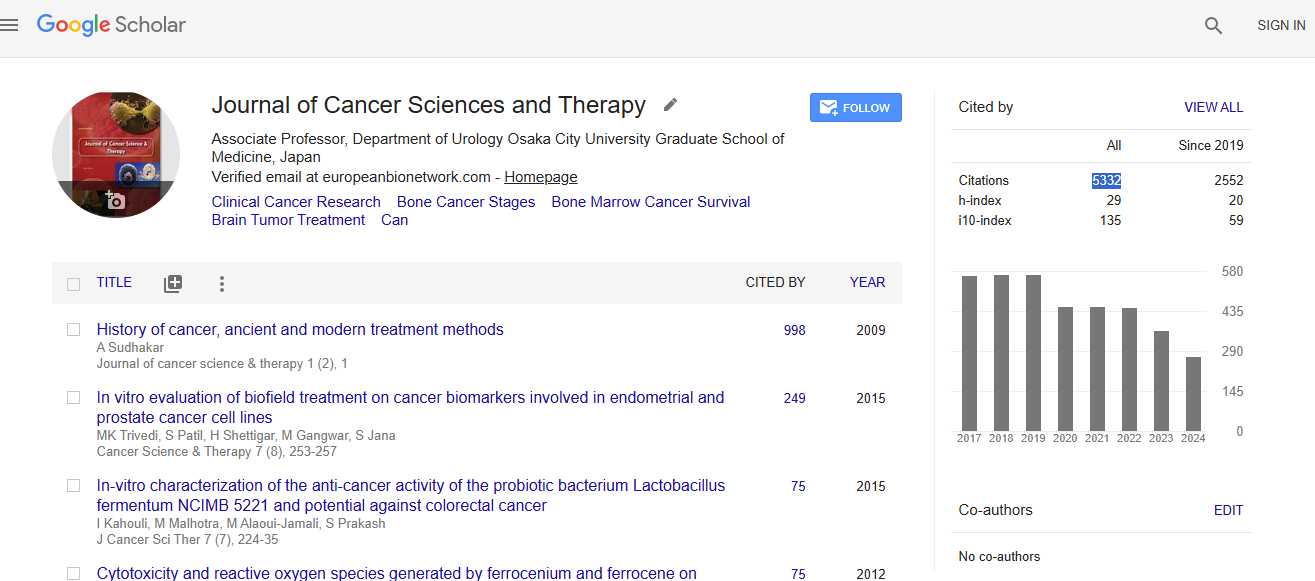
Cancer Science & Therapy received 5332 citations as per Google Scholar report