Perspective - (2025) Volume 11, Issue 4
Received: 02-Nov-2025, Manuscript No. jotr-25-175615;
Editor assigned: 04-Nov-2025, Pre QC No. P-175615;
Reviewed: 18-Nov-2025, QC No. Q-175615;
Revised: 24-Nov-2025, Manuscript No. jotr-25-175615;
Published:
29-Nov-2025
, DOI: 10.37421/2476-2261. 2025.11.326
Citation: Pavlichenko, Leonid. ”Cancer Cell Lines: Preclinical Research to Precision Oncology.” J Oncol Transl Res 11 (2025):326.
Copyright: © 2025 Pavlichenko L. This is an open-access article distributed under the terms of the Creative Commons Attribution License, which permits unrestricted use, distribution and reproduction in any medium, provided the original author and source are credited.
Cancer cell lines serve as fundamental models in biomedical research, offering an indispensable platform for unraveling the complexities of cancer biology and driving the development of new therapeutic strategies. These established models play a crucial role in preclinical drug development, particularly for breast cancer, where they help understand disease mechanisms, identify therapeutic targets, and screen potential anti-cancer agents, ultimately accelerating the translation of research findings into clinical practice [1].
A deep understanding of the extensive genomic characterization of cancer cell lines is vital, as it reveals their genetic diversity and similarity to primary tumors, guiding the selection of appropriate models for specific research questions and interpreting experimental results in the context of human cancer [2].
Building on genomic insights, epigenetic profiling of cancer cell lines reveals intricate regulatory mechanisms beyond the genetic code that influence cell behavior and drug response, underscoring the importance of integrating epigenetic data with genomic information for a comprehensive understanding of cancer biology and for developing novel therapies targeting epigenetic vulnerabilities [8].
The evolution of cancer cell line models, now including patient-derived and genetically engineered lines, signifies a significant advance. These next-generation models offer enhanced fidelity to primary tumors, making them invaluable tools for precision oncology, drug sensitivity prediction, and the development of personalized treatment strategies [5].
Advances in 3D cell culture and organoid models are transforming cancer drug discovery by better mimicking the in vivo tumor microenvironment, providing more predictive platforms for screening novel anti-cancer agents compared to traditional 2D monolayer cultures [3].
Similarly, 3D spheroid cultures derived from cancer cell lines are increasingly important for recapitulating aspects of the tumor microenvironment, instrumental in investigating cell-cell interactions, extracellular matrix dynamics, and nutrient/oxygen gradients, all critical for understanding tumor progression and drug resistance [6].
Furthermore, cancer cell lines prove highly useful in unraveling mechanisms of immune evasion and in refining strategies for immunotherapy. They facilitate the identification of novel immune checkpoints, the development of targeted immunotherapies, and a better understanding of patient response variability [4].
The application of CRISPR/Cas9 gene editing technology in cancer cell lines has revolutionized both basic research and potential therapeutic interventions. This precise genetic manipulation is invaluable, enabling researchers to meticulously study gene function, identify drug targets, and model disease mechanisms with exceptional accuracy [7].
These models, particularly those enriched for cancer stem cells, are also central to investigating complex mechanisms of drug resistance. They help elucidate the roles of intrinsic cellular adaptations, efflux pumps, and interactions with the tumor microenvironment that contribute to therapies becoming ineffective, guiding strategies to overcome resistance [9].
More recently, circulating tumor cell lines (CTCLs) have emerged as a promising new tool in personalized medicine and liquid biopsy research. These patient-derived models, established from CTCs, are used to study tumor heterogeneity, drug resistance, and to develop companion diagnostics, effectively bridging the gap between in vitro studies and patient outcomes [10].
Cancer cell lines are indispensable tools in oncology, offering controlled and reproducible systems to investigate cancer's fundamental aspects and drive new therapeutic strategies. They are particularly crucial for advancing preclinical drug development, exemplified in breast cancer research, by providing platforms to understand disease mechanisms, identify therapeutic targets, and screen anti-cancer agents. This work directly supports the acceleration of research findings into clinical applications [1]. A key strength lies in their extensive genomic characterization, which not only reveals significant genetic diversity but also demonstrates remarkable similarity to primary tumors. This detailed genomic understanding is paramount for researchers to judiciously select appropriate cell line models for specific research questions and to accurately interpret experimental results within the broader context of human cancer, ensuring relevance and predictive power [2].
Beyond foundational genomic insights, the epigenetic profiling of cancer cell lines has unveiled intricate regulatory mechanisms that operate independently of the genetic code, yet profoundly influence cellular behavior and drug response. Understanding these epigenetic landscapes is critical. The integration of this epigenetic data with genomic information is essential for a truly comprehensive grasp of cancer biology, simultaneously opening new avenues for developing novel therapies that specifically target epigenetic vulnerabilities [8]. Furthermore, the continuous advancement in cell line development now includes sophisticated next-generation models such as patient-derived and genetically engineered cell lines. These offer enhanced fidelity to primary tumors, making them invaluable tools for precision oncology, accurate drug sensitivity prediction, and the development of truly personalized treatment strategies tailored to individual patient profiles [5].
The evolution of cell culture technologies has dramatically enhanced the fidelity of cancer models, moving beyond simple 2D monolayer cultures. Advanced 3D cell culture and organoid models are transforming cancer drug discovery by better mimicking the intricate in vivo tumor microenvironment. These sophisticated systems provide more predictive platforms for screening novel anti-cancer agents compared to traditional methods, significantly improving the relevance of preclinical findings [3]. Building on this, 3D spheroid cultures derived from cancer cell lines are increasingly recognized for their ability to recapitulate critical aspects of the tumor microenvironment. These models prove instrumental for investigating complex phenomena such as cell-cell interactions, extracellular matrix dynamics, and the formation of crucial nutrient and oxygen gradientsâ??factors that are profoundly influential in tumor progression and the development of drug resistance within a more biologically relevant context [6].
Cancer cell lines also serve as vital tools for understanding and improving cancer immunotherapies. They are instrumental in unraveling complex immune evasion mechanisms, which is key to refining therapeutic strategies and improving patient outcomes. These models facilitate the identification of novel immune checkpoints, support the development of targeted immunotherapies, and help clarify the variability in patient responses to treatment, thereby guiding clinical translation [4]. Concurrently, the advent of CRISPR/Cas9 gene editing technology has provided unprecedented capabilities in manipulating the cancer cell line genome. This precise genetic manipulation is invaluable for both basic research and potential therapeutic interventions, enabling researchers to meticulously study gene function, identify new drug targets, and model disease mechanisms with exceptional accuracy and control [7].
One of the persistent and formidable challenges in cancer treatment is drug resistance, and cancer cell lines are pivotal in dissecting its complex mechanisms. Specifically, cell lines enriched for cancer stem cells are extensively used to elucidate the roles of intrinsic cellular adaptations, efflux pumps, and intricate interactions within the tumor microenvironment that contribute to therapies becoming ineffective. This research provides crucial insights for developing innovative strategies to overcome therapeutic failure and improve patient survival [9]. A promising and relatively novel frontier in personalized medicine and liquid biopsy research is the introduction of circulating tumor cell lines (CTCLs). These patient-derived models, established from circulating tumor cells (CTCs), allow for detailed study of tumor heterogeneity and drug resistance in a patient-specific context. CTCLs represent a significant bridge between in vitro studies and real-world patient outcomes, holding immense potential for developing companion diagnostics and informing precise treatment decisions [10].
Established cancer cell lines are vital for preclinical drug development, especially in areas like breast cancer, by helping us understand disease mechanisms, pinpoint therapeutic targets, and screen anti-cancer agents, pushing research closer to clinical reality. Their extensive genomic characterization reveals genetic diversity mirroring primary tumors, which is crucial for choosing the right models and interpreting experimental outcomes. Beyond genomics, epigenetic profiling of these cell lines uncovers regulatory mechanisms impacting cell behavior and drug response, emphasizing the need to integrate this data for comprehensive understanding and targeted therapies. The field has seen significant advances with 3D cell culture, organoid, and spheroid models. These mimic the in vivo tumor microenvironment more effectively than traditional 2D cultures, providing better platforms for screening novel agents, studying cell-cell interactions, and understanding drug resistance. Next-generation models, including patient-derived and genetically engineered cell lines, offer enhanced fidelity to primary tumors. They are becoming indispensable for precision oncology, predicting drug sensitivity, and developing personalized treatment strategies. Cancer cell lines are also instrumental in unraveling immune evasion mechanisms and refining immunotherapy strategies. They help identify immune checkpoints, develop targeted immunotherapies, and understand patient response variability. CRISPR/Cas9 gene editing technology applied to these cell lines allows for precise genetic manipulation, supporting studies on gene function, drug target identification, and accurate disease modeling. Furthermore, these models, particularly those enriched for cancer stem cells, are key to investigating drug resistance mechanisms, including cellular adaptations and microenvironment interactions, guiding efforts to overcome therapeutic failure. A novel development involves circulating tumor cell lines (CTCLs) derived from patient CTCs. These tools are valuable for personalized medicine and liquid biopsy research, enabling studies of tumor heterogeneity and drug resistance, thereby connecting in vitro findings with patient outcomes.
None
None
Priyanka R, Vikash K, Deepak K. "The Role of Cancer Cell Lines in Preclinical Studies for Developing Novel Therapies for Breast Cancer".Cancers (Basel) 15 (2023):5613.
Indexed at, Google Scholar, Crossref
Yi Z, Shan C, Yin P. "The genomic landscape of cancer cell lines".Semin Cancer Biol 65 (2020):13-22.
Indexed at, Google Scholar, Crossref
Roel D, Lisanne LvdW, Anne EdG. "Advances in 3D Cell Culture and Organoid Models in Cancer Drug Discovery".Adv Sci (Weinh) 8 (2021):2003882.
Indexed at, Google Scholar, Crossref
Maria DP, Michela DM, Debora C. "Cancer Cell Lines as Tools to Study Immune Evasion Mechanisms and Improve Immunotherapy".Front Oncol 11 (2021):666991.
Indexed at, Google Scholar, Crossref
Marc G, Franklin WH, Jesse J. "Cancer cell lines: The next generation".Semin Cancer Biol 65 (2020):29-37.
Indexed at, Google Scholar, Crossref
Xintao L, Kunkun C, Xiaonan M. "The Role of 3D Spheroid Culture in Studying the Tumor Microenvironment".Front Oncol 11 (2021):644131.
Indexed at, Google Scholar, Crossref
Shuai S, Jie W, Bing H. "CRISPR/Cas9-based gene editing for cancer research and therapy".Biomed Pharmacother 128 (2020):110255.
Indexed at, Google Scholar, Crossref
Roel GWV, Eliezer MVA, Seth ES. "Epigenetic landscapes of cancer cell lines".Semin Cancer Biol 65 (2020):23-28.
Indexed at, Google Scholar, Crossref
Mousa AA, Shamma A, Jad C. "Unraveling the Mechanisms of Drug Resistance in Cancer: A Focus on Cancer Stem Cells and the Tumor Microenvironment".Cells 10 (2021):2404.
Indexed at, Google Scholar, Crossref
Wenjuan Z, Huiran Y, Wenhui L. "Circulating Tumor Cell Lines: A Novel Tool for Precision Medicine and Liquid Biopsy Research".Cancers (Basel) 14 (2022):3139.
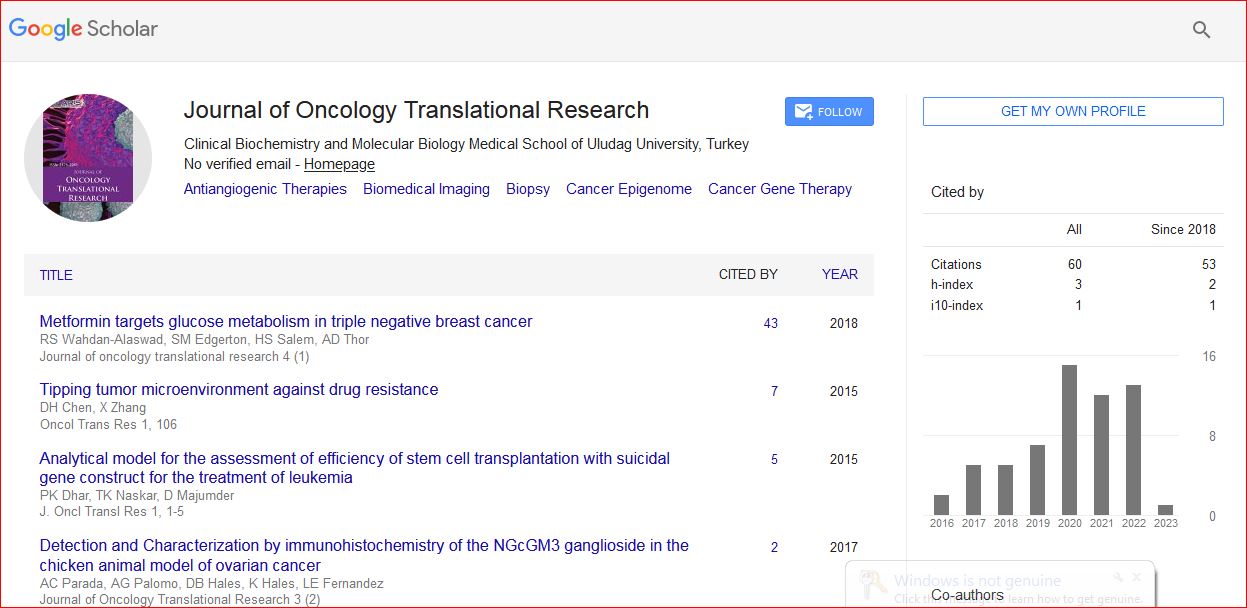
Journal of Oncology Translational Research received 93 citations as per Google Scholar report