Brief Report - (2025) Volume 11, Issue 5
Received: 02-Oct-2025, Manuscript No. jpnp-25-175525;
Editor assigned: 06-Oct-2025, Pre QC No. P-175525;
Reviewed: 20-Oct-2025, QC No. Q-175525;
Revised: 23-Oct-2025, Manuscript No. R-175525;
Published:
30-Oct-2025
, DOI: 10.37421/2472-0992.2025.11.384
Citation: Rahman, Laila. ”Cañahua: Nutrition, Health, Global Food Integration.” J Pharmacogn Nat Prod 11 (2025):384.
Copyright: © 2025 Rahman L. This is an open-access article distributed under the terms of the Creative Commons Attribution License, which permits unrestricted use, distribution and reproduction in any medium, provided the original author and source are credited.
Pseudocereals like cañahua, quinoa, and amaranth are garnering significant attention for their exceptional nutritional profiles, health benefits, and diverse technological applications. This review consolidates information on these aspects, particularly emphasizing cañahua's potential as a valuable food source due to its balanced amino acid composition, high protein content, and presence of essential micronutrients, advocating for its increased integration into global food systems [1].
Other research similarly highlights the rich composition of proteins, essential amino acids, minerals, vitamins, and bioactive compounds in cañahua, reinforcing its status as a highly nutritious food with significant health-promoting effects [10].
Indeed, recent advancements in understanding the nutritional composition of Andean pseudocereals and legumes, including cañahua, underscore its role as a source of high-quality protein, dietary fiber, and bioactive compounds. This contributes to its growing recognition as a valuable component of healthy diets and for its ethnopharmacological potential [7].
Beyond general nutrition, specific research delves into the unique bioactive components of cañahua. For instance, studies have explored the phenolic compound profile of cañahua seeds, identifying various bioactive compounds. These findings emphasize cañahua's potential as a source of natural antioxidants and health-promoting phytochemicals, further solidifying its recognition as a functional food with substantial nutritional benefits [3].
The in vitro hypoglycemic and hypolipidemic effects of various cañahua and quinoa cultivars have also been examined. The results indicate that cañahua possesses significant potential in managing blood glucose and lipid levels, suggesting its utility in the dietary prevention or management of conditions like diabetes and hyperlipidemia [4].
Further characterization of cañahua cultivars from the Bolivian Altiplano confirms its nutritional, phytochemical, and antioxidant properties. This work reveals significant variability among cultivars, highlighting specific ones with superior health-promoting compounds, which is valuable for breeding and promoting cañahua as a functional food [6].
The functional versatility of cañahua extends to its technological applications. Investigations into how adding cañahua flour affects gluten-free bread's rheological, physical, and sensory attributes show promising results. Findings suggest that cañahua flour can improve nutritional value and certain textural qualities in gluten-free products, offering a viable alternative for enhancing bread characteristics for individuals with celiac disease or gluten sensitivity [2].
Moreover, the impact of various processing methods, such as roasting, on cañahua grains has been studied. Research investigates how different roasting temperatures influence the nutritional composition, antioxidant activity, and phenolic profile of cañahua grains. The findings demonstrate that roasting can significantly affect these properties, providing insights into optimal processing methods to maximize cañahua's health benefits and sensory attributes [9].
To fully leverage cañahua's potential, extensive agronomic and genetic research is crucial. Detailed characterization of agronomic traits and biochemical components across a diverse collection of cañahua germplasm has identified varieties with superior nutritional profiles and growth characteristics. This offers valuable insights for breeding programs aimed at improving cañahua's yield and quality [5].
Similarly, studies on the genetic diversity and population structure of cañahua accessions from Bolivia using SSR markers reveal substantial genetic variation within cañahua germplasm. This information is vital for conservation efforts and for developing effective breeding strategies to enhance crop resilience and nutritional traits [8].
Cañahua (Chenopodium pallidicaule Aellen) is increasingly recognized as a vital Andean pseudocereal, celebrated for its robust nutritional and functional properties. Detailed reviews confirm its status as an excellent food source, rich in a balanced amino acid composition, high protein content, and a spectrum of essential micronutrients [1]. This reinforces its value in healthy diets, positioning it for greater integration into global food systems. Similarly, other research underscores cañahuaâ??s abundant proteins, essential amino acids, minerals, vitamins, and a variety of bioactive compounds, solidifying its role as a highly nutritious food with considerable health-promoting effects [10]. This comprehensive nutritional profile, including high-quality protein, dietary fiber, and various bioactive compounds, is consistently highlighted across studies, contributing to its growing recognition and ethnopharmacological potential [7].
Investigation into the specific health benefits of cañahua reveals compelling findings. For instance, studies have identified a diverse phenolic compound profile within cañahua seeds, showcasing various bioactive compounds [3]. These compounds contribute to cañahuaâ??s potential as a source of natural antioxidants and other health-promoting phytochemicals, thereby enhancing its standing as a functional food. Furthermore, in vitro studies have demonstrated the hypoglycemic and hypolipidemic effects of cañahua cultivars, alongside quinoa. The results suggest that cañahua holds significant promise in regulating blood glucose and lipid levels, indicating its utility in the dietary prevention and management of conditions such as diabetes and hyperlipidemia [4].
Characterizing different cañahua cultivars from regions like the Bolivian Altiplano has brought to light significant variability in their nutritional, phytochemical, and antioxidant properties [6]. This work identifies specific cultivars possessing superior health-promoting compounds, crucial for guiding breeding programs and effectively promoting cañahua as a functional food. Complementary research provides a comprehensive characterization of agronomic traits and biochemical components across a wide collection of cañahua germplasm. This effort aims to pinpoint varieties with enhanced nutritional profiles and growth characteristics, offering invaluable insights for breeding initiatives focused on improving cañahua's overall yield and quality [5].
Understanding the genetic underpinnings of cañahua is paramount for its sustainable cultivation and improvement. A study employing SSR markers to investigate the genetic diversity and population structure of cañahua accessions from Bolivia uncovered substantial genetic variation within the germplasm [8]. This significant genetic diversity is critical for informing conservation strategies and for developing robust breeding programs designed to enhance crop resilience and desired nutritional traits. Such efforts are vital for adapting cañahua to varying environmental conditions and for maximizing its potential as a staple crop.
Beyond its inherent nutritional value, cañahua offers practical applications in food technology. Research into the effects of incorporating cañahua flour into gluten-free bread, for example, demonstrates improvements in rheological, physical, and sensory attributes [2]. This makes cañahua a promising alternative for enhancing the characteristics of gluten-free products, particularly beneficial for individuals with celiac disease or gluten sensitivity. Furthermore, studies explore the impact of processing methods like roasting on cañahua grains, specifically examining how varying temperatures affect nutritional composition, antioxidant activity, and phenolic profiles. These findings are key to developing optimal processing techniques that can maximize cañahuaâ??s health benefits and refine its sensory appeal for wider consumption [9].
This review consolidates information on the nutritional profiles, health benefits, and various technological uses of pseudocereals like cañahua, quinoa, and amaranth. It highlights cañahua's potential as a valuable food source due to its balanced amino acid composition, high protein content, and presence of essential micronutrients, advocating for its increased integration into global food systems. Other research reinforces cañahua's rich composition of proteins, essential amino acids, minerals, vitamins, and bioactive compounds, along with its role as a source of high-quality protein, dietary fiber, and bioactive compounds, contributing to its growing recognition as a valuable component of healthy diets and for its ethnopharmacological potential. Specifically, studies show cañahua's in vitro hypoglycemic and hypolipidemic effects, indicating its potential in managing conditions like diabetes and hyperlipidemia. Its phenolic compound profile reveals it as a source of natural antioxidants and health-promoting phytochemicals, reinforcing its status as a functional food. In terms of technological uses, adding cañahua flour to gluten-free bread improves nutritional value and textural qualities, offering a promising alternative for those with celiac disease or gluten sensitivity. Agronomic research characterizes traits and biochemical components across diverse germplasm, identifying varieties with superior nutritional profiles and growth. Genetic studies reveal substantial diversity among Bolivian accessions, crucial for conservation and breeding strategies. Furthermore, investigations into processing, such as the impact of roasting temperatures, demonstrate how these methods influence nutritional composition, antioxidant activity, and phenolic profiles, helping optimize its health benefits and sensory attributes. The collective evidence strongly supports cañahua's recognition and increased integration into healthy diets and food systems.
None
None
Victoria MG, Nataly G, Sergio OS. "Quinoa, cañahua, and amaranth: a review of their nutritional characteristics, health benefits, and technological applications".Food Sci Nutr 11 (2023):1430-1447.
Indexed at, Google Scholar, Crossref
Silvia A, Ingrid M, J MP. "Effects of Cañahua (Chenopodium pallidicaule Aellen) Flour Addition on the Rheological, Physical, and Sensory Properties of Gluten-Free Bread".Foods 11 (2022):3913.
Indexed at, Google Scholar, Crossref
Vanessa G, Domas J, Florencia V. "Phenolic compounds in cañahua (Chenopodium pallidicaule Aellen) seeds".Food Chem X 15 (2022):100412.
Indexed at, Google Scholar, Crossref
Edwin A, Claudia S, Silvia A. "In Vitro Hypoglycemic and Hypolipidemic Potential of Cañahua (Chenopodium pallidicaule Aellen) and Quinoa (Chenopodium quinoa Willd) Cultivars".J Food Sci 87 (2022):3576-3585.
Indexed at, Google Scholar, Crossref
J LCM, Ingrid M, Gina S. "Comprehensive Characterization of Agronomic Traits and Biochemical Components in Diverse Cañahua (Chenopodium pallidicaule Aellen) Germplasm".Plants (Basel) 11 (2022):1564.
Indexed at, Google Scholar, Crossref
Claudia S, Silvia A, Edwin A. "Characterization of the Nutritional, Phytochemical, and Antioxidant Properties of Cañahua (Chenopodium pallidicaule Aellen) Cultivars from the Bolivian Altiplano".Foods 10 (2021):3158.
Indexed at, Google Scholar, Crossref
Ana C, Olivia T, Darwin G. "Recent advances in understanding the nutritional and health benefits of Andean pseudocereals and legumes".J Ethnopharmacol 279 (2021):114389.
Indexed at, Google Scholar, Crossref
Silvia A, Claudia S, Edwin A. "Genetic diversity and population structure analysis of cañahua (Chenopodium pallidicaule Aellen) accessions from Bolivia using SSR markers".Genet Resour Crop Evol 68 (2021):927-939.
Indexed at, Google Scholar, Crossref
Mercedes Q, Lizeth A, Edwin A. "Effect of Different Roasting Temperatures on the Nutritional Composition, Antioxidant Activity, and Phenolic Profile of Cañahua (Chenopodium pallidicaule Aellen) Grains".J Food Sci 85 (2020):4278-4286.
Indexed at, Google Scholar, Crossref
Andrea V, Erick T, Julio P. "Nutritional and functional properties of Andean pseudocereals: A review".J Food Qual 2020 (2020):8878564.
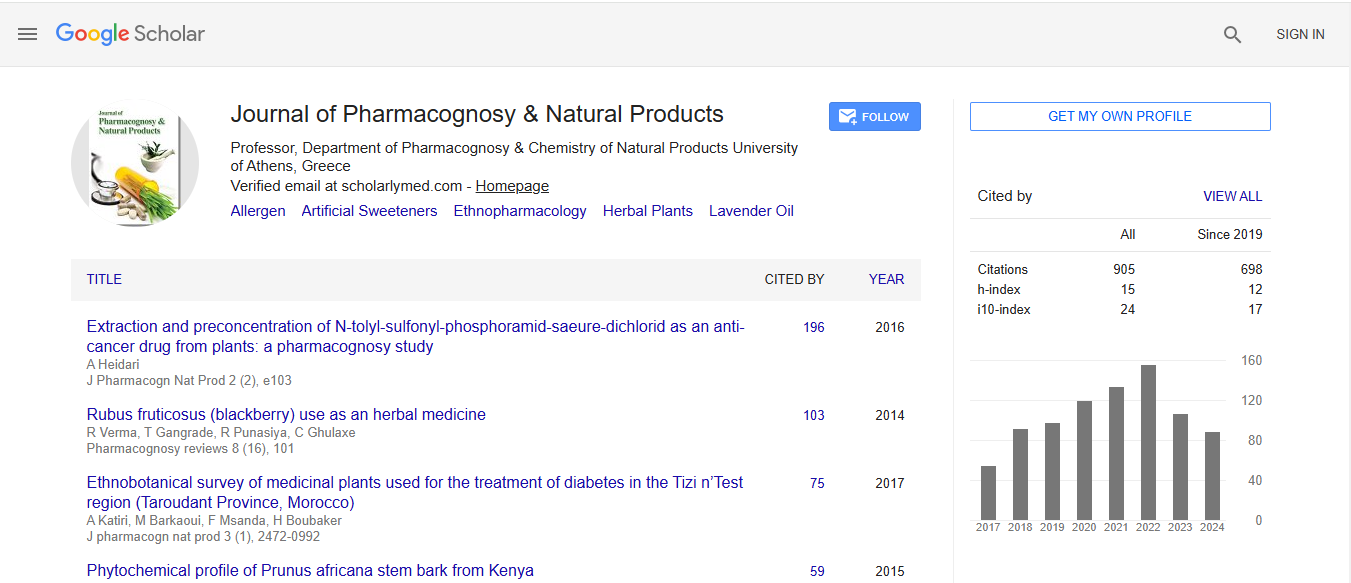
Journal of Pharmacognosy & Natural Products received 606 citations as per Google Scholar report