Commentary - (2025) Volume 9, Issue 1
Received: 01-Jan-2025, Manuscript No. jma-25-172656;
Editor assigned: 03-Jan-2025, Pre QC No. P-172656;
Reviewed: 17-Jan-2025, QC No. Q-172656;
Revised: 22-Jan-2025, Manuscript No. R-172656;
Published:
29-Jan-2025
, DOI: 10.37421/2684-4265.2025.09.358
Citation: Nishimura, Haruto. ”Cadaveric Dissection: Gold Standard, Evolution, Ethics.” J Morphol Anat 09 (2025):358.
Copyright: © 2025 Nishimura H. This is an open-access article distributed under the terms of the Creative Commons Attribution License, which permits unrestricted use, distribution and reproduction in any medium, provided the original author and source are credited.
Cadaveric dissection stands as a fundamental cornerstone in anatomical education, offering a unique and indispensable hands-on experience. This direct engagement is vital for developing detailed anatomical knowledge and essential clinical skills, setting a robust foundation for medical practice, despite the growing number of modern educational alternatives [1].
Plastinated specimens represent a significant advancement, providing durable, non-toxic, and remarkably realistic anatomical models. They effectively serve to supplement or, in specific educational contexts, can partially replace traditional cadaveric dissection, thereby enhancing learning flexibility without compromising critical anatomical detail [2].
The global COVID-19 pandemic severely disrupted conventional cadaveric dissection practices, leading to widespread student apprehension regarding the adequacy of online replacements. This period underscored the profound, often perceived as irreplaceable, value of direct, hands-on experience in mastering anatomy [3].
Virtual reality platforms are showing immense promise in anatomical education. They offer interactive and deeply immersive learning experiences that can not only supplement but potentially enhance students' understanding, especially when thoughtfully integrated with established traditional teaching methodologies [4].
Beyond technical skills, cadaveric dissection is instrumental in fostering empathy among medical students. It involves confronting mortality, promoting a deep respect for the human body, and initiating their fundamental understanding of patient care, contributing significantly to their overall professional identity formation [5].
Ethical considerations in cadaver donation are absolutely paramount, requiring transparent consent processes, dignified treatment of remains, and a meticulous adherence to cultural sensitivities. These measures are crucial to maintain public trust and honor the profound respect owed to donors [6].
Combining prosection with active dissection offers a well-balanced pedagogical approach. This strategy allows students to first learn from expertly prepared specimens before engaging in their own dissection, thereby optimizing valuable learning time and substantially improving overall learning efficiency and outcomes [7].
Many experienced educators continue to firmly uphold cadaveric dissection as the gold standard in anatomy education. They argue that its unique benefits, including superior three-dimensional understanding, essential haptic learning, and comprehensive professional development, cannot be fully replicated by any other means [8].
Three-dimensional printed anatomical models are becoming increasingly valuable in medical education. These models provide customizable, high-fidelity replicas of complex structures that effectively complement traditional teaching methods and offer highly accessible and versatile learning tools for students [9].
The enforced shift to online anatomy teaching during the COVID-19 pandemic revealed varied impacts on student performance and perception. This highlighted the pressing need for robust digital resources and innovative pedagogical strategies to effectively mitigate potential learning gaps in remote instructional environments [10].
Cadaveric dissection is undeniably a cornerstone of anatomical education, offering a hands-on experience crucial for developing detailed anatomical knowledge and essential clinical skills [1]. Many educators still consider it the gold standard, asserting its unique benefits for three-dimensional comprehension, haptic learning, and professional development cannot be fully replicated by other methods [8]. This direct engagement with human anatomy is seen as invaluable for foundational medical training.
While cadaveric dissection maintains its prominence, a range of modern alternatives and supplementary tools are increasingly integrated into anatomy curricula. Plastinated specimens provide durable, non-toxic, and realistic anatomical models that can effectively enhance learning flexibility and, in some cases, partially replace traditional dissection without compromising detail [2]. Similarly, 3D-printed anatomical models offer customizable, high-fidelity replicas of complex structures, serving as accessible and valuable learning tools that complement existing methods [9]. Furthermore, Virtual Reality platforms are emerging as promising educational aids, offering interactive and immersive experiences that can significantly supplement or even enhance understanding when integrated thoughtfully into traditional teaching [4].
Beyond just individual tools, pedagogical approaches are evolving. Combining prosection with dissection, for instance, offers a balanced method where students first learn from expertly prepared specimens before engaging in their own dissection. This approach optimizes time and improves learning efficiency [7]. Moreover, the role of cadaveric dissection extends beyond purely scientific understanding; it plays a critical role in fostering empathy among medical students. By confronting mortality and promoting respect for the human body, this experience helps initiate an understanding of patient care and contributes significantly to their professional identity formation [5].
The recent global health crisis, the COVID-19 pandemic, caused considerable disruption to traditional cadaveric dissection, leading to student concerns about the effectiveness of online replacements. This situation vividly highlighted the perceived irreplaceable value of direct, hands-on experience [3]. The mandated shift to online anatomy teaching during the pandemic had mixed impacts on student performance and perception. This experience emphasized the critical need for robust digital resources and well-designed pedagogical strategies to address and mitigate potential learning gaps arising from remote instruction [10].
Underlying all these methods, especially those involving human remains, are crucial ethical considerations. Cadaver donation demands transparent consent processes, dignified treatment of the remains, and careful adherence to cultural sensitivities. These practices are paramount to maintaining public trust and demonstrating profound respect for donors, ensuring the continued integrity of anatomical education and research globally [6].
Cadaveric dissection is a longstanding cornerstone of anatomical education, valued for providing essential hands-on experience and fostering detailed anatomical knowledge and clinical skills. Many educators regard it as the gold standard due to its unique benefits for three-dimensional understanding, haptic learning, and professional development, which are difficult to replicate fully. However, modern alternatives are increasingly supplementing or even partially replacing traditional methods. Plastinated specimens offer durable, non-toxic, and realistic models, enhancing learning flexibility. 3D-printed anatomical models provide customizable, high-fidelity replicas of complex structures, serving as accessible learning tools. Virtual Reality platforms also show promise with interactive, immersive experiences. Combining prosection with dissection can optimize learning efficiency by allowing initial study of expertly prepared specimens. Beyond technical skills, cadaveric dissection helps medical students develop empathy, promoting respect for the human body and initiating an understanding of patient care. The COVID-19 pandemic significantly disrupted traditional dissection, leading to concerns about online replacements and highlighting the irreplaceable value of hands-on experience. The shift to online teaching revealed mixed impacts on student performance, underscoring the need for robust digital resources. Ethical considerations in cadaver donation, including transparent consent and dignified treatment, are paramount for maintaining public trust.
None
None
Indexed at, Google Scholar, Crossref
Indexed at, Google Scholar, Crossref
Indexed at, Google Scholar, Crossref
Indexed at, Google Scholar, Crossref
Indexed at, Google Scholar, Crossref
Indexed at, Google Scholar, Crossref
Indexed at, Google Scholar, Crossref
Indexed at, Google Scholar, Crossref
Indexed at, Google Scholar, Crossref
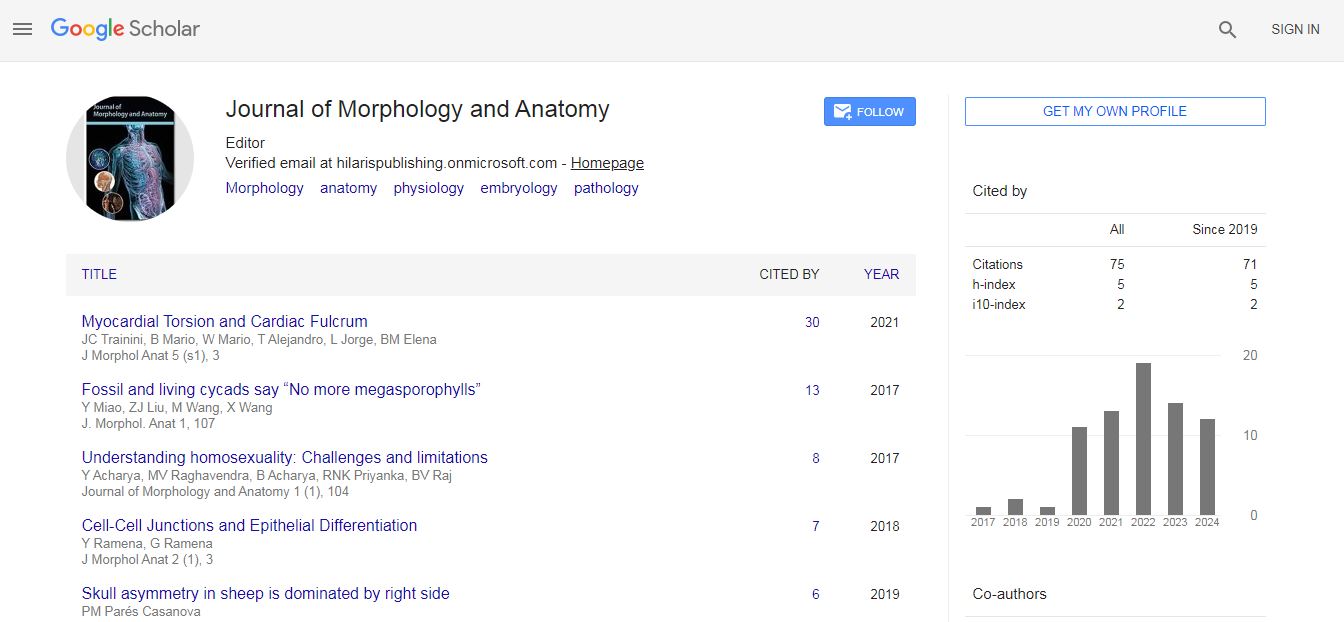
Journal of Morphology and Anatomy received 63 citations as per Google Scholar report