Perspective - (2025) Volume 14, Issue 3
Received: 01-Jun-2025, Manuscript No. jbfa-25-174147;
Editor assigned: 03-Jun-2025, Pre QC No. P-174147;
Reviewed: 17-Jun-2025, QC No. Q-174147;
Revised: 23-Jun-2025, Manuscript No. R-174147;
Published:
30-Jun-2025
, DOI: 10.37421/2167-0234.2025.14.535
Citation: Mansour, Ahmed. ”Business Sustainability: Innovation, Finance, ESG, Circularity.” J Bus Fin Aff 14 (2025):535.
Copyright: © 2025 Mansour A. This is an open-access article distributed under the terms of the Creative Commons Attribution License, which permits unrestricted use, distribution and reproduction in any medium, provided the original author and source are credited.
This study examines how ESG disclosure influences firm value, focusing on the enhancing effect of green innovation. It suggests that companies disclosing more ESG information can boost their value, especially when they actively pursue green innovation, indicating a strategic synergy between transparency and sustainable practices [1].
This systematic review synthesizes existing literature on circular economy business models, identifying key strategies, drivers, and barriers. It maps out the landscape of how businesses are adopting circular principles, highlighting the diversity of approaches and the challenges in transitioning from linear to circular operations [2].
This review explores the complex relationship between corporate social responsibility (CSR) and financial performance, synthesizing findings from numerous studies. It identifies various mechanisms through which CSR initiatives might impact a firm's bottom line, highlighting both positive and nuanced relationships and suggesting directions for future research [3].
This systematic review maps the intersection of digitalization and sustainable supply chain management, examining how digital technologies enable and transform sustainable practices across supply chains. It identifies key technological applications, benefits, and challenges, providing a comprehensive overview of the current research landscape [4].
This review explores the role of green entrepreneurship in driving sustainable development. It synthesizes literature on how entrepreneurial ventures focused on environmental solutions contribute to economic growth and ecological preservation, identifying key themes, challenges, and opportunities in this emerging field [5].
This systematic review provides a comprehensive overview of green bonds, analyzing their growth, impact, and characteristics in sustainable finance. It synthesizes findings on market development, investor motivations, and the environmental and financial performance of green bond issuance, identifying gaps for future investigation [6].
This systematic review examines the evolution and characteristics of various sustainability reporting frameworks. It identifies commonalities and differences among frameworks like GRI, SASB, and TCFD, analyzing their influence on corporate transparency and accountability regarding environmental, social, and governance performance [7].
This systematic review explores the interconnected concepts of sustainable consumption and production, examining how consumer behavior and industrial processes are evolving towards greater environmental and social responsibility. It highlights drivers, barriers, and policy implications for fostering more sustainable economic models [8].
This systematic review synthesizes research on the relationship between green innovation and firm performance. It identifies various types of green innovations and their impacts on financial, environmental, and operational outcomes, highlighting the strategic importance of eco-friendly practices for competitive advantage [9].
This systematic review investigates how sustainable entrepreneurship impacts firm performance. It explores how businesses integrating environmental and social goals into their core strategies achieve both financial success and positive societal outcomes, identifying the mechanisms and contextual factors at play [10].
Modern business environments increasingly emphasize corporate transparency and robust governance, revealing significant impacts on firm value and overall performance. Research indicates that ESG disclosure directly influences a company's financial standing, particularly when it is synergistically paired with green innovation efforts. Companies that actively disclose their ESG information and concurrently pursue eco-friendly advancements often experience a notable boost in their firm value, highlighting a strategic interplay between openness and sustainable business practices [1]. Parallel investigations into Corporate Social Responsibility (CSR) and financial performance offer a comprehensive synthesis of numerous studies, identifying diverse mechanisms through which CSR initiatives can affect a firmâ??s profitability. This review showcases both directly positive and more nuanced relationships, indicating CSRâ??s multifaceted impact on financial outcomes and suggesting avenues for further exploration [3]. The landscape of sustainability reporting frameworks, including prominent ones like GRI, SASB, and TCFD, has also been systematically reviewed. This analysis details their evolution and distinct characteristics, clarifying how these frameworks collectively shape corporate transparency and enhance accountability across environmental, social, and governance dimensions [7]. Together, these studies affirm that a commitment to ethical disclosure and responsible operations is not merely reputational but also strategically vital for a company's financial health and market perception.
Innovation and entrepreneurship are proving to be pivotal forces in driving sustainable development and improving organizational performance. A focused systematic review explores the relationship between green innovation and firm performance, categorizing various forms of eco-friendly innovations and detailing their tangible impacts on financial metrics, environmental stewardship, and operational efficiencies. This research underscores the strategic importance of adopting green practices for gaining a competitive edge [9]. Extending this, green entrepreneurship is recognized for its significant role in advancing sustainable development. Through a synthesis of relevant literature, studies identify how new entrepreneurial ventures, specifically those concentrated on environmental solutions, contribute simultaneously to economic growth and the preservation of ecological systems. This highlights key thematic areas, challenges, and burgeoning opportunities within this evolving field [5]. Furthermore, the broader concept of sustainable entrepreneurship's influence on firm performance has been thoroughly investigated. This research examines how businesses that embed environmental and social objectives at their core achieve not only financial success but also generate positive societal outcomes, meticulously identifying the underlying mechanisms and relevant contextual factors that facilitate such integrated achievements [10]. These insights collectively emphasize that purposeful innovation and entrepreneurial spirit are crucial for developing business models that are inherently sustainable and economically viable.
Transitioning towards truly sustainable economic models necessitates comprehensive systemic changes that encompass production, consumption, and resource management. A systematic review dedicated to circular economy business models identifies the primary strategies, driving forces, and prevailing barriers encountered in their implementation. This review meticulously maps the current landscape of how businesses are adopting circular principles, underscoring the diverse approaches undertaken and the inherent challenges involved in shifting away from traditional linear operational models [2]. Complementing this, research at the intersection of digitalization and sustainable supply chain management critically examines how various digital technologies facilitate and fundamentally transform sustainable practices throughout complex supply chains. This comprehensive review pinpoints key technological applications, delineates associated benefits, and identifies persistent challenges, thereby providing a holistic overview of the current research frontier [4]. Moreover, the interconnected concepts of sustainable consumption and production have been systematically explored, analyzing the evolving dynamics of consumer behavior and industrial processes as they move towards greater environmental and social accountability. This research highlights crucial drivers, potential barriers, and essential policy implications aimed at cultivating more sustainable economic paradigms [8]. These studies collectively advocate for a holistic transformation in industrial and consumer practices to foster a genuinely sustainable global economy.
The expanding realm of sustainable finance plays an increasingly vital role in catalyzing environmentally conscious initiatives and investments. A systematic review offers a comprehensive overview of green bonds, meticulously analyzing their trajectory of growth, their overall market impact, and their defining characteristics within the broader landscape of sustainable finance. This review synthesizes critical findings concerning market development, the motivations of investors, and the environmental alongside the financial performance of various green bond issuances, concurrently identifying significant gaps that warrant future investigation [6]. This particular financial instrument effectively channels capital towards projects with clear environmental benefits, illustrating the dynamic evolution of sustainable investment strategies and their considerable potential to accelerate the global transition towards a more environmentally friendly economy.
This collection of research underscores the accelerating global focus on integrating sustainability into core business practices and economic models. A significant portion of the literature comprises systematic reviews, offering comprehensive insights into diverse areas. Key themes include the crucial link between ESG disclosure and firm value, particularly when amplified by green innovation. The broader concept of green and sustainable entrepreneurship is explored for its role in driving sustainable development and enhancing firm performance by aligning environmental and social goals with financial success. Systemic changes in industrial and consumer practices are also central, with studies examining circular economy business models, digitalization's impact on sustainable supply chains, and the evolving landscape of sustainable consumption and production. The importance of corporate social responsibility (CSR) and its complex relationship with financial performance is detailed, alongside an analysis of sustainability reporting frameworks that bolster corporate transparency and accountability. Furthermore, the emergence of sustainable finance is highlighted through an overview of green bonds, assessing their growth, impact, and characteristics as a tool for environmentally beneficial investment. Collectively, these papers provide a multifaceted perspective on the challenges and opportunities in fostering a more sustainable, transparent, and responsible global economy through innovation, strategic governance, and systemic transformations.
None
None
Indexed at, Google Scholar, Crossref
Indexed at, Google Scholar, Crossref
Indexed at, Google Scholar, Crossref
Indexed at, Google Scholar, Crossref
Indexed at, Google Scholar, Crossref
Indexed at, Google Scholar, Crossref
Indexed at, Google Scholar, Crossref
Indexed at, Google Scholar, Crossref
Indexed at, Google Scholar, Crossref
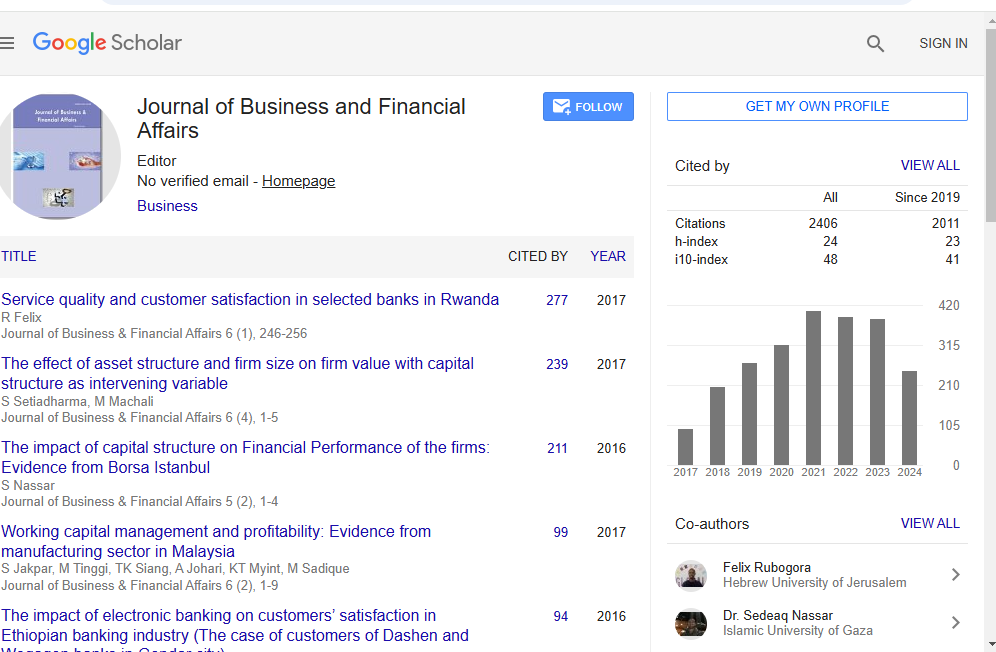
Journal of Business & Financial Affairs received 1726 citations as per Google Scholar report