Perspective - (2025) Volume 14, Issue 4
Received: 03-Aug-2025, Manuscript No. jnc-25-173962;
Editor assigned: 05-Aug-2025, Pre QC No. P-173962;
Reviewed: 19-Aug-2025, QC No. Q-173962;
Revised: 25-Aug-2025, Manuscript No. R-173962;
Published:
30-Aug-2025
, DOI: 10.37421/2167-1168.2025.14.722
Citation: Wei, Lin. ”Building a Resilient Global Nursing Workforce.” J Nurs Care 14 (2025):721.
Copyright: © 2025 Wei L. This is an open-access article distributed under the terms of the Creative Commons Attribution License, which permits unrestricted use, distribution and reproduction in any medium, provided the original author and source are credited.
The global nursing shortage presents a significant challenge to healthcare systems worldwide, demanding comprehensive and strategic interventions. This complex issue is driven by multiple interconnected factors, making a holistic approach essential rather than relying on quick fixes [1].
One key aspect is the need to retain nurses, particularly in challenging environments like rural and remote healthcare settings. Effective retention in these areas needs more than just financial incentives; it requires professional development, strong community integration, and robust support systems to keep nurses engaged and practicing in underserved regions [2].
A major exacerbating factor in the current crisis is nurse burnout, a problem that intensified significantly during the COVID-19 pandemic. The severe impact of burnout on the nursing workforce and patient care cannot be overstated. Let's break it down: ignoring burnout fuels the shortage, jeopardizing healthcare systems entirely, thus underscoring the urgent need for healthcare organizations and policymakers to implement interventions that support nurses' well-being and prevent attrition [3].
Various factors contribute to the nursing shortage across different countries, including inadequate compensation, challenging work environments, a lack of clear career progression pathways, and an aging nursing population. Here's the thing: the shortage isn't a single problem, but a complex web of interconnected issues, meaning solutions must be carefully tailored to specific regional contexts while consistently addressing these common underlying problems [4].
Nurse migration also plays a substantial role, acting as a significant factor in global health workforce planning and often perpetuating nursing shortages in source countries. What this really means is uncontrolled nurse migration can deepen existing shortages, especially in developing nations, highlighting the need for robust policies to manage international nurse mobility effectively and ethically [5].
To counter this, strategies aimed at increasing nursing student enrollment capacity are crucial. Effective approaches for boosting the pipeline of new nurses include expanding faculty, leveraging technology, and improving clinical placement opportunities. The core idea is that we need to actively grow the number of graduating nurses to meet future demand [6].
Beyond enrollment, the global nursing workforce faces multifaceted challenges, including resource limitations, significant demographic shifts, and the profound impact of health crises like pandemics. Understanding these challenges is the first step toward building a resilient global nursing workforce. This requires robust workforce planning, substantial investment in education, and the creation of supportive work environments to sustain the nursing profession worldwide [7].
Furthermore, the detrimental effects of inadequate nurse staffing are starkly evident on both nurses and patient outcomes. What this really means is that insufficient nurse numbers aren't just an inconvenience; they directly compromise the quality and safety of care, revealing a clear link between low staffing levels and increased nurse burnout, dissatisfaction, and adverse patient events, including higher mortality rates [8].
To address these systemic issues, innovative strategies are being implemented to tackle the nursing shortage. These focus on solutions like enhanced academic-practice partnerships, sophisticated technology integration, and the development of new care delivery models. Let's break it down: we can't solve an evolving problem with outdated methods, suggesting that creative and adaptable approaches are necessary to build a sustainable nursing workforce for the future [9].
Finally, reforming nursing education plays a critical role in addressing the ongoing shortage. The core idea is that a stronger educational foundation is essential to producing more and better-equipped nurses, necessitating curricula updates, increased clinical training opportunities, and dedicated faculty development to prepare a robust and adaptable workforce for future healthcare demands [10].
These multifaceted efforts collectively aim to mitigate the pervasive and complex challenges facing the global nursing profession.
The persistent global nursing shortage is a complex issue driven by an array of factors that demand comprehensive and coordinated solutions. One of the primary drivers is an an aging workforce combined with insufficient educational capacity and often poor working conditions [1]. Addressing this scarcity requires a holistic view, moving beyond simple fixes to implement policy reforms, improve retention strategies, and enhance recruitment efforts across various levels of healthcare systems [1].
Retaining nurses, especially in underserved regions, presents unique challenges. In rural and remote healthcare settings, simply offering financial incentives often proves insufficient. Instead, effective retention hinges on providing robust professional development opportunities, fostering strong community integration for nurses, and establishing adequate support systems to ensure they feel valued and sustained in these challenging environments [2]. This proactive approach helps to stabilize the workforce where it is most needed. Moreover, the severe impact of nurse burnout, significantly worsened by the COVID-19 pandemic, has become a critical concern. Ignoring burnout fuels the shortage, jeopardizing the integrity of healthcare systems entirely, thus creating an urgent call for healthcare organizations and policymakers to implement interventions that actively support nurses' well-being and prevent attrition [3].
The contributing factors to the nursing shortage are diverse and span across different countries, encompassing inadequate compensation, challenging work environments, a notable lack of career progression opportunities, and an overall aging nursing population. The takeaway here is that the shortage isn't a single problem but a complex web of interconnected issues. This means solutions must be meticulously tailored to specific regional contexts, even while addressing these common underlying problems that affect nursing globally [4]. Another significant aspect is nurse migration, which acts as a key factor in global health workforce planning and can perpetuate shortages in source countries. Uncontrolled nurse migration can deepen existing shortages, especially in developing nations, highlighting the crucial need for robust policies to manage international nurse mobility both effectively and ethically [5].
To counteract these trends, increasing nursing student enrollment capacity is a direct and vital response. Strategies such as expanding faculty numbers, leveraging technology for remote learning or simulation, and improving clinical placement opportunities are essential to boost the pipeline of new nurses. The core idea is that we need to actively grow the number of graduating nurses to meet future demand and build a sustainable workforce for the future [6]. Beyond recruitment, the global nursing workforce confronts multifaceted challenges including resource limitations, ongoing demographic shifts, and the profound impact of health crises like pandemics. Understanding these challenges is the first step toward building a resilient global nursing workforce, which necessitates robust workforce planning, strategic investment in education, and the creation of consistently supportive work environments worldwide [7].
Furthermore, the impact of inadequate nurse staffing is profoundly detrimental to both nurses and patient outcomes. What this really means is that insufficient nurse numbers aren't just an inconvenience; they directly compromise the quality and safety of care. There is a clear and alarming link between low staffing levels and increased nurse burnout, heightened dissatisfaction, and a rise in adverse patient events, including higher mortality rates [8].
In response to these pervasive issues, various innovative strategies are being implemented. These include enhanced academic-practice partnerships, strategic technology integration into care delivery, and the development of entirely new care models. Let's break it down: we can't solve an evolving problem with outdated methods. Creative and adaptable approaches are absolutely necessary to build a sustainable nursing workforce for the future [9]. Finally, reforming nursing education is a critical component in addressing the ongoing nursing shortage. The core idea is that a stronger educational foundation is essential to producing more and better-equipped nurses, calling for continuous curricula updates, increased clinical training opportunities, and dedicated faculty development to prepare a robust and adaptable workforce ready for future healthcare demands [10]. These collective efforts signify a concerted global push to stabilize and strengthen the nursing profession.
The global nursing shortage is a pressing and complex crisis stemming from an aging workforce, insufficient educational capacity, and often poor working conditions, further exacerbated by widespread nurse burnout and uncontrolled international migration. Addressing this scarcity demands multi-faceted, comprehensive strategies that include robust policy reforms, significantly improved retention initiatives, and enhanced recruitment efforts across all healthcare sectors. Retaining nurses, particularly in challenging rural and remote areas, goes beyond mere financial incentives, relying heavily on professional development opportunities, strong community integration, and adequate support systems. Critically, tackling nurse burnout is paramount to prevent mass attrition and to safeguard the stability of entire healthcare systems. The shortage is not a monolithic problem but rather a complex web of interconnected factors, such as inadequate compensation, demanding work environments, and a lack of clear career progression, necessitating solutions that are tailored to specific regional contexts. Managing nurse migration ethically is also crucial to avoid deepening existing shortages in source countries. To boost the future supply of nurses, increasing student enrollment capacity through faculty expansion, leveraging technology, and improving clinical placement opportunities is essential. The detrimental effects of inadequate nurse staffing are profound, directly compromising patient safety and leading to increased nurse burnout and dissatisfaction. Ultimately, innovative solutions, including enhanced academic-practice partnerships, strategic technology integration, new care delivery models, and significant reforms in nursing education, encompassing curricula updates and faculty development, are all necessary to cultivate a resilient and sustainable global nursing workforce ready for future demands.
None
None
1. Khalid A, Fahad A, Abdullah A. "Addressing the global nursing shortage: A call for comprehensive strategies".J Nurs Manag 31 (2023):3676-3682.
Indexed at, Google Scholar, Crossref
2. Renee C, David L, Kathy C. "Strategies for retaining nurses in rural and remote areas: A systematic review".Int J Nurs Stud 133 (2022):104273.
Indexed at, Google Scholar, Crossref
3. Karen H, Julie H, Robert GH. "Nurse burnout and the COVID-19 pandemic: An urgent call to action".Nurs Outlook 69 (2021):58-69.
Indexed at, Google Scholar, Crossref
4. Nomalizo S, Nqobile C, Fungai M. "Factors influencing the nursing shortage in selected countries: A systematic review".BMC Nurs 19 (2020):105.
Indexed at, Google Scholar, Crossref
5. Hridi S, Sarah VB, Lien VDW. "Nurse migration and health workforce planning: A scoping review".J Adv Nurs 79 (2023):4578-4592.
Indexed at, Google Scholar, Crossref
6. Daniel B, Jennifer LM, Jessica H. "Increasing nursing student enrollment capacity to address the nursing shortage: A systematic review".J Prof Nurs 42 (2022):1-13.
Indexed at, Google Scholar, Crossref
7. Vari MD, Mary C, Sumith DZ. "The challenges facing the global nursing workforce: A scoping review".J Nurs Manag 31 (2023):3824-3837.
Indexed at, Google Scholar, Crossref
8. Sanghee S, Min AK, Jung HK. "The impact of inadequate nurse staffing on nurse and patient outcomes: A systematic review".Appl Nurs Res 61 (2021):151478.
Indexed at, Google Scholar, Crossref
9. Carol SB, Ilene LF, Christine TK. "Innovative solutions to the nursing shortage: A review of strategies".Nurs Admin Q 47 (2023):350-362.
Indexed at, Google Scholar, Crossref
10. Rania G, Ahmad H, Mohamed A. "Reforming nursing education to address the nursing shortage: A systematic review".Nurse Educ Today 93 (2020):104523.
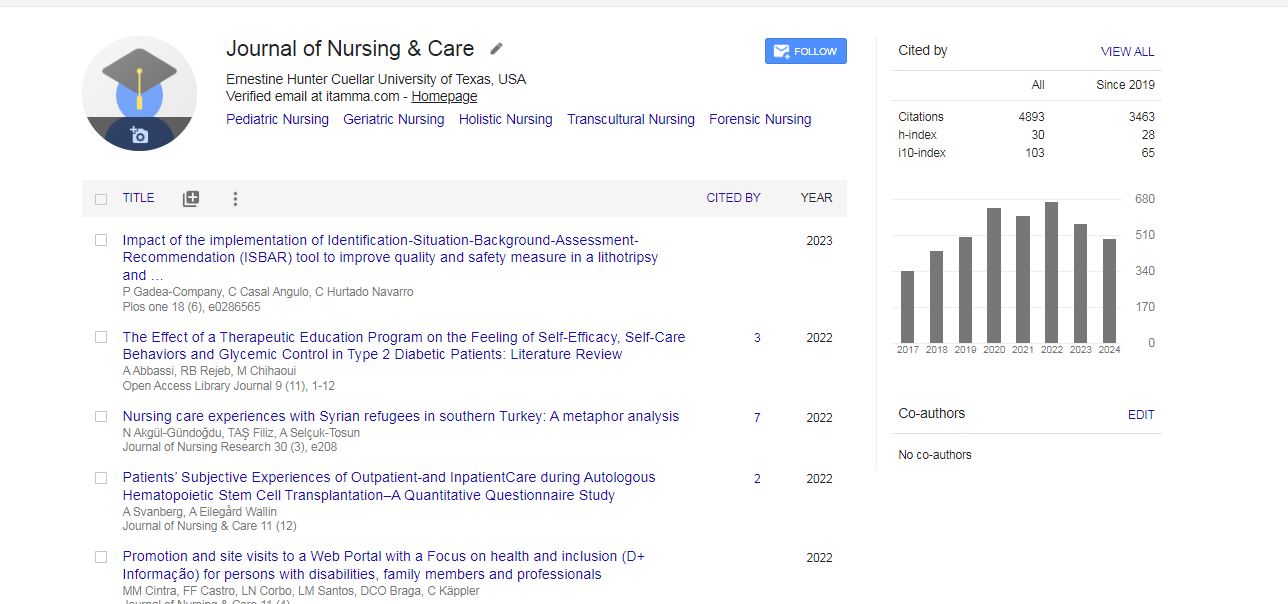
Journal of Nursing & Care received 4230 citations as per Google Scholar report