Commentary - (2025) Volume 15, Issue 4
Received: 31-Jul-2025, Manuscript No. jmcj-25-176895;
Editor assigned: 04-Aug-2025, Pre QC No. P-176895;
Reviewed: 18-Aug-2025, QC No. Q-176895;
Revised: 21-Aug-2025, Manuscript No. R-176895;
Published:
28-Aug-2025
, DOI: 10.37421/2165-7912.2025.15.630
Citation: Meyer, Tobias R. Broadcasting's Digital Future: Adapting, Innovating. J Mass Communicat Journalism 15(2025):630.
Copyright: © 2025 Meyer R. Tobias This is an open-access article distributed under the terms of the Creative Commons Attribution License, which permits unrestricted use, distribution and reproduction in any medium, provided the original author and source are credited.
The dramatic shift to digital platforms has initiated a significant re-evaluation among public service broadcasters globally, compelling them to strategically adapt to stay relevant and uphold their public value. This transformation involves a cross-national analysis, dissecting the varied innovative approaches and audience engagement tactics these organizations are implementing to navigate a fragmented digital media landscape [1].
Concurrently, understanding audience interaction with news content extends far beyond conventional broadcast channels to encompass social media platforms. This inquiry moves past traditional consumption views, uncovering the dynamic and participatory nature of engagement in the digital age and revealing distinct interaction patterns shaped by platform affordances and diverse user motivations [2].
It's clear that trust in traditional news media plays a significant role in how individuals confront and process online misinformation. This research demonstrates that even as digital platforms become inundated with false information, a fundamental trust in established broadcasters can serve as a crucial filtering mechanism, significantly influencing whether individuals accept or reject misleading narratives [3].
Furthermore, the growing presence of Artificial Intelligence (AI) in journalism is a phenomenon undergoing extensive review. This systematic analysis synthesizes existing research to precisely map out how AI tools are being integrated into various newsroom operations, including critical broadcast functions. These applications span content generation, personalization, and fact-checking, which naturally brings to light profound implications for both journalistic practice and ethical considerations within the field [4].
The complex landscape of local news presents unique challenges and promising opportunities, particularly for local broadcast television news. This involves a close examination of persistent economic pressures, the observable changes in audience habits, and the continuous rise of digital competitors. The study also identifies actionable strategies and innovative pathways local stations can pursue to sustain their vital community role within their communities [5].
What this really means is that the widespread proliferation of streaming services is profoundly altering the traditional broadcast television landscape in fundamental ways. Through an intricate audience segmentation analysis, this research meticulously illustrates how different viewer groups are actively shifting their consumption habits, indicating a substantial migration away from conventional linear broadcast content toward more flexible, on-demand digital alternatives. This profound shift invariably challenges traditional broadcasters to urgently adapt their core strategies and business models [6].
Media policy plays a truly critical role in shaping the long-term future of public service broadcasting amidst the digital transformation. This comprehensive paper underscores the significant challenges presented by dominant global platforms and the ongoing evolution of consumption patterns. At the same time, it thoughtfully points to emerging opportunities for public broadcasters to fundamentally redefine their mandate and explore innovative delivery mechanisms through the strategic implementation of new policy frameworks [7].
Meanwhile, the exciting world of innovations in sports broadcasting continues to evolve at a rapid pace. This research meticulously details how cutting-edge technologies are being adopted and integrated to significantly enhance both the production processes and the overall audience experience of major sports events. These advancements range from highly immersive viewing technologies to sophisticated advanced data analytics, all working in concert to fundamentally transform how fans engage with their favorite sports [8].
Let's break it down: traditional broadcasters are increasingly navigating the dynamic and expansive podcasting boom. This specific study examines how radio stations, in particular, are adapting their strategic approaches, content creation methodologies, and distribution models. The goal is to effectively integrate podcasting into their existing offerings, thereby successfully reaching new and diverse audiences and evolving seamlessly with the rapidly changing trends in audio media consumption [9].
Finally, broadcast journalists face an intricate ethical minefield within today's exceptionally rapid digital news cycle. This article thoroughly dissects the ongoing tension between the imperative to maintain objectivity, the complex task of managing inherent implicit biases, and the intense, often overwhelming, pressure to deliver news at lightning speed. It ultimately underscores the enduring relevance and critical importance of established ethical principles within a perpetually evolving and fast-paced media environment [10].
The broadcasting industry finds itself at a critical juncture, navigating a profound digital transformation that compels public service broadcasters (PSBs) to strategically reassess their core operations and public value proposition. This extensive shift is meticulously documented through a cross-national analysis, which illuminates the varied, innovative responses PSBs are implementing across different countries to maintain relevance and effectively deliver public value within an increasingly fragmented digital media landscape [1]. Here's the thing: robust media policy emerges as a truly critical determinant in shaping the long-term future of these vital institutions. Policy frameworks must adeptly address the significant challenges posed by global digital platforms and the constantly evolving consumption patterns of audiences, while simultaneously identifying and fostering new opportunities for public broadcasters to fundamentally redefine their mandate and delivery mechanisms through progressive, forward-thinking approaches [7]. Parallel to this, traditional broadcasters, particularly those in radio, are actively navigating the expansive podcasting boom. This involves a crucial adaptation of their strategic approaches, content creation methodologies, and distribution models to seamlessly integrate podcasting into their existing offerings, thereby successfully reaching new and diverse audiences and evolving in harmony with contemporary audio media consumption trends [9].
Audience engagement with news content has dramatically expanded beyond the confines of traditional broadcast channels, now heavily integrating social media platforms as primary touchpoints. This evolution underscores a dynamic, participatory nature of engagement prevalent in the digital age, with distinct patterns of interaction clearly emerging based on specific platform affordances and the underlying motivations of users [2]. What this really means is that the widespread proliferation of streaming services is fundamentally altering the traditional broadcast television landscape in a transformative manner. Through a detailed audience segmentation analysis, this research convincingly demonstrates a significant migration of diverse viewer groups away from conventional linear broadcast content towards more flexible, on-demand digital alternatives. This profound shift presents a formidable challenge to traditional broadcasters, compelling them to urgently adapt their core strategies and business models to remain competitive and relevant [6]. Furthermore, trust in traditional news media continues to play a pivotal and enduring role in how individuals actively encounter, interpret, and ultimately process misinformation online. Crucially, research consistently shows that even as digital platforms become increasingly rife with false or misleading information, a baseline level of trust in established broadcasters can function as a vital cognitive filter, significantly influencing whether individuals choose to accept or decisively reject misleading narratives presented to them [3].
Technology continues its relentless march, fundamentally reshaping journalistic practices with Artificial Intelligence (AI) playing an increasingly central and indispensable role. A systematic review meticulously maps out how various AI tools are being integrated into modern newsrooms, encompassing crucial broadcast operations. These advanced applications span a wide range of tasks, including sophisticated content generation, personalized content delivery, and rigorous fact-checking, directly addressing the multifaceted implications for both journalistic practice and pressing ethical considerations within the field [4]. This pervasive adoption of new technologies is not limited to news reporting; it extends vividly to innovations in sports broadcasting. Here, immersive viewing experiences and advanced data analytics are not merely supplementary but are actively enhancing both the production quality and the overall audience experience of major sports events, fundamentally transforming how fans engage with and consume their favorite sports [8].
Local news ecologies are grappling with a complex array of interconnected challenges and opportunities, particularly those impacting local broadcast television news. These encompass significant and persistent economic pressures, the observable and continuous shifts in audience habits, and the relentless rise of diverse digital competitors. Despite these formidable hurdles, the research also highlights clear, actionable pathways and innovative strategies local stations can pursue to not only survive but thrive, sustaining their vital community role and ensuring continued public service [5]. Amidst all these rapid technological and societal changes, broadcast journalists are faced with an intricate ethical minefield within today's exceptionally rapid digital news cycle. This critical area involves dissecting the ongoing tension between the imperative to maintain unwavering objectivity, the complex and continuous task of identifying and managing inherent implicit biases, and the intense, often overwhelming, pressure to deliver news at lightning speed. This collective predicament powerfully underscores the enduring relevance and critical importance of established ethical principles within a perpetually evolving and fast-paced media environment [10]. The convergence of these dynamic factors illustrates a highly complex and fluid media ecosystem where proactive adaptation, seamless technological integration, and unwavering adherence to ethical considerations are absolutely paramount for sustained relevance, public trust, and ultimately, the future viability of broadcasting.
The broadcasting industry is in the midst of a significant digital transformation, prompting public service broadcasters globally to adapt strategically to ensure relevance and deliver public value in a fragmented media landscape [1]. This includes rethinking their mandate through innovative policy frameworks [7] and, for radio, integrating podcasting to reach new audiences [9]. Audience behavior is also fundamentally changing. People are increasingly engaging with news on social media platforms [2] and shifting from linear broadcast television to on-demand streaming services, which profoundly challenges traditional broadcasters [6]. Interestingly, trust in established news media plays a crucial role in filtering misinformation online, with this baseline trust helping individuals discern false narratives [3]. Technology is driving further evolution in journalism. Artificial Intelligence is being integrated into newsrooms for content generation, personalization, and fact-checking, bringing new ethical considerations [4]. Similarly, sports broadcasting is adopting advanced technologies, from immersive viewing to data analytics, to enhance audience experiences [8]. Meanwhile, local broadcast television news grapples with economic pressures, changing habits, and digital competitors, yet opportunities for innovation exist to sustain its community role [5]. Throughout these shifts, broadcast journalists face ongoing ethical challenges, balancing objectivity, bias, and speed in the fast-paced digital news cycle, underscoring the enduring importance of ethical principles [10]. The overall picture is one of constant adaptation and innovation across all facets of broadcasting.
None
None
Eva-Maria J, Gregory F, Florian W. "The Digital Transformation of Public Service Broadcasting: A Cross-National Analysis of Strategic Responses".J Broadcast Electron Media 65 (2021):124-142.
Indexed at, Google Scholar, Crossref
Alice EM, Laura H, Amanda S. "Beyond the Broadcast: Examining Audience Engagement with News Content on Social Media Platforms".Communication Research 49 (2022):443-465.
Indexed at, Google Scholar, Crossref
Benjamin KJ, Eun HL, Jaeho C. "Trust in traditional news media and the consumption of misinformation in the digital age".Mass Commun Society 23 (2020):841-862.
Indexed at, Google Scholar, Crossref
Andreas G, Christian B, Alexander G. "Artificial intelligence in journalism: A systematic review of the literature".Journalism Practice 14 (2020):852-872.
Indexed at, Google Scholar, Crossref
Philip MN, Eunji K, Jessica SJ. "Local News Ecologies: Understanding the Challenges and Opportunities for Local Broadcast Television News".Int J Press/Politics 26 (2021):107-126.
Indexed at, Google Scholar, Crossref
Patrick RCvD, Marisa IO, Charlotte HvL. "The Impact of Streaming Services on Traditional Broadcast Television: An Audience Segmentation Analysis".Poetics 92 (2022):101654.
Indexed at, Google Scholar, Crossref
Gregory FL, Jeanette S, David G. "Media Policy and the Future of Public Service Broadcasting: Challenges and Opportunities in the Digital Age".Commun Culture Crit 13 (2020):1-17.
Indexed at, Google Scholar, Crossref
Andrew CB, Marie MH, Michael LB. "Innovations in Sports Broadcasting: Exploring the Adoption of New Technologies and Audience Experiences".Int J Sport Commun 14 (2021):1-15.
Indexed at, Google Scholar, Crossref
Jonas B, Tobias O, Mattias E. "From radio to podcast: How traditional broadcasters adapt to the podcasting era".Radio J Int Stud Broadcast Audio Media 18 (2020):221-236.
Indexed at, Google Scholar, Crossref
Stephen JAW, Chris R, Elly VE. "Ethical Challenges in Broadcast Journalism: Navigating Objectivity, Bias, and Speed in the Digital News Cycle".J Media Ethics 38 (2023):1-16.
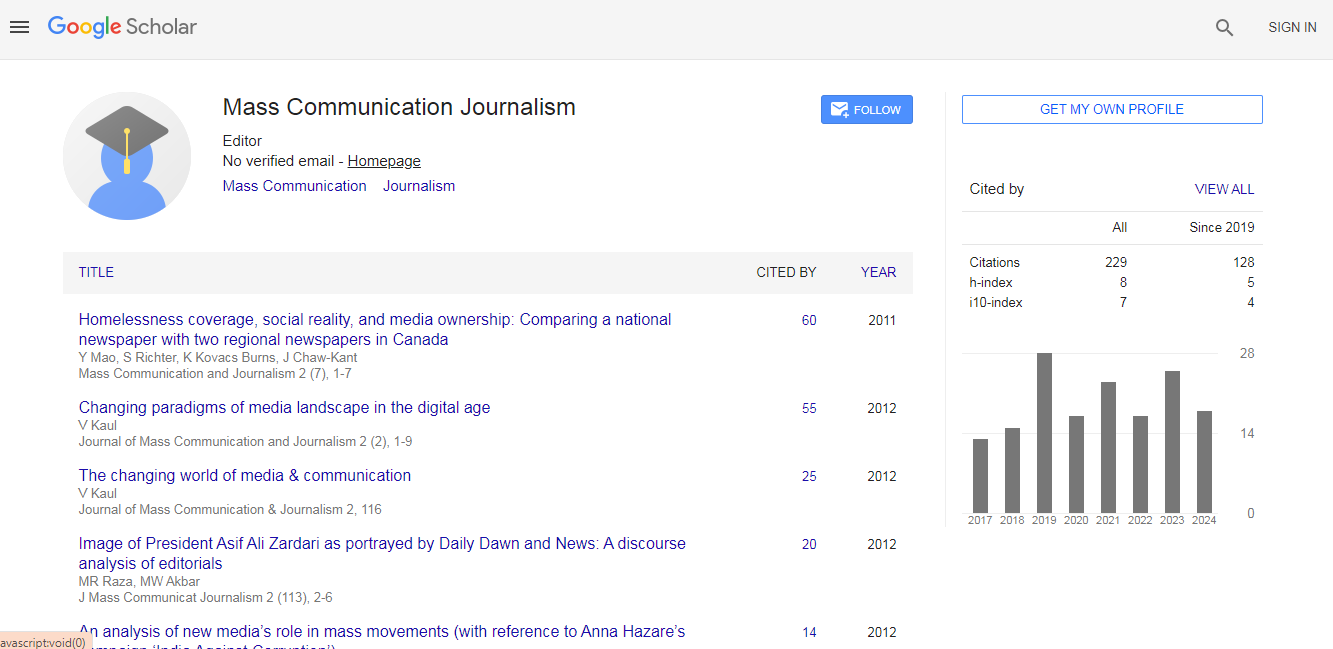
Journal of Mass Communication & Journalism received 205 citations as per Google Scholar report