Opinion - (2025) Volume 14, Issue 4
Received: 01-Jul-2025, Manuscript No. iem-26-179819;
Editor assigned: 03-Jul-2025, Pre QC No. P-179819;
Reviewed: 14-Jul-2025, QC No. Q-179819;
Revised: 22-Jul-2025, Manuscript No. R-179819;
Published:
29-Jul-2025
, DOI: 10.37421/2169- 0316.2025.14.313
Citation: Rahman, Mohamed Abdel. âBottleneck Resolution: Systems, Data, and Innovation.â J Ind Eng Manag 14 (2025):313.
Copyright: © 2025 Rahman A. Mohamed This is an open-access article distributed under the terms of the Creative Commons Attribution License, which permits unrestricted use, distribution and reproduction in any medium, provided the original author and source are credited.
The identification and subsequent elimination of bottlenecks within industrial systems is a practice of paramount importance for optimizing operational efficiency and overall performance. These systemic inefficiencies, often subtle and easily overlooked, can exert a significant drag on productivity, inflate costs, and impede the smooth functioning of complex industrial environments. A structured, data-driven approach is essential for pinpointing these constraints. [1] The interconnected nature of modern supply chains means that bottlenecks in one area can have cascading effects, disrupting the flow of goods and impacting numerous downstream processes. Quantifying the impact of these disruptions and fostering collaboration among stakeholders are key to resolving them effectively. [2] Advancements in Artificial Intelligence (AI) and Machine Learning (ML) are revolutionizing the way bottlenecks are detected and resolved. Novel algorithms can now analyze vast amounts of real-time operational data to identify anomalies indicative of constraints, offering predictive capabilities and optimized resource allocation. [3] Process simulation serves as a powerful tool for understanding and managing bottlenecks. By creating virtual models of industrial processes, engineers can experiment with different scenarios and assess the ripple effects of proposed solutions without disrupting live operations. [4] Lean Manufacturing principles, particularly the Theory of Constraints, offer a robust framework for bottleneck management. This methodology emphasizes identifying the single limiting factor in a system and optimizing its performance before addressing subsequent constraints. [5] In the complex domain of large-scale construction projects, bottleneck issues are frequently encountered due to intricate interdependencies. Proactive risk assessment and agile response mechanisms are crucial for identifying critical path constraints and mitigating their impact on project timelines and budgets. [6] Beyond technical solutions, human factors and organizational culture play a vital role in bottleneck management. A supportive work environment, clear communication, and a culture that encourages problem-solving are as critical as technological interventions for sustained improvement. [7] In service systems, such as healthcare and logistics, advanced analytics and data visualization tools are instrumental in uncovering hidden inefficiencies and bottlenecks. Developing methods for collecting and analyzing diverse data streams facilitates real-time monitoring and targeted interventions. [8] The integration of Internet of Things (IoT) sensors and edge computing offers a promising avenue for real-time bottleneck detection and management in smart factories. This approach enables immediate data capture and localized processing, leading to enhanced agility and efficiency in responding to operational constraints. [9] A comprehensive understanding of bottleneck analysis methodologies is essential for developing effective strategies. Existing approaches vary in their strengths and weaknesses, and continued research is needed to identify gaps and develop more integrated and dynamic solutions for bottleneck management. [10]
The critical practice of identifying and subsequently eliminating bottlenecks within industrial systems is explored in detail, emphasizing how hidden systemic inefficiencies can severely impact productivity, increase costs, and hinder overall operational performance. A structured, data-driven approach involving process mapping and the application of Lean and Six Sigma methodologies is presented as a means to pinpoint these constraints, with practical mitigation strategies like resource optimization and workflow redesign discussed. [1] Within the realm of supply chain operations, this paper meticulously examines how bottlenecks can manifest and disrupt the seamless flow of goods. It underscores the inherently interconnected nature of supply chains, illustrating how a constraint in one segment can propagate and affect subsequent processes. Analytical techniques for quantifying the severity of bottleneck impacts and insights into collaborative resolution strategies involving diverse stakeholders are proposed. [2] The application of Artificial Intelligence (AI) and Machine Learning (ML) in the identification and resolution of production bottlenecks is investigated. The research introduces novel algorithms capable of analyzing extensive operational data in real-time to detect anomalies that signal the presence of bottlenecks. Furthermore, it delves into how AI-driven solutions can facilitate optimized resource allocation and provide predictive insights into potential future constraints. [3] Process simulation is highlighted as a vital methodology for the identification and management of bottlenecks. By constructing virtual representations of industrial processes, engineers gain the ability to test various scenarios and comprehend the far-reaching consequences of implementing changes. This risk-free experimentation allows for the identification of optimal solutions to alleviate bottlenecks without causing disruptions to ongoing operations. [4] This paper delves into the application of Lean Manufacturing principles, specifically the Theory of Constraints, for identifying and addressing bottlenecks within repetitive manufacturing settings. It meticulously details the process of analyzing a system to locate its single limiting factor and subsequently optimizing its performance before progressing to the next constraint, supported by case study examples. [5] The study investigates bottleneck issues that commonly arise in large-scale construction projects, a sector characterized by complex interdependencies. A framework is proposed for pinpointing critical path constraints and managing their detrimental effects on project timelines and budgets, stressing the importance of proactive risk assessment and adaptable response mechanisms. [6] The influence of human factors and organizational culture on the effective identification and resolution of bottlenecks is examined. The article posits that while technical solutions are indispensable, a supportive work environment and clear communication channels are equally crucial for achieving sustained improvements. Recommendations are provided for cultivating a culture that champions problem-solving and continuous enhancement. [7] This paper concentrates on the utilization of advanced analytics and sophisticated data visualization tools for the identification of bottlenecks within intricate service systems, such as those found in healthcare or logistics. It outlines methodologies for the collection and analysis of diverse data streams to uncover latent inefficiencies, and proposes strategies for real-time monitoring and timely intervention. [8] The research explores the integration of Internet of Things (IoT) sensors and edge computing for the real-time detection and management of bottlenecks in smart factory environments. By enabling immediate data capture and localized processing, the proposed system can swiftly identify and respond to operational constraints, thereby significantly enhancing both agility and overall efficiency. [9] This article presents a systematic literature review focused on bottleneck analysis methodologies employed within industrial systems. It categorizes existing approaches, critically discusses their respective strengths and weaknesses, and identifies key areas requiring further research. The authors provide a roadmap for future investigations, emphasizing the necessity for more integrated and dynamically responsive bottleneck management solutions. [10]
This compilation addresses the critical issue of bottlenecks in industrial and operational systems. It highlights various methodologies for identifying and resolving these constraints, ranging from traditional Lean and Six Sigma approaches to advanced techniques like Artificial Intelligence, Machine Learning, and process simulation. The importance of data-driven analysis, supply chain interdependencies, and human factors is emphasized. The research also covers applications in specific sectors like manufacturing, construction, and service systems, and explores innovative solutions using IoT and edge computing. The overarching goal is to improve efficiency, reduce costs, and enhance overall performance through effective bottleneck management.
None
None
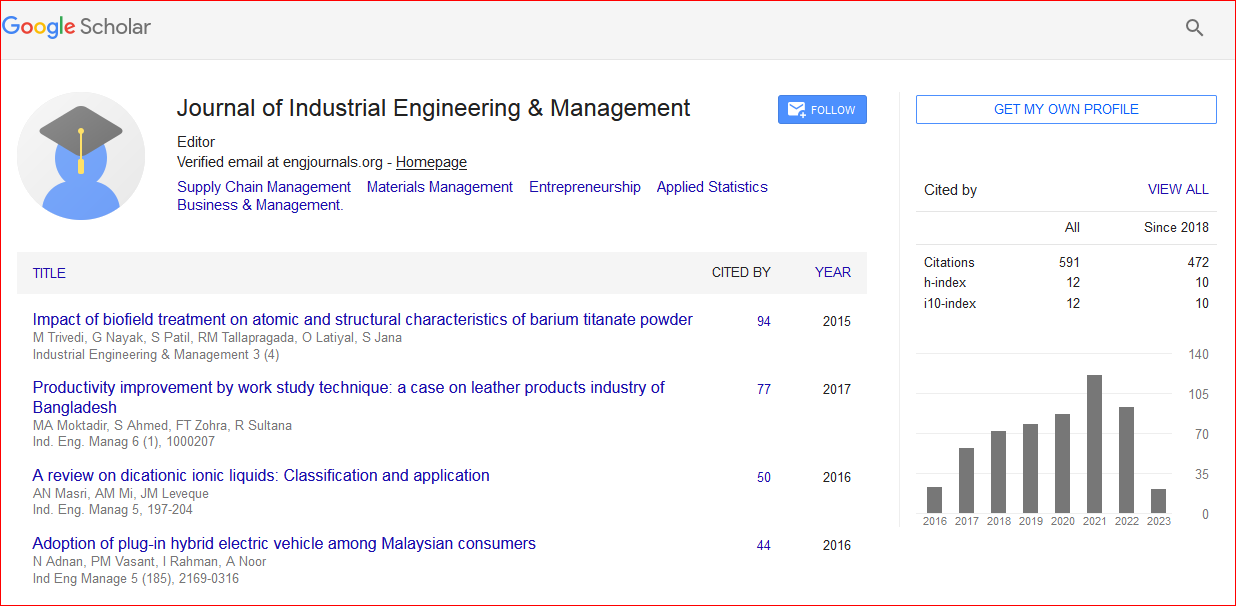
Industrial Engineering & Management received 739 citations as per Google Scholar report