Short Communication - (2025) Volume 9, Issue 2
Received: 04-Mar-2025, Manuscript No. jma-25-172685;
Editor assigned: 06-Mar-2025, Pre QC No. P-172685;
Reviewed: 20-Mar-2025, QC No. Q-172685;
Revised: 25-Mar-2025, Manuscript No. R-172685;
Published:
31-Mar-2025
, DOI: 10.37421/2684-4265.2025.09.376
Citation: Sofia G. Petrova. ”Bone Morphology: Evolution, Health, Function, Disease.” J Morphol Anat 09 (2025):376.
Copyright: © 2025 P. G. Sofia This is an open-access article distributed under the terms of the Creative Commons Attribution License, which permits unrestricted use, distribution and reproduction in any medium, provided the original author and source are credited.
Understanding bone morphology, its intricate internal structure, and how these factors change over time and in response to various influences is a cornerstone of skeletal biology. Here's the thing, recent studies have begun to unravel the complexities, from age-related changes to evolutionary adaptations and disease impacts. For instance, a detailed micro-computed tomography study on human vertebral bodies explores how their morphology and internal bone structure transform with age. These findings underscore age-related deterioration in bone microarchitecture, which is crucial for understanding spinal health and age-related skeletal disorders. It offers insights into specific structural changes that contribute to vertebral fragility [1].
What this really means is, the functional aspects of bone are deeply intertwined with its form. A comprehensive review provides an overview of how bone morphology serves its functional roles, discussing various current methods and future research directions. It emphasizes the complex interplay between bone structure and its mechanical properties, highlighting the importance of understanding this relationship for biomechanical research and clinical applications [2].
The evolutionary trajectory of skeletal structures also offers a broad perspective on current forms. This article delves into the evolutionary history of the vertebrate skeleton, exploring how different morphological forms have arisen and adapted over time. It reviews key principles of skeletal evolution, offering a framework for understanding the diversity and constraints of skeletal structures across different vertebrate lineages [3].
Forces applied to bones significantly shape their development and maintenance. For example, mechanical loading is a major factor in determining skeletal morphology and bone microstructure in land vertebrates. This paper synthesizes current knowledge on how forces applied to bones influence their shape and internal architecture, revealing fundamental principles of bone adaptation to mechanical environments [4].
Beyond external forces, developmental pathways are equally important. This article explores the developmental origins of variations in skeletal morphology, discussing how early developmental processes contribute to the diverse forms observed in adult skeletons. It emphasizes the implications of these developmental pathways for understanding evolutionary changes and phenotypic plasticity [5].
Skeletal health conditions, such as osteoporosis, profoundly affect bone structure. An update on bone microarchitecture and morphology in osteoporosis explains how this condition alters the internal structure and overall shape of bones, making them more fragile. It summarizes current understanding of these changes and their impact on bone strength, offering crucial insights for diagnosis and treatment strategies [6].
To elaborate, osteoporosis severely impacts the trabecular bone's morphology, as detailed in a systematic review. It consolidates findings from various studies, illustrating how the porous internal structure of bones changes, contributing to increased fracture risk. This synthesis is valuable for understanding the disease's skeletal manifestations [7].
The specific characteristics of bone can also vary significantly based on individual biological factors. This study identifies sex-specific differences in the morphology and microarchitecture of long bones in mice across different ages. The findings highlight crucial variations that could influence bone disease susceptibility and responses to treatments, providing an important animal model for understanding human skeletal biology [8].
Let's break it down: both genetic makeup and environmental factors profoundly influence skeletal morphology and its biomechanical properties. This article highlights the complex interplay that shapes bone structure and function, impacting bone health and disease susceptibility [9].
Furthermore, morphological adaptations are central to understanding locomotion. This study examines morphological variations in the appendicular skeleton and their significance for understanding the evolution of locomotion in primates. It provides insights into how skeletal adaptations correlate with different forms of movement, shedding light on the evolutionary pathways that led to the diverse locomotor behaviors seen in primates [10].
These diverse studies collectively highlight the dynamic and multifaceted nature of bone morphology across biological scales and contexts.
Bone morphology and microarchitecture are fundamental to understanding both the healthy function and pathological conditions of the skeletal system. Research consistently demonstrates how bone structure is dynamic, adapting to internal and external cues. For example, studies extensively explore age-related changes in the human vertebral body, revealing significant deterioration in bone microarchitecture that directly contributes to spinal fragility and age-related skeletal disorders [1]. This age-related decline underscores the importance of understanding specific structural alterations at the micro-level to inform clinical interventions and improve spinal health, particularly in an aging population.
The functional roles of bone morphology are complex and critical for understanding biomechanics and clinical applications. Various approaches emphasize the intricate interplay between bone structure and its mechanical properties, providing a comprehensive overview of how form dictates function and suggesting future research directions [2]. Beyond individual function, the evolutionary history of the vertebrate skeleton offers a broad framework, detailing how diverse morphological forms have emerged and adapted over geological timescales. This perspective is vital for grasping the extensive diversity and inherent constraints observed in skeletal structures across different vertebrate lineages [3]. Such evolutionary studies provide context for understanding current bone forms.
External influences like mechanical loading are pivotal in shaping skeletal morphology. Here's the thing, data shows that forces applied to bones fundamentally influence their shape and internal architecture in land vertebrates, illuminating key principles of bone adaptation to specific mechanical environments [4]. This adaptive capacity is not solely post-developmental; early developmental processes are crucial determinants of variations in adult skeletal morphology, with significant implications for evolutionary change and phenotypic plasticity [5]. These developmental origins underline how inherent biological programming sets the stage for later structural diversity, impacting how individuals respond to environmental pressures throughout their lives.
Skeletal pathologies like osteoporosis provide stark examples of how altered morphology leads to impaired function and increased fragility. Osteoporosis, for instance, markedly modifies bone microarchitecture and overall morphology, rendering bones more susceptible to fracture [6]. This condition particularly impacts the trabecular bone, where a systematic review confirms significant changes in its porous internal structure, directly contributing to heightened fracture risk and compromising bone strength [7]. Understanding these disease-specific morphological changes is paramount for advancing diagnostic methods and developing effective treatment strategies that target specific structural deficiencies.
Furthermore, intrinsic factors like sex and genetic predispositions also play substantial roles in determining skeletal characteristics. Studies have identified notable sex-specific differences in the morphology and microarchitecture of long bones in mice across different ages, offering valuable insights into human skeletal biology and potential variations in disease susceptibility and treatment responses [8]. Let's break it down: both genetic makeup and environmental factors collectively influence skeletal morphology and its biomechanical properties, highlighting a complex interplay that affects overall bone health and vulnerability to disease [9]. This comprehensive view suggests that bone structure is a product of multiple interacting forces.
Finally, the appendicular skeleton provides clues for evolutionary insights. Its morphological variations are instrumental in understanding the evolution of locomotion in primates, showing distinct correlations between skeletal adaptations and diverse movement patterns. This sheds light on the evolutionary pathways that have shaped primate locomotor behaviors [10]. This collective body of work illustrates that bone morphology is a multifaceted field, integrating developmental biology, evolutionary science, biomechanics, and clinical research to provide a holistic understanding of skeletal form and function.
Bone morphology, its internal structure, and microarchitecture are central to understanding skeletal biology, health, and evolution. Research reveals age-related deterioration in human vertebral bodies, highlighting structural changes that contribute to fragility and spinal disorders. The functional roles of bone morphology are complex, with significant interplay between structure and mechanical properties, which is crucial for biomechanical research and clinical applications. Evolutionary studies show how diverse morphological forms of the vertebrate skeleton have arisen and adapted over time, influenced by fundamental principles of skeletal evolution. Mechanical loading is a key factor, actively shaping bone structure and internal architecture in land vertebrates, demonstrating bone's adaptive capacity to its environment. Developmental processes also play a critical role, contributing to the wide variations seen in adult skeletons and influencing evolutionary changes and phenotypic plasticity. Osteoporosis significantly impacts bone, altering its internal structure and overall shape, making bones fragile and increasing fracture risk. This condition specifically affects trabecular bone morphology, a porous internal structure essential for bone strength. Furthermore, studies identify sex-specific differences in long bone morphology and microarchitecture, which can affect disease susceptibility and treatment responses. Both genetic makeup and environmental factors are acknowledged as profound influences on skeletal morphology and its biomechanical properties, shaping bone health. Finally, morphological variations in the appendicular skeleton provide insights into the evolution of locomotion in primates, showing how skeletal adaptations correlate with different forms of movement.
None
None
Indexed at, Google Scholar, Crossref
Indexed at, Google Scholar, Crossref
Indexed at, Google Scholar, Crossref
Indexed at, Google Scholar, Crossref
Indexed at, Google Scholar, Crossref
Indexed at, Google Scholar, Crossref
Indexed at, Google Scholar, Crossref
Indexed at, Google Scholar, Crossref
Indexed at, Google Scholar, Crossref
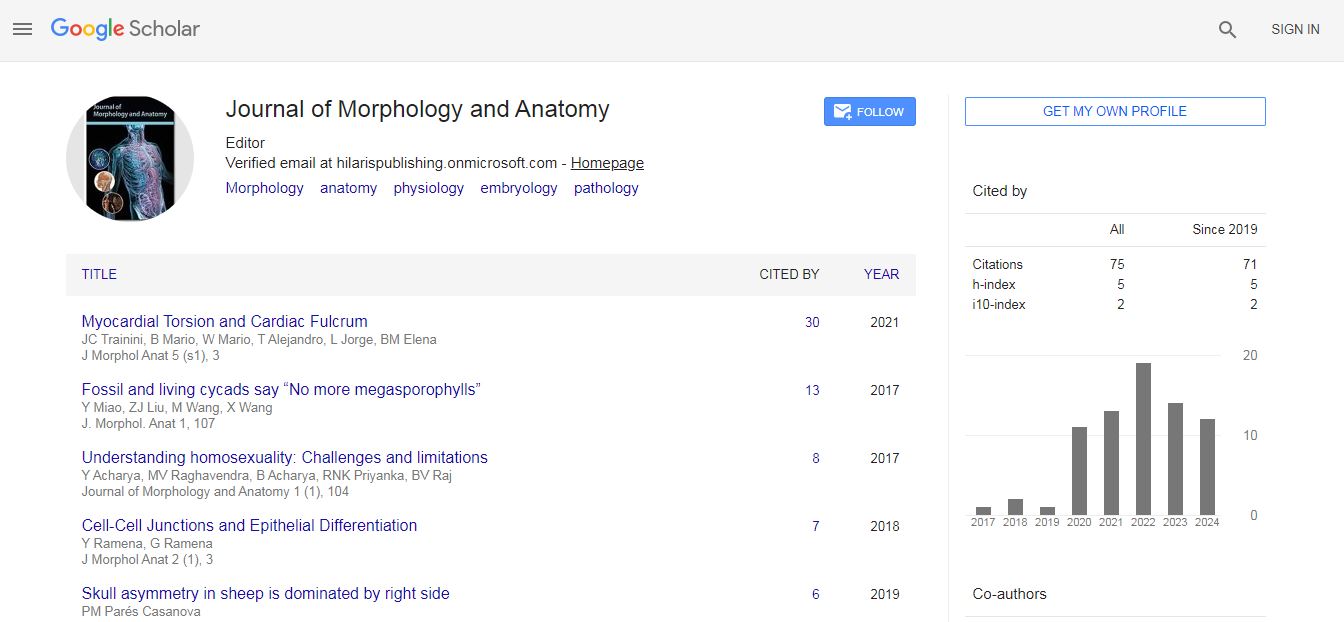
Journal of Morphology and Anatomy received 63 citations as per Google Scholar report