Commentary - (2025) Volume 14, Issue 4
Received: 01-Aug-2025, Manuscript No. jbfa-25-176808;
Editor assigned: 04-Aug-2025, Pre QC No. P-176808;
Reviewed: 18-Aug-2025, QC No. Q-176808;
Revised: 22-Aug-2025, Manuscript No. R-176808;
Published:
29-Aug-2025
, DOI: 10.37421/2167-0234.2025.14.542
Citation: Moretti, Giulia. ”Blockchain: Transforming Finance, Opportunities, Challenges.” J Bus Fin Aff 14 (2025):542.
Copyright: © 2025 Moretti G. This is an open-access article distributed under the terms of the Creative Commons Attribution License, which permits unrestricted use, distribution and reproduction in any medium, provided the original author and source are credited.
The financial sector is currently undergoing significant transformation, driven by the emergence of distributed ledger technologies, most notably blockchain. Decentralized Finance (DeFi) is viewed as a transformative force in financial services, poised to disrupt traditional banking through blockchain-enabled protocols. This movement promises greater financial inclusion, transparency, and efficiency, yet it also contends with considerable risks such as regulatory uncertainty, smart contract vulnerabilities, and systemic instability [1].
Blockchain technology's broader impact extends across financial markets, where it is systematically analyzed for its effects on trading, clearing, settlement, and regulation. It is recognized for enhancing transparency, reducing operational costs, and accelerating transactions, thereby potentially democratizing access to financial services. However, critical challenges, including scalability issues, significant energy consumption, and the pressing need for robust regulatory frameworks to manage new forms of market risk, must be addressed [2].
Central Bank Digital Currencies (CBDCs) represent another new frontier for financial systems, offering potential benefits for monetary policy, financial stability, and payment systems. While CBDCs could significantly improve payment efficiency and financial inclusion, policymakers face tough choices regarding design, balancing benefits against challenges like privacy concerns, cybersecurity risks, and the potential for bank disintermediation [3].
Within corporate finance, blockchain technology provides a conceptual framework for new applications, including capital raising, supply chain finance, and corporate governance. Its inherent capabilities enhance transparency, reduce agency costs, and streamline financial operations. A comprehensive research agenda is proposed to explore the empirical implications, regulatory challenges, and strategic adoption of blockchain within this critical corporate landscape [4].
Moreover, blockchain is instrumental in facilitating sustainable finance. It enhances transparency and traceability in Environmental, Social, and Governance (ESG) reporting and green bond issuance, offering potential to verify impact metrics, streamline carbon credit trading, and promote ethical investments. Still, hurdles like regulatory compliance, interoperability, and the energy demands of certain consensus mechanisms need further development [5].
For financial risk management practices, blockchain technology offers notable enhancements. Its immutable, transparent, and distributed nature can significantly improve data integrity, reduce operational risks, and facilitate more efficient compliance and audit processes. Its applications span fraud detection, credit scoring, and supply chain finance, though it also introduces new risks, particularly smart contract vulnerabilities and scalability challenges that require careful attention [6].
Asset tokenization, enabled by blockchain, reviews regulatory implications, economic benefits, and technological frameworks. This process allows for fractional ownership, increased liquidity, and enhanced transparency for various asset classes. Addressing legal uncertainties and operational complexities necessitates adaptable regulatory responses to fully harness its potential while mitigating associated risks [7].
The environmental implications of blockchain technology, especially concerning proof-of-work systems, are a significant debate with direct relevance to the financial services industry's sustainability goals. This involves analyzing the trade-offs between blockchain's security and decentralization benefits against its considerable environmental footprint. There is a clear call for energy-efficient innovations and consideration of emerging consensus mechanisms to align with broader Environmental, Social, and Governance (ESG) objectives [8].
Blockchain technology also plays a crucial role in combating financial crime, including money laundering, terrorist financing, and fraud. Its transparent and immutable ledger can greatly enhance transaction traceability, improve due diligence processes, and enable more effective regulatory oversight. Nevertheless, challenges such as privacy concerns, the pseudo-anonymity of some cryptocurrencies, and the need for international cooperation are vital for developing comprehensive anti-financial crime strategies utilizing blockchain effectively [9].
Finally, the intersection of blockchain technology and crowdfunding is actively transforming fundraising for startups and projects. Decentralized platforms increase transparency, reduce intermediation costs, and enhance global reach for both investors and entrepreneurs. Yet, key challenges persist, including regulatory hurdles, platform scalability, and the paramount importance of investor protection in this nascent and rapidly evolving market [10].
These collective insights highlight blockchain's multifaceted role and its ongoing evolution within the global financial ecosystem.
Blockchain technology is fundamentally reshaping the financial industry, introducing both innovative opportunities and complex challenges across various domains. Decentralized Finance (DeFi) stands out as a significant disruptor, aiming to revolutionize traditional banking by offering enhanced financial inclusion, transparency, and efficiency through blockchain-enabled protocols. This transformative potential is tempered by risks such as regulatory uncertainty, vulnerabilities in smart contracts, and potential systemic instability [1]. Alongside this, Central Bank Digital Currencies (CBDCs) are gaining traction, explored for their capacity to improve payment efficiency and financial inclusion. Policymakers are meticulously evaluating different design models, weighing benefits against critical issues like privacy, cybersecurity, and the possibility of bank disintermediation [3].
The broader application of blockchain profoundly impacts financial markets. Systematic reviews highlight its ability to enhance transparency, significantly reduce costs, and accelerate transactions in processes like trading, clearing, and settlement, thereby democratizing access to financial services. However, these benefits are accompanied by challenges related to scalability, considerable energy consumption, and the imperative for robust regulatory frameworks to manage novel market risks [2]. Within corporate finance, blockchain offers a conceptual framework for new applications, including capital raising, supply chain finance, and corporate governance. Its inherent capabilities enhance transparency, reduce agency costs, and streamline financial operations [4]. Furthermore, blockchain serves as a powerful enabler for sustainable finance, enhancing transparency and traceability in Environmental, Social, and Governance (ESG) reporting and green bond issuance. Its capability to verify impact metrics and streamline carbon credit trading promotes ethical investments, despite ongoing challenges with regulatory compliance, interoperability, and the energy footprint of certain blockchain mechanisms [5].
Blockchain technology also plays a critical role in enhancing financial risk management practices. Its inherent immutability, transparency, and distributed nature contribute to improved data integrity, reduced operational risks, and more efficient compliance and audit processes. Applications range from fraud detection and credit scoring to supply chain finance. Yet, introducing new risks like smart contract vulnerabilities and scalability concerns requires careful consideration [6]. Asset tokenization leverages blockchain to enable fractional ownership, increase liquidity, and enhance transparency across a diverse array of asset classes. This innovation necessitates adaptable regulatory responses to navigate legal uncertainties and operational complexities, ensuring its full potential is realized while mitigating associated risks [7]. Crucially, blockchain's transparent, immutable ledger significantly aids in combating financial crime, including money laundering, terrorist financing, and fraud, by improving transaction traceability and regulatory oversight. Addressing privacy concerns, the pseudo-anonymity of some cryptocurrencies, and fostering international cooperation are essential for effective anti-financial crime strategies [9].
A significant point of discourse involves the energy consumption of blockchain technologies, particularly proof-of-work systems. This debate holds substantial implications for the financial services industry's sustainability objectives. There is an ongoing analysis of the trade-offs between blockchain's security and decentralization benefits versus its environmental footprint, pushing for energy-efficient innovations and new consensus mechanisms to align with broader Environmental, Social, and Governance (ESG) goals [8]. Beyond these, blockchain is revolutionizing crowdfunding by establishing decentralized platforms that increase transparency, reduce intermediation costs, and expand global reach for both investors and entrepreneurs. Nevertheless, challenges such as regulatory hurdles, platform scalability, and the vital importance of investor protection persist in this rapidly evolving market [10]. The collective body of research underscores blockchain's pervasive influence and its continuous evolution, signaling a shift towards more transparent, efficient, and inclusive financial ecosystems, albeit with persistent regulatory and technical hurdles to navigate.
Blockchain technology is fundamentally transforming various aspects of financial services. Decentralized Finance (DeFi) emerges as a significant force, aiming to disrupt traditional banking by offering greater financial inclusion, transparency, and efficiency through blockchain protocols, though it faces risks from regulation and smart contract vulnerabilities. Similarly, Central Bank Digital Currencies (CBDCs) are being explored for their potential to enhance payment efficiency and inclusion, alongside concerns about privacy and bank disintermediation. The broader impact of blockchain on financial markets includes improved transparency, reduced costs, and accelerated transactions in areas like trading, clearing, and settlement. Within corporate finance, blockchain offers ways to enhance capital raising, supply chain finance, and governance by improving transparency and reducing agency costs. It also plays a crucial role in sustainable finance, providing traceability for Environmental, Social, and Governance (ESG) reporting and green bonds, despite challenges like energy consumption. Financial risk management benefits from blockchainâ??s immutability and transparency, aiding fraud detection and compliance, while recognizing new risks like smart contract flaws. Asset tokenization leverages blockchain for fractional ownership and increased liquidity across various assets, necessitating adaptable regulatory frameworks. The environmental impact of blockchain, particularly proof-of-work systems, is a key concern, pushing for energy-efficient innovations. Finally, blockchain helps combat financial crime by enhancing transaction traceability and is revolutionizing crowdfunding by increasing transparency and global reach, though regulatory hurdles remain. This collection of research outlines both the profound opportunities and significant challenges blockchain presents across the financial ecosystem.
None
None
Indexed at, Google Scholar, Crossref
Indexed at, Google Scholar, Crossref
Indexed at, Google Scholar, Crossref
Indexed at, Google Scholar, Crossref
Indexed at, Google Scholar, Crossref
Indexed at, Google Scholar, Crossref
Indexed at, Google Scholar, Crossref
Indexed at, Google Scholar, Crossref
Indexed at, Google Scholar, Crossref
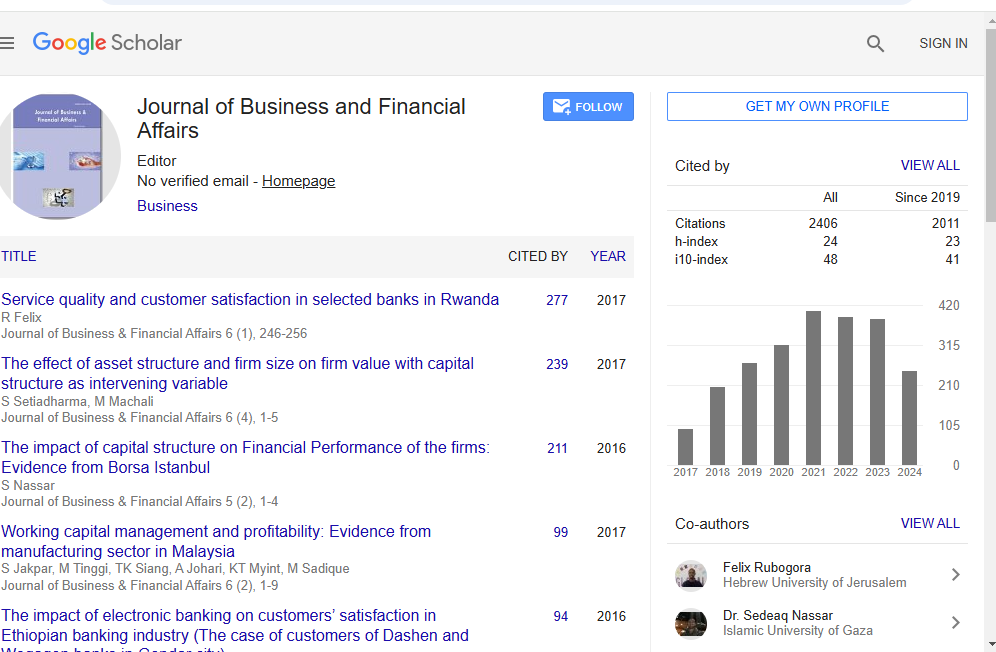
Journal of Business & Financial Affairs received 1726 citations as per Google Scholar report