Short Communication - (2025) Volume 16, Issue 4
Received: 31-Jul-2025, Manuscript No. gjto-25-176014;
Editor assigned: 04-Aug-2025, Pre QC No. P-176014;
Reviewed: 14-Aug-2025, QC No. QC-176014;
Revised: 21-Aug-2025, Manuscript No. R-176014;
Published:
28-Aug-2025
, DOI: 10.37421/2229-8711.2025.16.463
Citation: Mendez, Soraya. ”Blockchain: Principles, Diverse Applications, Key Challenges.” Global J Technol Optim 16 (2025):463.
Copyright: © 2025 Mendez S. This is an open-access article distributed under the terms of the Creative Commons Attribution License, which permits unrestricted use,
distribution and reproduction in any medium, provided the original author and source are credited.
Blockchain technology fundamentally reshapes how we approach secure data management and decentralized systems. A comprehensive review establishes its foundational principles, explores existing applications, and highlights the significant challenges that lie ahead, offering a complete picture of the field, from basic concepts to future directions [1]. One major hurdle facing blockchain networks is scalability. Researchers are actively pursuing diverse approaches to enable these networks to process more transactions without compromising stability. This systematic review meticulously details the variety of solutions available and critically examines the inherent trade-offs involved in each method [2]. Beyond core infrastructure, blockchain is making considerable inroads into sector-specific applications. For instance, its integration is profoundly transforming supply chain management. This review breaks down current applications, pinpoints the challenges businesses encounter during adoption, and suggests critical areas for future research, underscoring how enhanced transparency and traceability can revolutionize logistical operations [3]. The technology also presents substantial opportunities for fostering more sustainable energy systems. It connects decentralized technological frameworks with green initiatives, examining the latest advancements, identifying barriers to broader adoption, and charting future research priorities to fully unlock this potential [4].
Another critical area of convergence is with the Internet of Things (IoT). This paper surveys various architectural strategies and applications that emerge from integrating blockchain with IoT, projecting future trends. What this really means is addressing significant trust and security deficits prevalent in traditional IoT systems through decentralized immutability [5]. However, the powerful capabilities of smart contracts introduce their own set of security considerations. This comprehensive review systematically investigates the vulnerabilities and threats that can impact smart contracts, providing crucial insights into potential failure points and offering strategies for prevention. It's a must-read for anyone involved in building secure applications on blockchain platforms [6]. In the realm of finance, Decentralized Finance (DeFi) is rapidly redefining traditional financial services. This survey maps out the extensive DeFi landscape, classifying its diverse components, identifying current obstacles, and forecasting its future trajectory. It’s a great piece for understanding this rapidly evolving sector and its transformative potential [7]. The healthcare sector stands to gain immensely from blockchain adoption, particularly in managing sensitive patient data. This comprehensive review explores various blockchain applications, detailing their potential to enhance security and interoperability. It also identifies the challenges that must be overcome to realize a future of more secure health records and seamless data exchange [8]. Privacy remains a paramount concern in data sharing, especially with distributed ledger technologies. This review delves into how blockchain can be leveraged to safeguard privacy while simultaneously enabling secure data exchange. It explores numerous techniques and solutions designed to maintain information confidentiality on a public ledger, striving for a balance between transparency and individual privacy rights [9]. Finally, the educational landscape is increasingly exploring blockchain's transformative potential. This systematic review investigates the application and implementation of blockchain in academic settings. It covers areas such as digital credentialing, secure record-keeping, and innovative learning management systems, highlighting the promise of more secure and verifiable academic processes for the future of education [10].
Blockchain technology offers a profound shift in how digital information is managed and secured, providing foundational principles, diverse applications, and confronting significant challenges across various sectors. For anyone seeking a complete understanding of the field, from its basic concepts to future directions, a comprehensive overview is essential [C001]. A critical hurdle for its widespread adoption, however, is scalability, with researchers continually exploring solutions to enable blockchain networks to handle increased transaction volumes without compromising integrity or performance [C002]. What this really means is finding effective ways to process more data faster, which is key for real-world use.
The practical applications of blockchain are diverse and transformative. In supply chain management, it introduces unprecedented levels of transparency and traceability, fundamentally altering how goods are tracked and managed from origin to consumer. This shift, while promising, also brings adoption challenges that businesses must navigate [C003]. Here's the thing: the potential extends to sustainable energy systems, where decentralized technology can integrate with green initiatives to enhance efficiency and reliability. Examining recent advances and future prospects helps unlock this potential, despite the hurdles preventing wider implementation [C004]. Furthermore, the convergence of blockchain with the Internet of Things (IoT) addresses critical trust and security issues inherent in IoT ecosystems, offering architectural approaches and applications that point towards a more secure future for connected devices [C005].
As the technology evolves, specific components like smart contracts play a pivotal role, yet they also introduce a unique set of security risks. A thorough review of these vulnerabilities and threats is crucial for anyone developing on blockchain, providing necessary insights to mitigate potential exploits and ensure the robustness of decentralized applications [C006]. The financial sector is experiencing a significant disruption through Decentralized Finance (DeFi), an innovative ecosystem that is redefining traditional financial services. Mapping out its taxonomy, identifying current challenges, and projecting future directions helps to grasp this rapidly evolving domain [C007].
In sensitive areas like healthcare, blockchain could revolutionize the management of patient data. It offers significant benefits for security and interoperability, outlining a clear path towards more secure health records and improved data sharing among providers [C008]. Similarly, privacy is a paramount concern, especially when sharing sensitive data across networks. Blockchain offers privacy-preserving mechanisms for secure data sharing, exploring techniques designed to maintain confidentiality on a public ledger. What this really means is striking a crucial balance between transparent operations and individual data privacy [C009].
Beyond these industrial and security-focused applications, blockchain is also finding exciting use cases in education. A systematic review reveals how it is being explored and implemented in academic settings for credentialing, secure record-keeping, and enhancing learning management systems. This demonstrates the potential for more verifiable and trustworthy academic processes in the future [C010]. These varied applications, from fundamental system improvements to sector-specific innovations, highlight blockchain's expansive influence while also underscoring the ongoing need to address its inherent challenges.
Blockchain technology provides a solid foundation, covering its principles, current applications, and the significant challenges ahead. It helps us get a complete picture, from basics to future directions. For example, scalability is a major hurdle that researchers are actively tackling with various solutions. Beyond core technology, blockchain is transforming supply chain management by boosting transparency and traceability, even with adoption challenges. It also shows promise for sustainable energy systems, linking decentralized tech with environmental goals. Integrating blockchain with the Internet of Things (IoT) can address trust and security issues, exploring new architectures and applications. Smart contracts, while powerful, also come with their own security risks, which need careful attention. Decentralized Finance (DeFi) is rapidly evolving, changing how we view financial services, but it still faces hurdles in taxonomy and future development. In healthcare, blockchain could really shake things up, particularly for managing sensitive patient data securely and ensuring interoperability. It offers a path to more secure health records. Privacy is another huge deal; blockchain is being used to protect privacy while allowing secure data sharing, balancing transparency with individual confidentiality. Finally, education is exploring blockchain for credentialing, record-keeping, and learning management, aiming for more verifiable academic processes. This broad application across various fields showcases the transformative potential of blockchain, while acknowledging ongoing challenges in its widespread adoption and secure implementation.
None
None
Md RH, Md A, Syed MH. "A Comprehensive Review of Blockchain Technology: Fundamentals, Applications, and Challenges".IEEE Access 11 (2023):78082-78103.
Indexed at, Google Scholar, Crossref
Mohammed SA, Haya A, Ahmad MA. "Scalability solutions in blockchain: A systematic review".Computers & Security 122 (2022):102914.
Indexed at, Google Scholar, Crossref
Mohammad RMF, Farimah S, Arash H. "Blockchain technology in supply chain management: A comprehensive review and future research directions".Computers & Industrial Engineering 162 (2021):107693.
Indexed at, Google Scholar, Crossref
Amir HG, Amir HG, Mohammad JS. "Blockchain for sustainable energy systems: A comprehensive review of recent advances, challenges, and future prospects".Sustainable Energy Technologies and Assessments 56 (2023):103001.
Indexed at, Google Scholar, Crossref
Mohammad HA, M.F. A, M.S. A. "Blockchain and IoT integration: A survey of architecture, applications, and future trends".Wireless Networks 28 (2022):3673–3700.
Indexed at, Google Scholar, Crossref
Hamed H, Mohammad RG, Behnam MS. "Security vulnerabilities and threats in smart contracts: A comprehensive review".Journal of Network and Computer Applications 185 (2021):103073.
Indexed at, Google Scholar, Crossref
Muhammad I, Ali A, Khurram KK. "A Survey on Decentralized Finance (DeFi): Taxonomy, Challenges, and Future Directions".IEEE Access 11 (2023):104520-104543.
Indexed at, Google Scholar, Crossref
Khaleel A, Mohsin R, Mohammad S. "Blockchain technology for healthcare: A comprehensive review".Journal of Network and Computer Applications 171 (2020):102830.
Indexed at, Google Scholar, Crossref
Amir HG, Fatemeh R, Mehrdad S. "Privacy-preserving blockchain for secure data sharing: A review".Pervasive and Mobile Computing 87 (2022):101700.
Indexed at, Google Scholar, Crossref
Mohamed NA, Hamdan OA, Ahmad AA. "Blockchain technology in education: A systematic review".Education and Information Technologies 26 (2021):6633–6658.
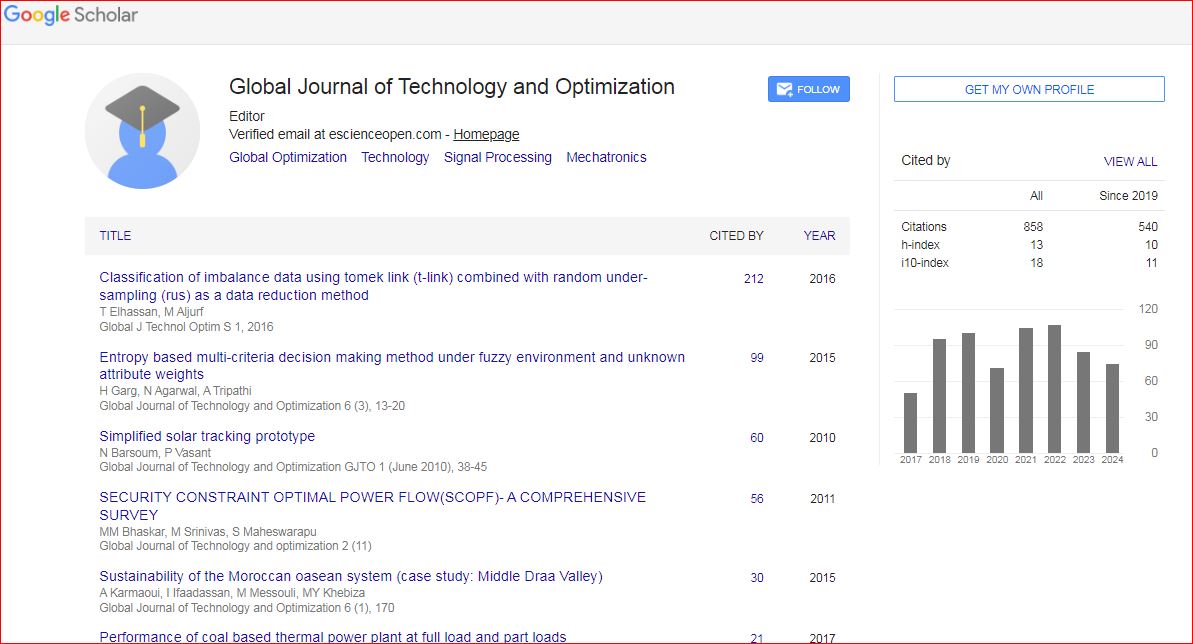
Global Journal of Technology and Optimization received 847 citations as per Google Scholar report