Brief Report - (2025) Volume 15, Issue 5
Received: 01-Oct-2025, Manuscript No. mccr-25-173801;
Editor assigned: 03-Oct-2025, Pre QC No. P-173801;
Reviewed: 17-Oct-2025, QC No. mccr-25-173801;
Revised: 22-Oct-2025, Manuscript No. R-173801;
Published:
29-Oct-2025
, DOI: 10.37421/2161-0444.2025.15.799
Citation: El-Sayed, Ahmed. ”Biotransformation: Versatile, Sustainable Innovation Across Sectors.” Med Chem 15 (2025):799.
Copyright: © 2025 El-Sayed A. This is an open-access article distributed under the terms of the Creative Commons Attribution License, which permits unrestricted use, distribution and reproduction in any medium, provided the original author and source are credited.
Biotransformation stands out as a remarkably versatile and environmentally conscious approach across a spectrum of scientific and industrial applications. This method harnesses biological systems, often microorganisms or enzymes, to modify complex molecules, leading to the creation of novel compounds with enhanced therapeutic properties, reduced toxicity, or improved functionality [1].
This offers a sustainable alternative to traditional chemical synthesis, emphasizing green chemistry principles. The field of microbial biotransformation, in particular, is revolutionizing drug discovery and development [1].
It provides an elegant pathway for creating new drugs by allowing microorganisms to alter existing structures, resulting in compounds that might be more potent or safer. This approach is seen as a key player in fostering sustainable innovation within the pharmaceutical sector. Moving beyond human health, biotransformation plays a pivotal role in tackling environmental pollution. A critical review highlights its application in the degradation of Per- and Polyfluoroalkyl Substances (PFAS), shedding light on the intricate mechanisms microorganisms employ to break down these persistent environmental pollutants [2].
Understanding these pathways is crucial for developing biological strategies to remediate widespread PFAS contamination, presenting both significant challenges and immense potential. Similarly, plant systems are being explored for their biotransformation capabilities [3].
Plants can effectively modify natural products, a process that can lead to enhanced bioactivity, improved solubility, or reduced toxicity of these compounds. This offers a natural route to producing novel and more effective bioactive compounds, with implications for pharmaceuticals, cosmetics, and other industries. The human body itself is a complex biotransformation system. Recent advancements in understanding human drug biotransformation enzymes, with a specific focus on cytochrome P450s and UDP-Glucuronosyltransferases, underscore their critical roles [4].
These enzymes process drugs, profoundly impacting their efficacy and safety, and insights into their functions are vital for managing drug-drug interactions and advancing personalized medicine. Marine environments are rich sources of unique biological catalysts. A comprehensive review showcases the diversity of marine microorganisms and their enzymatic machinery, capable of modifying complex natural product structures [5].
This opens up exciting avenues for discovering novel bioactive compounds from the oceans and improving existing ones for therapeutic applications, leveraging an underexplored biological resource. Furthermore, fungal biotransformation is gaining traction for its role in biorefineries [6].
Fungi are efficient in deconstructing lignocellulosic biomass, converting plant material into valuable products such as biofuels and biochemicals. This presents a sustainable and economically viable approach for processing agricultural waste and promoting a circular economy. The critical issue of pharmaceutical contamination in wastewater treatment plants is also being addressed through biotransformation [7].
Both microbial and enzymatic degradation pathways are detailed, underscoring the vital role biological processes play in removing these emerging contaminants. Strategies to enhance removal efficiencies are continually being developed to protect environmental health. In agricultural contexts, microbial biotransformation offers solutions for detoxifying harmful chemicals. Recent advances highlight its potential in degrading organophosphorus pesticides, detailing the enzymatic mechanisms and specific microbial strains involved [8].
This provides promising strategies for environmental bioremediation, mitigating the impact of these toxic substances. Enzymatic biotransformation also represents a significant leap forward in organic synthesis [9].
It offers considerable advantages over traditional chemical methods, including higher selectivity and the ability to operate under milder reaction conditions. This technology is being widely applied in the production of fine chemicals and pharmaceuticals, promoting greener synthetic routes. Finally, microbial biotransformation plays a key role in the food industry for creating natural food flavorings [10].
Various microbial species and their enzymatic activities are utilized to convert precursors into desirable aroma compounds. This offers a sustainable and natural approach to flavor enhancement, aligning with consumer demand for natural ingredients.
Biotransformation, the biological modification of compounds, is a cornerstone of modern scientific and industrial innovation, offering sustainable and efficient pathways across diverse fields. In drug discovery, for instance, microbial biotransformation has emerged as a powerful, environmentally friendly method [1]. It enables microorganisms to modify complex molecules, leading to novel compounds that boast improved therapeutic properties or reduced toxicity, often providing a more sustainable alternative to conventional chemical synthesis. This extends to marine environments, where the diversity of marine microorganisms and their unique enzymatic machinery are being leveraged to modify natural products, leading to the discovery of novel bioactive compounds and enhancing existing ones for therapeutic applications [5]. These biological processes promise a new era in pharmaceutical development by utilizing natureâ??s own catalytic toolkit.
Beyond pharmaceuticals, biotransformation is crucial for environmental protection and remediation efforts. Persistent environmental pollutants like Per- and Polyfluoroalkyl Substances (PFAS) pose significant challenges, but microbial biotransformation offers a viable solution [2]. Reviews critically examine the mechanisms and pathways microorganisms use to break down these resilient compounds, highlighting both the complexities and the considerable potential for biological strategies in mitigating PFAS contamination. Similarly, the biotransformation of pharmaceuticals in wastewater treatment plants is a key area of focus [7]. Both microbial and enzymatic degradation pathways are detailed, emphasizing the essential role biological processes play in removing these emerging contaminants and the ongoing development of strategies to enhance removal efficiencies for overall environmental health. Furthermore, microbial biotransformation has shown recent advances in detoxifying harmful organophosphorus pesticides, with specific microbial strains and enzymatic mechanisms offering promising strategies for environmental bioremediation [8].
The applications of biotransformation extend to biomass utilization and the production of specialized chemicals. Plant biotransformation, for example, is increasingly used for modifying natural products, enhancing their bioactivity, solubility, or reducing their toxicity [3]. This involves diverse plant systems and enzymes that produce novel and more effective bioactive compounds for the pharmaceutical and other industries. In the realm of renewable resources, fungal biotransformation of lignocellulosic biomass is presenting new opportunities [6]. Fungi efficiently deconstruct plant material, converting it into valuable products such as biofuels and biochemicals, thereby promoting a sustainable approach for biorefineries and reducing reliance on fossil fuels. These methods underscore a global shift towards bio-based economies.
Human physiology itself relies heavily on biotransformation processes. Understanding human drug biotransformation enzymes, particularly cytochrome P450s and UDP-Glucuronosyltransferases, is vital for drug efficacy and patient safety [4]. Recent advances highlight their profound impact on how drugs are processed, influencing drug-drug interactions and paving the way for more personalized medicine. This intricate enzymatic network determines how quickly drugs are metabolized and eliminated, directly affecting therapeutic outcomes and potential side effects.
The principles of biotransformation are also transforming organic synthesis. Enzymatic biotransformation, leveraging specific enzyme classes, offers significant benefits over traditional chemical methods [9]. These include higher selectivity, milder reaction conditions, and reduced waste, making it a greener and more efficient route for producing fine chemicals and pharmaceuticals. Lastly, in the food industry, microbial biotransformation plays a key role in creating natural food flavorings [10]. Specific microbial species and their enzymatic activities convert precursors into desirable aroma compounds, offering a sustainable and natural approach to flavor enhancement, meeting consumer demands for cleaner labels and natural ingredients.
The provided data highlights the widespread utility of biotransformation across various scientific and industrial sectors. Microbial biotransformation emerges as a powerful, environmentally friendly method for drug discovery, leading to novel compounds with improved therapeutic properties or reduced toxicity, serving as a sustainable alternative to chemical synthesis. Marine microorganisms also contribute significantly to modifying natural products, showcasing their potential for novel bioactive compound discovery. Beyond pharmaceuticals, microbial processes are crucial for addressing environmental challenges, such as the degradation of persistent Per- and Polyfluoroalkyl Substances (PFAS) and organophosphorus pesticides. They also play a vital role in the biotransformation of pharmaceuticals in wastewater treatment plants and in producing natural food flavorings. Plant biotransformation offers a means to modify natural products, enhancing bioactivity or reducing toxicity, yielding effective bioactive compounds for diverse industries. Fungal biotransformation focuses on efficiently deconstructing lignocellulosic biomass, converting it into valuable products like biofuels and biochemicals, promoting sustainable biorefineries. In human biology, drug biotransformation enzymes, especially cytochrome P450s and UDP-Glucuronosyltransferases, are essential for drug efficacy and safety, influencing drug-drug interactions and personalized medicine. Enzymatic biotransformation is also advancing organic synthesis, offering benefits like higher selectivity and milder conditions for producing fine chemicals. Overall, biotransformation is presented as a green, sustainable, and versatile tool for innovation in medicine, environmental protection, industrial processes, and food science.
None
None
1. Saurabh BG, Vipin K, Gaurav KG. "Microbial biotransformation: A green and sustainable tool for drug discovery and development".Curr Drug Metab 24 (2023):440-457.
Indexed at, Google Scholar, Crossref
2. Mengqi L, Mengting L, Xiaoyue C. "Biotransformation of Per- and Polyfluoroalkyl Substances (PFAS) by Microorganisms: A Critical Review".Environ Sci Technol 57 (2023):1-19.
Indexed at, Google Scholar, Crossref
3. Yanan Z, Yufeng Y, Yiming M. "Plant Biotransformation of Bioactive Natural Products: A Review".Molecules 28 (2023):1546.
Indexed at, Google Scholar, Crossref
4. Yu-Yen H, Chuan-Ming C, Hsin-Fu L. "Recent Advances in Understanding Human Drug Biotransformation Enzymes: A Focus on Cytochrome P450s and UDP-Glucuronosyltransferases".Pharmaceutics 14 (2022):2603.
Indexed at, Google Scholar, Crossref
5. Jian-Bin W, Ying S, Yuan Y. "Marine microbial biotransformation of natural products: A comprehensive review".Mar Drugs 19 (2021):569.
Indexed at, Google Scholar, Crossref
6. Muhammad I, Faizan U, Muhammad R. "Fungal Biotransformation of Lignocellulosic Biomass: Recent Advances and Future Perspectives".Biotechnol Bioeng 120 (2023):3-19.
Indexed at, Google Scholar, Crossref
7. Meihong H, Xiaoyan S, Jianbing L. "Biotransformation of pharmaceuticals in wastewater treatment plants: A review on microbial and enzymatic degradation".Sci Total Environ 858 (2023):160100.
Indexed at, Google Scholar, Crossref
8. Zhiyuan D, Yu Y, Ling Y. "Microbial biotransformation of organophosphorus pesticides: Recent advances and future perspectives".J Hazard Mater 403 (2021):123680.
Indexed at, Google Scholar, Crossref
9. Yuancheng S, Xiaohong H, Xuekai L. "Recent advances in enzymatic biotransformation for organic synthesis".Curr Opin Biotechnol 78 (2022):102830.
Indexed at, Google Scholar, Crossref
10. Chunlei H, Jianbo X, Chunyan L. "Microbial biotransformation for the production of natural food flavorings: A review".Food Chem 350 (2021):129218.
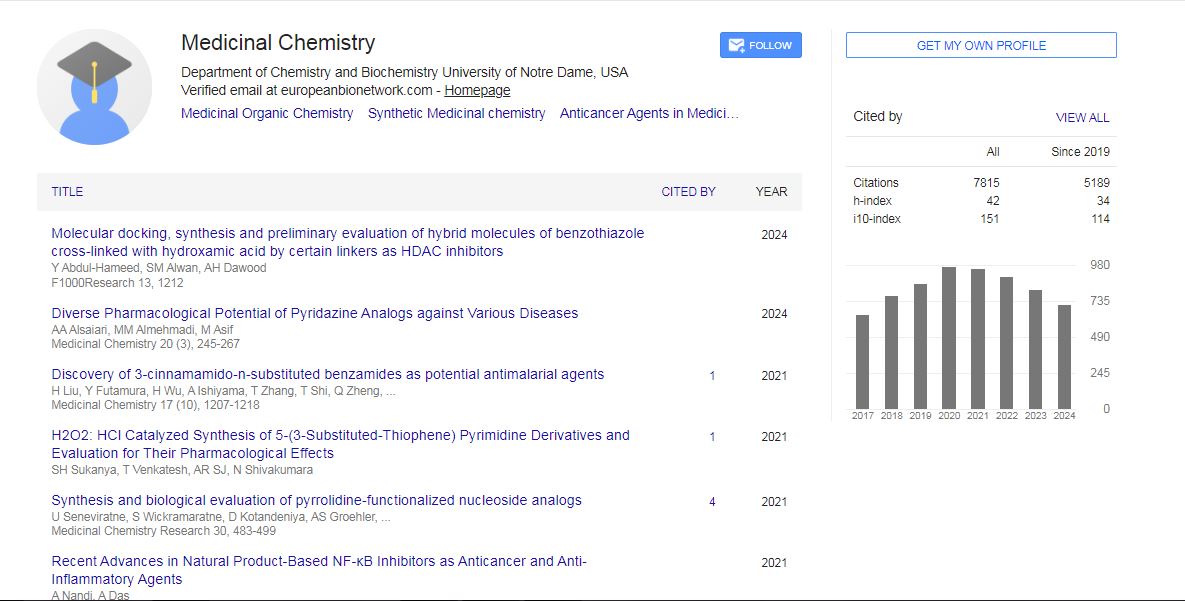
Medicinal Chemistry received 6627 citations as per Google Scholar report