Commentary - (2025) Volume 15, Issue 4
Received: 02-Jul-2025, Manuscript No. jbpbt-25-178509;
Editor assigned: 04-Jul-2025, Pre QC No. P-178509;
Reviewed: 18-Jul-2025, QC No. Q-178509;
Revised: 23-Jul-2025, Manuscript No. R-178509;
Published:
30-Jul-2025
, DOI: 10.37421/2155-9821.2025.15.685
Citation: Tanaka, Yuki. âBiosimilar Bioprocess Development: Advancements and Strategies.â J Bioprocess Biotech 15 (2025):685.
Copyright: © 2025 Tanaka Y. This is an open-access article distributed under the terms of the Creative Commons Attribution License, which permits unrestricted use,
distribution and reproduction in any medium, provided the original author and source are credited.
The field of biosimilar production has rapidly evolved, necessitating robust and scalable manufacturing strategies to ensure therapeutic accessibility and economic viability. This overview delves into the multifaceted aspects of bioprocess development, a critical cornerstone in bringing high-quality biosimilars to market. Key considerations span from the initial stages of cell line engineering to the final purification steps, all guided by stringent regulatory frameworks and a demand for consistent product quality [1].
At the heart of efficient biosimilar manufacturing lies the development of a high-titer cell line. Accelerating this crucial phase is paramount for reducing development timelines and enhancing overall productivity. Innovative approaches, including advanced gene editing techniques and high-throughput screening, are being employed to rapidly identify and characterize cell lines capable of high-yield monoclonal antibody production [2].
Beyond cell line development, the optimization of upstream bioprocessing is indispensable for maximizing biosimilar yield and quality. This involves meticulous fine-tuning of media formulations and bioreactor operational parameters. Strategies such as varied feeding regimens and precise control of dissolved oxygen levels are explored to significantly boost cellular growth and product accumulation [3].
The downstream purification of biosimilars presents a unique set of challenges, primarily focused on achieving exceptional purity and effectively removing process-related impurities. A comprehensive evaluation of various chromatographic techniques, including affinity and mixed-mode chromatography, is essential for designing processes that efficiently clear impurities and ensure viral inactivation, meeting rigorous regulatory standards [4].
Demonstrating biosimilarity hinges on sophisticated analytical characterization. Advanced techniques such as mass spectrometry and multidimensional liquid chromatography play a pivotal role in providing a comprehensive profile of the biosimilar's structure and function. This detailed analytical data is vital for supporting regulatory submissions and establishing comparability [5].
Process analytical technology (PAT) offers a transformative approach to real-time monitoring and control within biosimilar manufacturing. The implementation of PAT tools, encompassing inline spectroscopy and automated sampling, enhances process understanding and guarantees consistent product quality throughout the entire production lifecycle, leading to improved process robustness [6].
Scaling up bioprocesses for biosimilar production introduces complexities related to mass transfer, mixing efficiency, and shear stress. This requires careful examination of strategies for transitioning bioreactor operations from laboratory-scale to pilot and commercial scales. The primary objective is to maintain consistent process performance and product quality during scale-up [7].
The integration of continuous manufacturing principles into biosimilar production offers a pathway to increased efficiency and a reduced manufacturing footprint. Exploring the potential of perfusion bioreactors and continuous downstream processing can lead to more agile and cost-effective manufacturing platforms for biosimilars, promising future advancements [8].
Current regulatory landscapes for biosimilar development are dynamic and demanding. Understanding the evolving scientific data requirements and emphasizing robust comparability studies and thorough process validation are crucial for successful regulatory submissions. Adherence to these guidelines is fundamental for market approval [9].
Ensuring the safety of biosimilars necessitates well-defined immunogenicity assessment strategies. Reviewing current methodologies for predicting and detecting potential immunogenic responses is critical. A key focus is correlating analytical characterization data with clinical outcomes to provide a comprehensive safety profile [10].
The intricate world of biosimilar production is underpinned by sophisticated bioprocess development, aiming for robust and scalable manufacturing. This process involves a strategic orchestration of various stages, from initial cell line development to final purification, all while adhering to stringent quality standards and economic considerations. The ultimate goal is to ensure that biosimilars are not only therapeutically equivalent but also accessible to patients worldwide [1].
A foundational element in efficient biosimilar manufacturing is the development of high-titer cell lines. The acceleration of this process is a key objective, driving efforts to shorten development timelines and enhance volumetric productivity. Novel gene engineering techniques, such as CRISPR/Cas9, coupled with advanced screening methods like flow cytometry, are instrumental in achieving rapid cell line selection and characterization for monoclonal antibody production [2].
Optimization of upstream bioprocessing is paramount for maximizing biosimilar yield and ensuring high product quality. This optimization involves a detailed examination of media formulations and bioreactor operating conditions. Through systematic investigation of feeding strategies and dissolved oxygen levels, significant improvements in cell growth and product accumulation have been demonstrated, often driven by data-driven process control [3].
Downstream purification of biosimilars presents significant challenges in achieving stringent purity requirements and removing potential process-related impurities. The evaluation of diverse chromatography techniques, including Protein A affinity and mixed-mode chromatography, is crucial. These evaluations guide the development of efficient impurity clearance strategies and viral inactivation methods to meet demanding regulatory expectations [4].
Analytical characterization stands as a cornerstone for demonstrating biosimilarity. Advanced analytical tools, such as high-resolution mass spectrometry and multidimensional liquid chromatography, are indispensable for comprehensive profiling of the biosimilar's structural and functional attributes. The data generated from these analyses are vital for supporting regulatory submissions and establishing comparability [5].
Process Analytical Technology (PAT) offers substantial advantages for real-time monitoring and control in biosimilar manufacturing. The implementation of PAT tools, including inline spectroscopy and automated sampling systems, enhances process understanding and guarantees consistent product quality throughout the manufacturing lifecycle, contributing to more robust and predictable processes [6].
Scaling up bioprocesses for biosimilar production introduces inherent complexities, particularly concerning mass transfer, mixing dynamics, and shear stress mitigation. This study examines the critical challenges and effective strategies for scaling bioreactor operations from laboratory to commercial scales, with a focus on maintaining process performance and product integrity at each stage [7].
The exploration of continuous manufacturing principles in biosimilar production holds the potential for significant gains in efficiency and a reduction in the physical footprint of manufacturing facilities. Investigating the utility of perfusion bioreactors and continuous downstream processing methods can pave the way for more agile and economically viable biosimilar manufacturing platforms [8].
Navigating the evolving regulatory landscape for biosimilar biologics is a complex but essential aspect of development. Understanding the current regulatory expectations and the scientific evidence required for applications, with a strong emphasis on robust comparability studies and process validation, is fundamental for successful market entry [9].
Strategies for immunogenicity assessment are critical for ensuring the safety of biosimilars. This review examines current methodologies for predicting and detecting potential immunogenic responses to biosimilars. The importance of correlating detailed analytical data with clinical outcomes is highlighted to provide a comprehensive safety evaluation [10].
This collection of research highlights key advancements and strategies in biosimilar bioprocess development. It covers essential aspects such as accelerated cell line development using gene editing, upstream process optimization through feeding strategies and bioreactor control, and downstream purification techniques for achieving high purity. The importance of advanced analytical characterization, process analytical technology for real-time monitoring, and robust scale-up strategies are also emphasized. Furthermore, the potential of continuous manufacturing and the navigation of evolving regulatory landscapes and immunogenicity assessment are discussed, all contributing to the efficient and safe production of biosimilars.
None
None
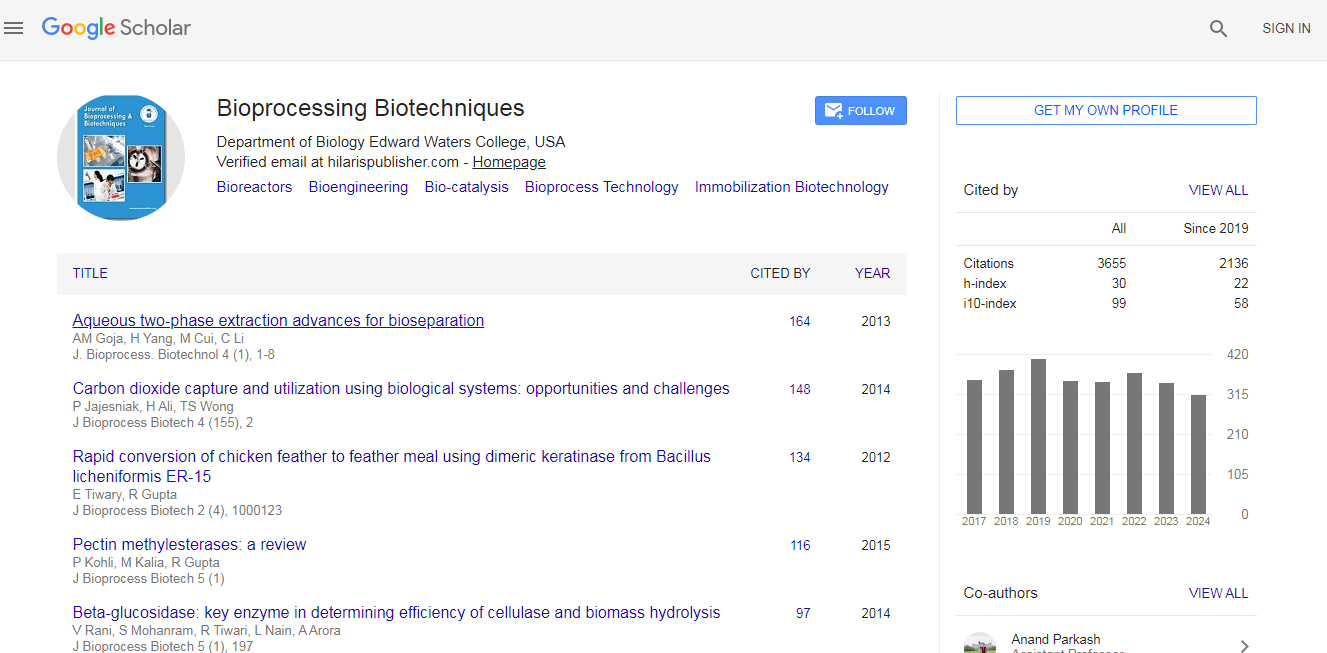
Journal of Bioprocessing & Biotechniques received 3351 citations as per Google Scholar report