Commentary - (2025) Volume 15, Issue 6
Received: 01-Nov-2025, Manuscript No. jbpbt-25-178528;
Editor assigned: 03-Nov-2025, Pre QC No. P-178528;
Reviewed: 17-Nov-2025, QC No. Q-178528;
Revised: 24-Nov-2025, Manuscript No. R-178528;
Published:
29-Nov-2025
, DOI: 10.37421/2155-9821.2025.15.704
Citation: Novak, Peter J.. âBioseparation Evolution: Enhanced Efficiency and Selectivity.â J Bioprocess Biotech 15 (2025): 704.
Copyright: © 2025 Novak J. Peter This is an open-access article distributed under the terms of the Creative Commons Attribution License, which permits unrestricted use,
distribution and reproduction in any medium, provided the original author and source are credited.
Recent breakthroughs in bioseparation techniques are revolutionizing the isolation of complex biomolecules, marking a significant advancement in biotechnological processes. Innovations in chromatography, particularly multi-modal stationary phases and simulated moving bed (SMB) chromatography, are enhancing resolution and yield for challenging separations such as antibody-drug conjugates and recombinant proteins [1].
Membrane-based separations, including advanced ultrafiltration and nanofiltration, are becoming increasingly efficient and selective, offering new avenues for purification [2].
Affinity-based methods, especially those employing engineered ligands and magnetic beads, provide high specificity for targeted purification, a critical aspect for therapeutic molecules [4].
Furthermore, the integration of process analytical technology (PAT) with real-time monitoring is enabling adaptive control and optimization of these complex bioseparation processes, leading to improved efficiency and product quality [5].
Continuous chromatography, such as Simulated Moving Bed (SMB) technology, is gaining traction for high-volume manufacturing due to its productivity and reduced solvent consumption [3].
Multi-modal chromatography, utilizing stationary phases with multiple interaction mechanisms, offers enhanced selectivity for separating closely related biomolecules and resolving complex mixtures [6].
Magnetic separation, leveraging magnetic nanoparticles functionalized with specific ligands, provides a rapid and scalable method for isolating target biomolecules, useful for initial capture from complex matrices [7].
The purification of extracellular vesicles (EVs) presents unique challenges due to their heterogeneity and low abundance, with advances in various techniques enabling more efficient isolation [8].
Electrophoretic techniques, particularly capillary electrophoresis (CE), continue to offer high-resolution separations for charged biomolecules, crucial for biopharmaceutical quality control and research [10].
Advanced centrifugation techniques are also being utilized for more selective separation of cellular components and protein complexes, enhancing the recovery of specific biomolecular fractions [9].
The field of bioseparation is witnessing transformative advancements driven by a variety of innovative techniques. Chromatography, a cornerstone of biomolecule purification, has seen significant progress with the development of multi-modal stationary phases and simulated moving bed (SMB) chromatography, which improve resolution and yield for challenging separations like antibody-drug conjugates and recombinant proteins [1].
Membrane-based separations, utilizing advanced ultrafiltration and nanofiltration technologies, are becoming more efficient and selective, addressing the need for high-performance purification of sensitive biomolecules [2].
Affinity-based methods, particularly those employing engineered ligands and magnetic beads, offer unparalleled specificity for targeted purification, crucial for obtaining highly pure therapeutic proteins [4].
The integration of process analytical technology (PAT) with real-time monitoring is a paradigm shift, enabling adaptive control and optimization of complex bioseparation processes, ultimately leading to enhanced efficiency and superior product quality [5].
Simulated Moving Bed (SMB) chromatography is emerging as a powerful tool for continuous separation of biomolecules, especially in high-volume manufacturing, due to its high productivity and reduced solvent consumption [3].
Multi-modal chromatography, characterized by stationary phases with multiple interaction mechanisms, provides enhanced selectivity for separating closely related biomolecules and resolving complex mixtures such as aggregates and charge variants of therapeutic proteins [6].
Magnetic separation, utilizing magnetic nanoparticles functionalized with specific ligands, offers a rapid and scalable approach for isolating target biomolecules, proving advantageous for pre-treatment and initial capture from intricate biological matrices [7].
The purification of extracellular vesicles (EVs) is an area of active development, with ongoing research leveraging techniques like size-exclusion chromatography (SEC), tangential flow filtration (TFF) with tailored membranes, and affinity-based methods to achieve more efficient and pure isolation [8].
Centrifugal force applications are being re-envisioned through advanced centrifugation techniques, often coupled with specific rotor designs and media, for more selective separation of cellular components and protein complexes, including density gradient and continuous-flow centrifugation [9].
Electrophoretic techniques, particularly capillary electrophoresis (CE) and its microfluidic implementations, continue to provide high-resolution separations for charged biomolecules, with ongoing advancements in buffer systems, detection methods, and chip-based designs improving sensitivity, speed, and throughput [10].
Bioseparation techniques are undergoing significant evolution, driven by advancements in chromatography, membrane filtration, and affinity-based methods. Innovations such as multi-modal stationary phases, simulated moving bed (SMB) chromatography, and advanced membrane materials are enhancing resolution, efficiency, and selectivity in purifying complex biomolecules. Affinity methods utilizing engineered ligands and magnetic beads offer high specificity. Process analytical technology (PAT) is being integrated for real-time monitoring and adaptive control, leading to improved process efficiency and product quality. Continuous chromatography, magnetic separation, and advanced centrifugation are also playing crucial roles in large-scale and targeted purification. Electrophoretic techniques like capillary electrophoresis continue to offer high-resolution separations for charged biomolecules. These developments collectively contribute to more robust and efficient bioseparation processes for a wide range of applications.
None
None
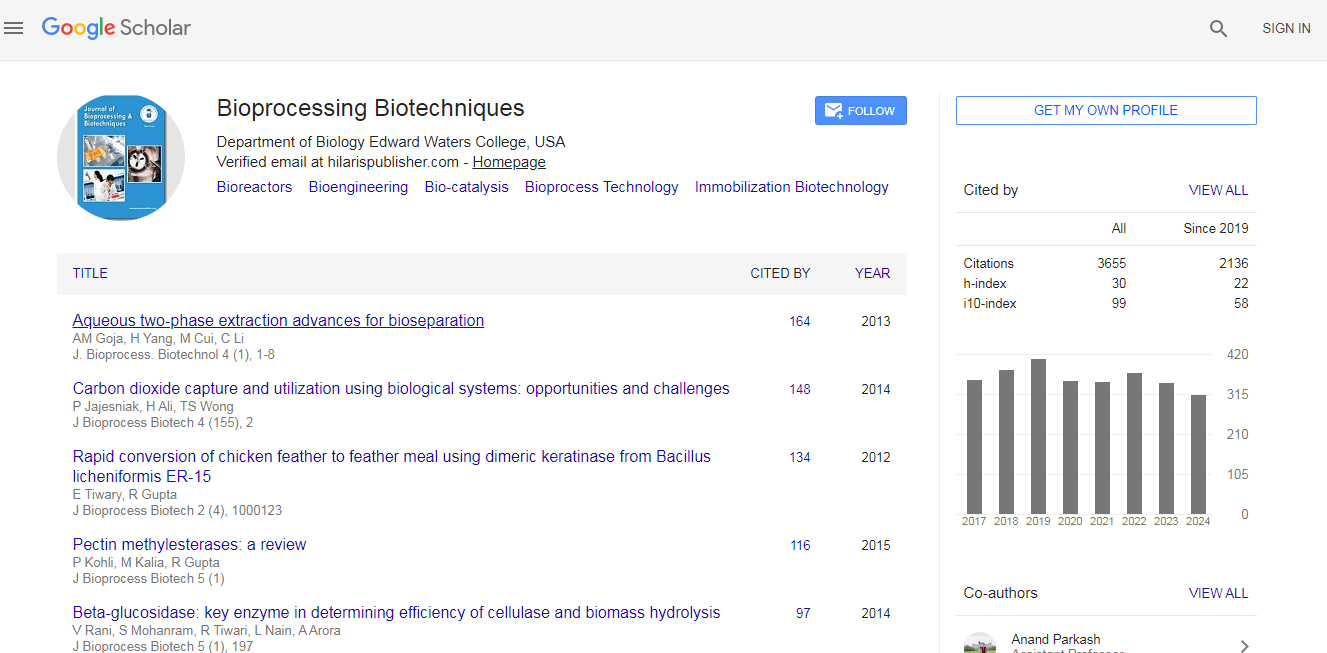
Journal of Bioprocessing & Biotechniques received 3351 citations as per Google Scholar report