Opinion - (2025) Volume 16, Issue 6
Received: 01-Dec-2025, Manuscript No. jbmbs-26-183419;
Editor assigned: 03-Dec-2025, Pre QC No. P-183419;
Reviewed: 17-Dec-2025, QC No. Q-183419;
Revised: 22-Dec-2025, Manuscript No. R-183419;
Published:
29-Dec-2025
, DOI: 10.37421/2155-6180.2025.16.304
Citation: Laurent, Sophie. ”Biometrics Revolutionize Forensics: Accuracy, Ethics, and Future.” J Biom Biosta 16 (2025):304.
Copyright: © 2025 Laurent S. This is an open-access article distributed under the terms of the Creative Commons Attribution License, which permits unrestricted use, distribution and reproduction in any medium, provided the original author and source are credited.
Biometric identification is rapidly transforming forensic science, introducing objective and dependable techniques for individual identification. These technologies, encompassing fingerprint, DNA, facial, and gait recognition, are increasingly integrated into criminal investigations, significantly improving accuracy and reducing human error. This advanced approach provides crucial evidence for legal proceedings, although ethical considerations and privacy concerns continue to be significant areas of ongoing discussion and development [1].
The application of sophisticated computational methods, particularly machine learning, is markedly enhancing the precision and effectiveness of biometric identification within forensic contexts. Deep learning models are demonstrating considerable promise in specific domains like latent fingerprint matching and facial recognition, leading to better detection rates and a reduction in false positives, signaling a trend towards more data-driven forensic analysis [2].
Ensuring the reliability and legal admissibility of biometric evidence in court is of paramount importance. Current research efforts are directed towards establishing standardized protocols for the collection, analysis, and presentation of biometric findings. A thorough understanding of the error rates and inherent limitations associated with various biometric modalities is essential for guaranteeing fair legal proceedings and preventing instances of wrongful convictions [3].
Multimodal biometric systems, which judiciously combine several identification methods such as fingerprints and facial features, offer substantial improvements in accuracy and robustness against sophisticated spoofing attempts. The integration of these systems is particularly valuable in forensic applications where a high degree of certainty is a prerequisite for linking suspects to crime scenes effectively [4].
The ethical dimensions surrounding the utilization of biometrics in forensic science, especially concerning privacy, data security, and the potential for inherent biases, are critical concerns that demand careful attention. The responsible deployment of biometric systems, ensuring they do not disproportionately impact certain demographic groups, presents an ongoing challenge that necessitates thorough consideration and stringent regulatory oversight [5].
Recent advancements in forensic gait analysis are introducing a non-intrusive methodology for identifying individuals from video surveillance footage. This particular biometric modality proves exceptionally useful for tracking suspects over extended periods or in scenarios where alternative biometric data might be unavailable or compromised due to various factors [6].
The incorporation of biometrics into the field of digital forensics is significantly broadening the investigative toolkit available to practitioners. The analysis of behavioral biometrics, which includes aspects like typing patterns and mouse movements, can effectively aid in user identification and the detection of fraudulent activities, thereby complementing established traditional identification methods [7].
Ongoing research is dedicated to the development of more resilient and robust biometric systems capable of overcoming common challenges such as the effects of aging, variations in facial expressions, and partial occlusions. Emerging techniques, including advanced 3D facial recognition and deep learning-based feature extraction, are enhancing system performance under diverse and challenging conditions, making them more suitable for long-term forensic applications [8].
The utility of biometrics in forensic science extends beyond the established domain of DNA analysis. Exploratory research into identifying individuals based on unique ear shapes or even through the analysis of sweat patterns is actively pushing the boundaries of personal identification, aiming to provide supplementary and novel forms of evidence in complex investigative cases [9].
Crucial to effective cross-jurisdictional investigations is the establishment of interoperability and standardization for biometric data across various forensic laboratories and databases. Concerted efforts are currently underway to develop common frameworks and protocols that will ensure biometric information can be reliably shared, compared, and utilized across different investigative bodies and jurisdictions [10].
Biometric identification is revolutionizing forensic science by introducing objective and reliable methods for individual identification. Technologies such as fingerprint, DNA, facial, and gait recognition are increasingly being integrated into criminal investigations. This integration enhances accuracy, reduces human error, and provides crucial evidence for legal proceedings, though ethical and privacy considerations remain significant areas of discussion and development [1].
The application of advanced computational approaches, particularly machine learning, is enhancing the accuracy and efficiency of biometric identification in forensic contexts. Deep learning models are showing significant promise in areas like latent fingerprint matching and facial recognition, improving detection rates and reducing false positives. This integration signifies a crucial move towards more data-driven forensic analysis [2].
The reliability and admissibility of biometric evidence in court are critical factors. Research is actively focused on establishing standardized protocols for the collection, analysis, and presentation of biometric findings. Understanding the error rates and limitations of different biometric modalities is essential for ensuring fair legal proceedings and preventing wrongful convictions [3].
Multimodal biometric systems, which combine multiple identification methods (e.g., fingerprints and facial features), offer enhanced accuracy and robustness against spoofing attempts. This integration is particularly valuable in forensic applications where a high degree of certainty is required to link suspects to crime scenes [4].
The ethical implications of using biometrics in forensic science, especially concerning privacy, data security, and potential biases, are critical. Ensuring that biometric systems are deployed responsibly and do not disproportionately affect certain demographic groups is an ongoing challenge that requires careful consideration and regulatory oversight [5].
Advancements in forensic gait analysis are providing a non-intrusive method for identifying individuals from video footage. This biometric modality is particularly useful for tracking suspects over longer periods or in situations where other biometrics are not available or are compromised [6].
The integration of biometrics into digital forensics is expanding the investigative toolkit. Analyzing behavioral biometrics, such as typing patterns or mouse movements, can help identify users and detect fraudulent activities, complementing traditional identification methods [7].
Research is ongoing to develop more robust and resilient biometric systems that can overcome challenges like aging, facial expression changes, and occlusions. Techniques such as 3D facial recognition and deep learning-based feature extraction are improving performance in variable conditions, making them more suitable for long-term forensic applications [8].
The use of biometrics in forensic science extends to the analysis of biological traces beyond DNA. Research into identifying individuals from ear shapes or even sweat patterns is exploring new frontiers in personal identification, aiming to provide supplementary evidence in complex cases [9].
The interoperability and standardization of biometric data across different forensic laboratories and databases are crucial for effective cross-jurisdictional investigations. Efforts are underway to develop common frameworks and protocols to ensure that biometric information can be reliably shared and compared [10].
Biometric identification, including fingerprint, DNA, facial, and gait recognition, is revolutionizing forensic science by enhancing accuracy and reducing errors in criminal investigations. Advanced computational methods and machine learning, particularly deep learning, are improving identification processes. Ensuring the reliability and admissibility of biometric evidence through standardized protocols and understanding limitations is crucial for fair legal proceedings. Multimodal systems offer increased accuracy and robustness. Ethical considerations regarding privacy, data security, and bias are paramount. Emerging techniques like gait analysis, behavioral biometrics, and novel modalities beyond DNA are expanding forensic capabilities. Standardization and interoperability of biometric data across jurisdictions are essential for effective investigations.
None
None
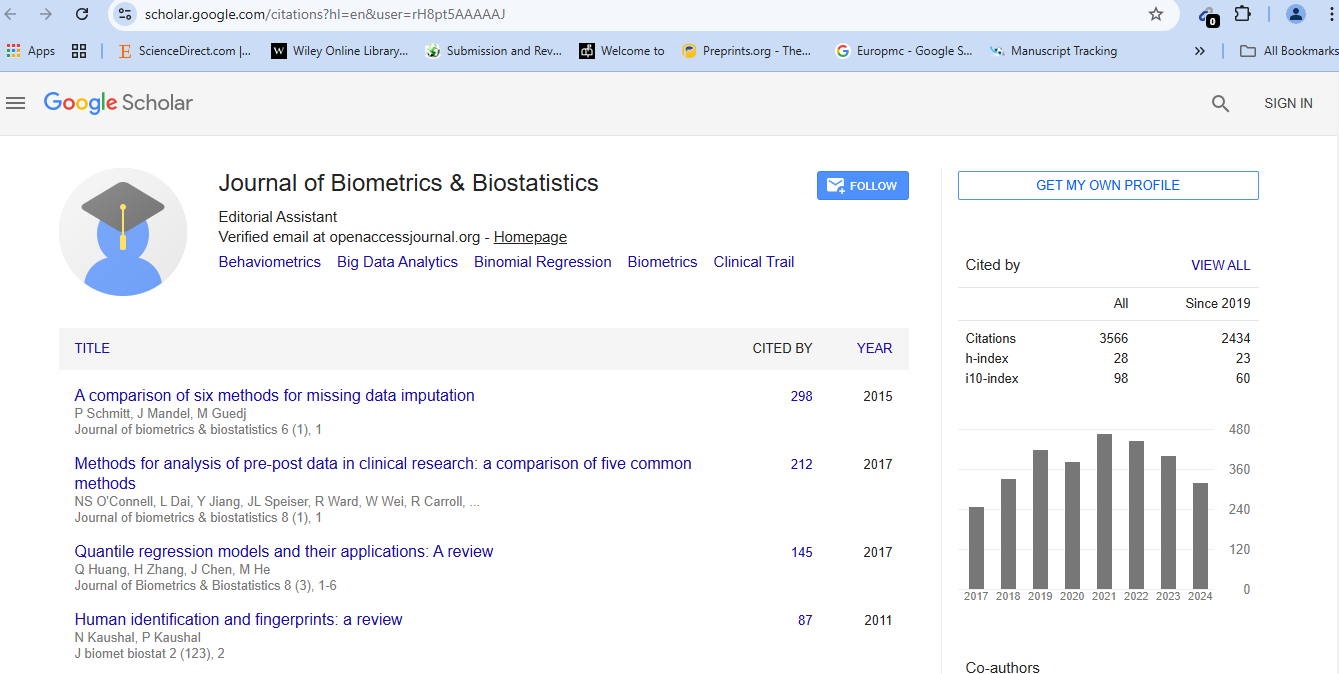
Journal of Biometrics & Biostatistics received 3496 citations as per Google Scholar report