Short Communication - (2025) Volume 16, Issue 2
Received: 01-Apr-2025, Manuscript No. jbmbs-26-183382;
Editor assigned: 03-Apr-2025, Pre QC No. P-183382;
Reviewed: 17-Apr-2025, QC No. Q-183382;
Revised: 22-Apr-2025, Manuscript No. R-183382;
Published:
29-Apr-2025
, DOI: 10.37421/2155-6180.2025.16.269
Citation: Müller, Thomas. ”Biometrics, Privacy, and Secure Authentication Technologies.” J Biom Biosta 16 (2025):269.
Copyright: © 2025 Müller T. This is an open-access article distributed under the terms of the Creative Commons Attribution License, which permits unrestricted use, distribution and reproduction in any medium, provided the original author and source are credited.
The landscape of digital security is undergoing a profound transformation, driven by the escalating demand for robust and privacy-conscious authentication mechanisms. Traditional password-based systems are increasingly proving inadequate against sophisticated threats, necessitating the exploration of more secure alternatives. Biometric authentication, which leverages unique physiological or behavioral characteristics, has emerged as a promising solution. However, the inherent sensitivity of biometric data raises significant privacy concerns. This has spurred extensive research into methods that can verify identity using biometrics while simultaneously protecting personal information from unauthorized access and misuse. The integration of advanced cryptographic techniques and novel algorithmic approaches is central to addressing this dual challenge of security and privacy in biometric systems [1].
The field of biometric authentication is rapidly evolving, with researchers exploring innovative ways to enhance both accuracy and privacy. Deep learning, a powerful subset of artificial intelligence, has shown remarkable potential in improving the performance of biometric systems. In particular, its application to iris recognition has led to the development of sophisticated models capable of performing accurate matching without direct exposure of sensitive biometric templates. These deep learning architectures are designed to embed template protection directly within the model, mitigating the need for complex external cryptographic protocols and offering a more streamlined approach to privacy-preserving authentication [2].
Among the various privacy-enhancing technologies, homomorphic encryption stands out as a particularly powerful tool for secure biometric authentication. This advanced cryptographic technique allows computations, such as template matching, to be performed directly on encrypted data, meaning that servers never need to decrypt sensitive biometric templates. This capability offers the potential for truly private biometric systems, where raw user data remains confidential throughout the entire authentication process. The theoretical underpinnings and practical implementations of homomorphic encryption in this domain are being actively investigated, exploring its applicability to different biometric modalities like fingerprints and facial features [3].
Another significant area of research involves the combination of multiple biometric traits to enhance security and privacy. Multi-modal biometric systems, which integrate information from different sources, are inherently more robust. To address privacy concerns in these systems, researchers are employing techniques like fuzzy vault schemes in conjunction with secure multi-party computation (SMC). This approach enables the distribution of sensitive biometric templates across multiple servers, ensuring that no single entity has access to complete user data, thereby bolstering privacy defenses [4].
The convergence of emerging technologies like blockchain with established cryptographic methods is also paving the way for innovative privacy-preserving biometric solutions. Blockchain technology, with its decentralized and immutable ledger, can provide a secure and transparent platform for storing and managing biometric templates. When combined with secure multiparty computation, it allows for privacy-preserving facial recognition systems where user templates can be securely stored and verified without revealing raw data, fostering trust and enhancing user control over personal information [5].
Differential privacy is another key cryptographic concept being applied to protect biometric templates. This technique involves adding carefully calibrated noise to biometric data or its derived features. The goal is to obscure an individual's identity to an extent that guarantees privacy against potential attackers, while still permitting accurate matching for legitimate authentication purposes. Research in this area focuses on analyzing the theoretical privacy guarantees and addressing the practical challenges, such as the trade-off between the level of privacy and the accuracy of the recognition system [6].
Cancelable biometrics represents a proactive approach to safeguarding biometric data by transforming templates into a format that can be revoked and reissued if compromised. When integrated with attribute-based encryption (ABE), these cancelable templates can be managed with fine-grained access control. This means that only authorized entities can perform verification using specific attributes, ensuring that biometric data is accessed and used according to predefined policies, offering a flexible and secure solution for privacy-conscious authentication [7].
The increasing reliance on deep learning for biometric authentication also brings forth new security considerations, particularly concerning adversarial attacks. These attacks involve crafting specialized inputs designed to deceive deep neural networks, potentially leading to misidentifications or the leakage of private information. Consequently, research is actively exploring defense mechanisms, such as adversarial training and input sanitization, to bolster the robustness and privacy of deep learning-based biometric systems, ensuring their reliability in real-world applications [8].
Distributed approaches are also being developed for specific biometric modalities, such as fingerprint recognition. In these systems, fingerprint templates are intentionally split and stored across multiple untrusted servers. This decentralization prevents any single server from possessing the complete biometric data, thereby mitigating the risk of large-scale data breaches. Cryptographic protocols are employed to enable decentralized matching, balancing privacy, accuracy, and computational efficiency within this distributed framework [9].
Voice biometrics, with its widespread accessibility, is another area benefiting from privacy-preserving techniques. The application of homomorphic encryption to voice authentication allows for the encryption of voice features, enabling matching operations to be performed on the encrypted data. This preserves user privacy by ensuring that raw voice data is never exposed during the authentication process. Research in this domain addresses the unique challenges posed by the high dimensionality and variability of voice data to achieve accurate and secure speaker verification [10].
The critical need for secure and private identity verification in the digital age has propelled advancements in biometric authentication, which utilizes unique personal characteristics for identification. A significant challenge lies in safeguarding the sensitive nature of biometric data. To address this, researchers are developing various privacy-enhancing technologies that ensure the confidentiality of personal information while enabling reliable authentication. These technologies include sophisticated cryptographic methods and algorithmic innovations, aiming to create systems that are both secure against unauthorized access and respectful of individual privacy rights. The ongoing research in this domain seeks to establish a new paradigm for digital identity management [1].
Deep learning has emerged as a transformative technology in the realm of biometric authentication, particularly for modalities like iris recognition. Novel deep neural network architectures are being designed to intrinsically protect biometric templates. This approach integrates template protection directly into the model's training and operation, thereby reducing the reliance on external cryptographic measures. The objective is to enable accurate iris recognition without ever exposing raw biometric data, thus enhancing user privacy. Studies have demonstrated that these deep learning-based methods can achieve performance levels comparable to traditional systems while offering superior privacy guarantees, indicating a promising future for secure iris-based identification [2].
Homomorphic encryption offers a groundbreaking solution for achieving privacy-preserving biometric authentication by enabling computations on encrypted data. This means that sensitive biometric templates, such as those derived from fingerprints or facial scans, can be matched without ever being decrypted. This capability ensures that the raw biometric data remains confidential, even when processed by potentially untrusted servers. The research in this area involves a thorough analysis of the theoretical foundations and practical implications, focusing on the computational overhead and the necessary trade-offs for implementing effective and efficient homomorphic encryption schemes in biometric systems [3].
Multi-modal biometric authentication, which combines data from various biometric sources, provides enhanced security. To maintain privacy in such systems, approaches like fuzzy vault schemes are integrated with secure multi-party computation (SMC). This distributed architecture involves partitioning biometric templates across multiple servers, preventing any single entity from accessing complete user information. SMC allows these servers to collaboratively compute matching scores without revealing individual template data, offering a robust defense against privacy breaches and enhancing the overall security and privacy of multi-modal biometric systems [4].
The integration of blockchain technology with secure multiparty computation presents a novel framework for privacy-preserving facial recognition. In this system, user facial templates are stored on a decentralized blockchain, ensuring transparency and security. Verification is performed through a privacy-preserving protocol that leverages cryptographic techniques to protect both the template and the matching results. This distributed approach enhances trust and security, making it a compelling solution for privacy-conscious facial recognition applications, where user data is managed with a high degree of control and confidentiality [5].
Differential privacy provides a robust mathematical framework for protecting biometric template privacy. By introducing carefully controlled noise into biometric data or its features, it becomes significantly harder to identify an individual, even if the data is compromised. The research in this area focuses on establishing clear privacy guarantees and addressing the practical challenges associated with implementing differential privacy, such as its potential impact on the accuracy of biometric recognition systems. The aim is to develop systems with provable security against privacy violations [6].
Cancelable biometrics offers a method to generate biometric templates that can be transformed and reissued, providing a means to revoke compromised templates. When combined with attribute-based encryption (ABE), these cancelable templates can be secured with fine-grained access control. This allows for selective access to biometric data, ensuring that only authorized parties with specific attributes can perform authentication. This approach enhances both the security and flexibility of biometric systems, offering a privacy-conscious solution for managing sensitive biometric information [7].
Deep learning models, while powerful for biometric authentication, are susceptible to adversarial attacks. These attacks can compromise the integrity and privacy of the system by manipulating input data. Research is actively developing defense strategies, including adversarial training and input sanitization, to make these deep learning-based biometric systems more resilient to such threats. This ensures that the high accuracy offered by deep learning does not come at the expense of system security and user privacy [8].
For biometric modalities like fingerprints, distributed processing offers a significant privacy advantage. In a distributed privacy-preserving fingerprint recognition system, templates are stored and processed across multiple untrusted servers. This prevents any single server from gaining access to complete fingerprint data, thereby mitigating the risks associated with centralized data storage. The use of cryptographic protocols enables decentralized matching, balancing the critical aspects of privacy, accuracy, and computational efficiency in a secure manner [9].
Voice biometrics can also be secured using privacy-preserving techniques, notably through the application of homomorphic encryption. This method involves encrypting voice features, allowing for authentication to occur on the encrypted data. This preserves user privacy by ensuring that raw voice samples are never exposed. The research addresses the inherent complexities of voice data, such as its high dimensionality and variability, to develop accurate and secure speaker verification systems suitable for privacy-sensitive environments [10].
This collection of research explores the intersection of biometric authentication and privacy preservation. It highlights the growing need for systems that can verify identity using unique biological traits while safeguarding sensitive personal data. Various privacy-enhancing technologies are discussed, including homomorphic encryption, secure multi-party computation, differential privacy, and blockchain technology, detailing their application to different biometric modalities such as fingerprints, iris, face, and voice. Challenges in implementation, such as computational overhead and trade-offs between privacy and accuracy, are addressed, alongside adversarial attack defenses and distributed processing approaches. The research collectively aims to enable secure and confidential authentication processes.
None
None
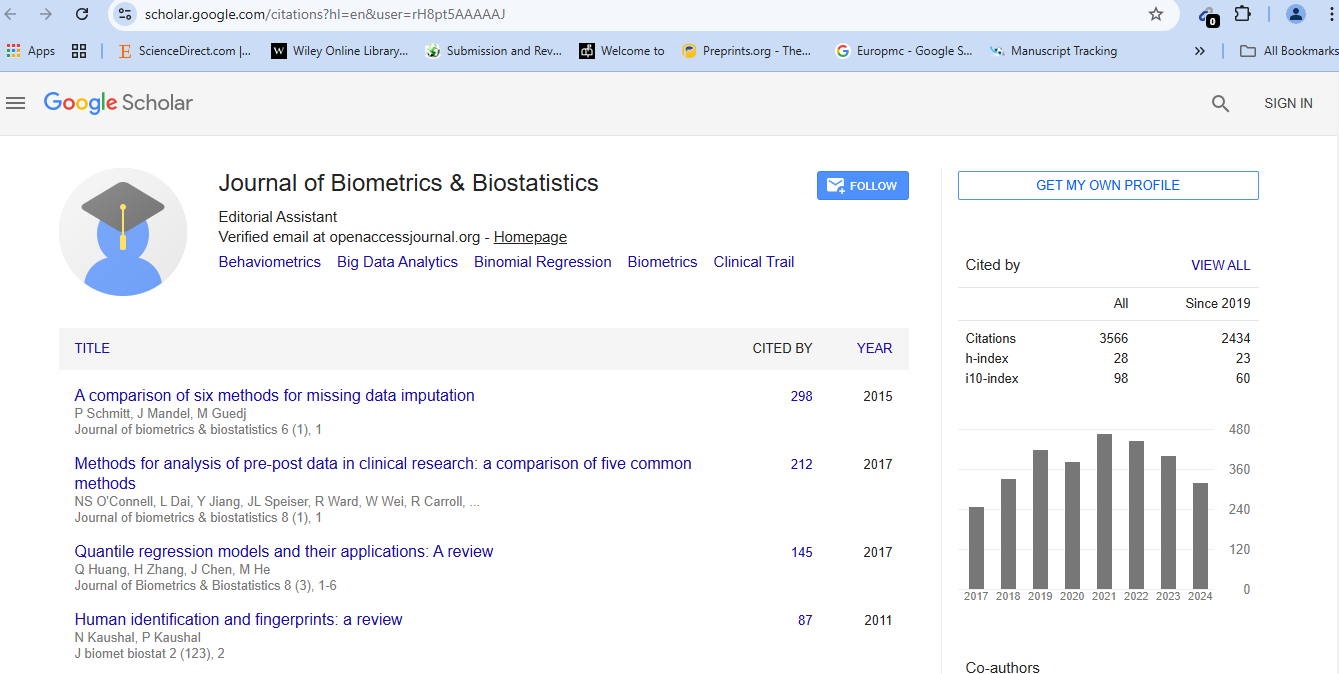
Journal of Biometrics & Biostatistics received 3496 citations as per Google Scholar report