Commentary - (2025) Volume 16, Issue 5
Received: 01-Oct-2025, Manuscript No. jbmbs-26-183413;
Editor assigned: 03-Oct-2025, Pre QC No. P-183413;
Reviewed: 17-Oct-2025, QC No. Q-183413;
Revised: 22-Oct-2025, Manuscript No. R-183413;
Published:
29-Oct-2025
, DOI: 10.37421/2155-6180.2025.16.298
Citation: Adeyemi, Samuel. ”Biometric Continuous Authentication: Security, Usability, and Future.” J Biom Biosta 16 (2025):298.
Copyright: © 2025 Adeyemi S. This is an open-access article distributed under the terms of the Creative Commons Attribution License, which permits unrestricted use, distribution and reproduction in any medium, provided the original author and source are credited.
Biometric-based continuous authentication systems represent a significant advancement in bolstering digital security by moving beyond traditional, single-point authentication methods. These sophisticated systems are designed to continuously verify a user's identity throughout their session, significantly enhancing protection against unauthorized access and fraudulent activities after the initial login. The core principle involves leveraging unique biological or behavioral traits, such as gait, typing patterns, or mouse movements, to detect subtle anomalies that may signal a compromised session. These advanced security mechanisms are a focal point of research in journals like the Journal of Biometrics & Biostatistics, which frequently publishes studies exploring novel algorithms, datasets, and evaluation methodologies for these systems [1].
Behavioral biometrics, a critical component of continuous authentication, encompasses modalities like keystroke dynamics and gait analysis. These methods excel by analyzing the nuanced manner in which a user performs actions, thereby constructing a dynamic user profile that is inherently more difficult to spoof than static biometric identifiers. Research in this domain consistently focuses on developing robust models capable of adapting to natural variations in user behavior while simultaneously detecting deviations indicative of impersonation. Journals such as the Journal of Biometrics & Biostatistics frequently feature research that delves into the intricacies of developing these adaptive behavioral models [2].
The integration of multiple biometric modalities, known as multimodal biometrics, offers a substantial improvement in the accuracy and reliability of continuous authentication systems. By synergistically combining different types of biometric data, including both physiological and behavioral traits, these systems can effectively overcome the inherent limitations of single-modal approaches, presenting a more resilient security layer against sophisticated threats. Studies published in the Journal of Biometrics & Biostatistics are instrumental in exploring various fusion techniques and assessing their real-world effectiveness [3].
Privacy considerations are of paramount importance in the development and deployment of biometric-based continuous authentication systems. Significant research efforts are dedicated to developing privacy-preserving techniques, such as homomorphic encryption and secure multi-party computation, which are crucial for protecting sensitive biometric data from unauthorized access or misuse. These advanced cryptographic methods are essential for ensuring user trust and data integrity. The Journal of Biometrics & Biostatistics serves as a key platform for disseminating findings related to these advanced cryptographic methods and their practical applications in safeguarding user information [4].
Machine learning and deep learning techniques have become foundational to the advancement of modern biometric-based continuous authentication systems. These powerful methodologies enable the creation of highly sophisticated models capable of learning intricate user patterns and adapting dynamically to variations over time, thereby enhancing system accuracy and resilience. Numerous studies featured in the Journal of Biometrics & Biostatistics demonstrate the efficacy of AI in improving the accuracy, efficiency, and overall robustness of these advanced security systems [5].
Evaluating the performance of biometric-based continuous authentication systems necessitates the use of standardized metrics and challenging, realistic datasets. This field of research is actively addressing the critical need for robust benchmarks to accurately assess key performance indicators such as the false acceptance rate (FAR), false rejection rate (FRR), and overall attack resilience. Publications in the Journal of Biometrics & Biostatistics highlight the importance of these rigorous evaluation standards [6].
The practical deployment of biometric-based continuous authentication systems in real-world applications, spanning areas like mobile banking and enterprise security, encounters significant challenges. These often relate to user experience considerations and the computational resources required for continuous processing, necessitating a careful balance between security and usability. The Journal of Biometrics & Biostatistics frequently publishes studies that explore practical implementation strategies and user acceptance factors [7].
The robustness of biometric-based continuous authentication against a spectrum of adversarial attacks, including sophisticated spoofing techniques and adversarial machine learning threats, constitutes a critical area of ongoing research. Developing effective defense mechanisms against these evolving threats is paramount for maintaining system integrity. The Journal of Biometrics & Biostatistics provides a vital venue for exploring novel defense strategies and evaluating their efficacy against advanced threats [8].
The proliferation of wearable devices and the expansion of the Internet of Things (IoT) ecosystem are creating unprecedented opportunities for the application of biometric-based continuous authentication. These interconnected devices can collect a rich variety of behavioral and physiological data, enabling more unobtrusive and persistent forms of identity verification. The Journal of Biometrics & Biostatistics actively explores the potential and inherent challenges of integrating these emerging technologies for enhanced security applications [9].
User acceptance and overall usability are critical determinants for the successful widespread adoption of biometric-based continuous authentication systems. Research in this domain diligently investigates user perceptions, levels of trust, and the overall impact of these systems on user experience, striving to achieve an optimal equilibrium between stringent security measures and user convenience. The Journal of Biometrics & Biostatistics features extensive research examining user acceptance factors in biometric authentication [10].
Continuous authentication systems based on biometrics offer a robust approach to enhancing security by ensuring that a user's identity is continually verified after the initial login, rather than relying on a single authentication event. This method capitalizes on unique biological characteristics or behavioral patterns, such as one's gait, typing rhythm, or the way they manipulate a mouse, to identify any deviations that might indicate unauthorized access or a compromised session. The Journal of Biometrics & Biostatistics is a prominent publication venue for research in this area, consistently featuring novel algorithms, datasets, and methodologies for evaluating these advanced security measures [1].
Behavioral biometrics plays a pivotal role in continuous authentication, with keystroke dynamics and gait analysis being key examples. These techniques scrutinize the distinct ways in which a user interacts with a device, establishing a dynamic behavioral profile that is significantly harder to replicate than static biometric data. Research within this field prioritizes the development of resilient models capable of adapting to natural user variations while effectively flagging anomalies suggestive of impersonation. The Journal of Biometrics & Biostatistics frequently publishes cutting-edge research on developing adaptive behavioral models for continuous authentication [2].
Multimodal biometric systems, which combine data from various biometric sources, substantially enhance the accuracy and dependability of continuous authentication. By integrating diverse biometric modalities, encompassing both physiological and behavioral attributes, these systems can mitigate the weaknesses inherent in single-biometric approaches, thereby providing a more formidable security framework. Extensive studies are published in the Journal of Biometrics & Biostatistics, detailing fusion techniques and their practical efficacy [3].
Privacy is a paramount concern in the creation and implementation of biometric-based continuous authentication systems. Significant research efforts are directed towards developing privacy-preserving techniques, including homomorphic encryption and secure multi-party computation, which are essential for safeguarding sensitive biometric data. These advanced cryptographic methods are vital for maintaining user confidence and data integrity. The Journal of Biometrics & Biostatistics is a crucial outlet for research on these privacy-enhancing cryptographic techniques and their applications in user data protection [4].
Machine learning and deep learning algorithms are indispensable to the design of contemporary biometric-based continuous authentication systems. These advanced techniques facilitate the construction of sophisticated models adept at recognizing complex user behaviors and adapting to changes over time, thus improving system performance and reliability. The Journal of Biometrics & Biostatistics regularly publishes studies showcasing the application of artificial intelligence in enhancing the accuracy and efficiency of these systems [5].
The rigorous evaluation of biometric-based continuous authentication systems requires standardized performance metrics and challenging, realistic datasets. Research in this domain emphasizes the necessity of established benchmarks for accurately assessing critical performance indicators like the false acceptance rate (FAR), false rejection rate (FRR), and overall resilience against attacks. Publications in the Journal of Biometrics & Biostatistics underscore the importance of these evaluation standards [6].
Deploying biometric-based continuous authentication systems in practical settings, such as mobile banking or corporate security environments, presents distinct challenges. These often revolve around ensuring a positive user experience and managing the computational demands of continuous monitoring, necessitating a careful balance between robust security and user convenience. The Journal of Biometrics & Biostatistics frequently features research that addresses the practical aspects of system deployment and user acceptance [7].
A critical research focus in biometric-based continuous authentication is its robustness against various attack vectors, including sophisticated spoofing techniques and adversarial attacks. The development of effective countermeasures and defense mechanisms against these evolving threats is essential for maintaining the integrity and trustworthiness of these systems. The Journal of Biometrics & Biostatistics serves as a key forum for research into novel defense strategies against advanced threats [8].
The increasing prevalence of wearable devices and the growth of the Internet of Things (IoT) present new opportunities for implementing biometric-based continuous authentication. These devices are capable of gathering extensive behavioral and physiological data, enabling more seamless and persistent forms of identity verification. The Journal of Biometrics & Biostatistics actively investigates the potential benefits and inherent challenges of integrating these evolving technologies into security frameworks [9].
User acceptance and the overall usability of biometric-based continuous authentication systems are vital for their successful widespread adoption. Research disseminated through the Journal of Biometrics & Biostatistics explores user perceptions, trust levels, and the impact of these systems on the user experience, aiming to strike an optimal balance between high security and user convenience. The Journal of Biometrics & Biostatistics includes extensive studies on user acceptance of biometric authentication methods [10].
Biometric-based continuous authentication systems enhance security by continuously verifying user identity using unique biological or behavioral traits, detecting anomalies indicative of fraud. Behavioral biometrics like keystroke dynamics and gait analysis are crucial, forming dynamic user profiles harder to spoof. Multimodal biometrics, combining various traits, improve accuracy and reliability. Privacy-preserving techniques and advanced cryptographic methods are essential for safeguarding sensitive data. Machine learning and deep learning are fundamental to creating sophisticated, adaptive models. Performance evaluation relies on standardized metrics and realistic datasets to assess accuracy and resilience against attacks. Real-world deployment faces challenges in user experience and computational resources, requiring a balance between security and usability. Robustness against adversarial attacks and spoofing is a key research area. The rise of wearables and IoT offers new avenues for unobtrusive continuous authentication. Ultimately, user acceptance and usability are critical for the successful adoption of these systems, with research aiming to balance security and convenience.
None
None
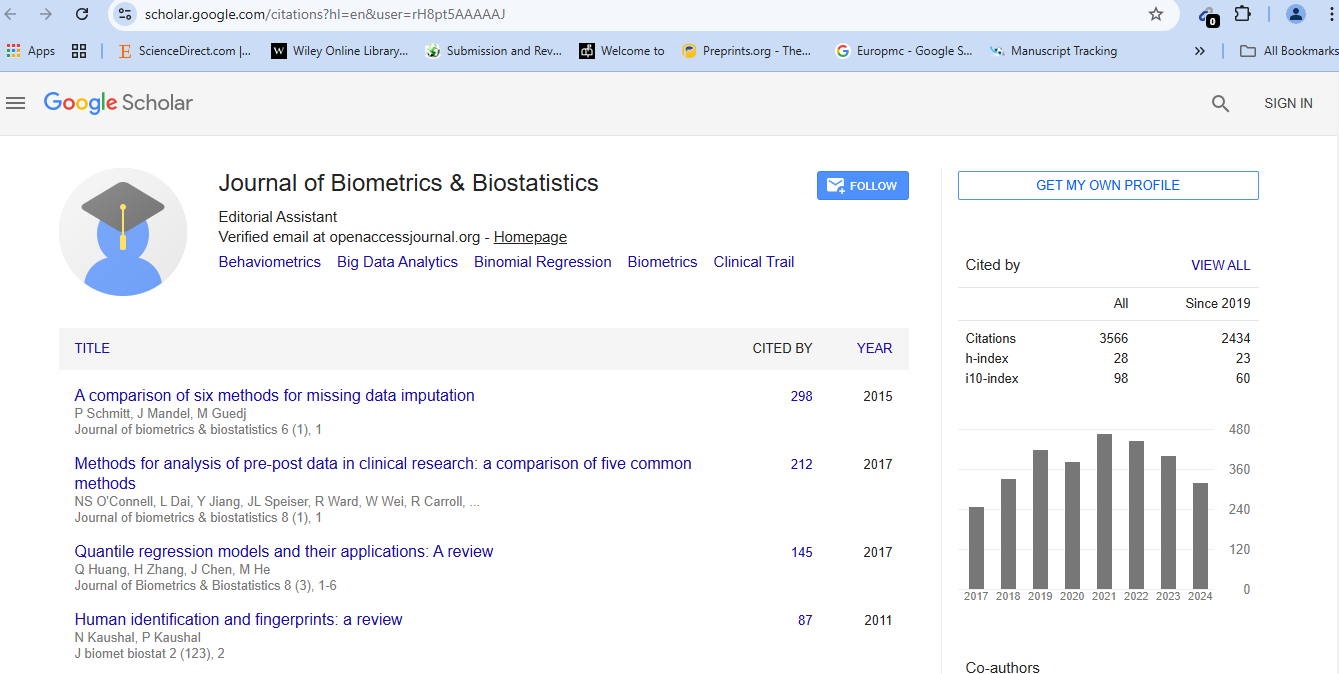
Journal of Biometrics & Biostatistics received 3496 citations as per Google Scholar report