Perspective - (2025) Volume 16, Issue 6
Received: 01-Dec-2025, Manuscript No. jmbd-26-179552;
Editor assigned: 03-Dec-2025, Pre QC No. P-179552;
Reviewed: 15-Dec-2025, QC No. Q-179552;
Revised: 22-Dec-2025, Manuscript No. R-179552;
Published:
29-Dec-2025
, DOI: 10.37421/2155-9929.2025.16.734
Citation: Patel, Rina. ”Biomarkers: Revolutionizing Disease Detection and Treatment.” J Mol Biomark Diagn 16 (2025):734.
Copyright: © 2025 Patel R. This is an open-access article distributed under the terms of the Creative Commons Attribution License, which permits unrestricted use, distribution
and reproduction in any medium, provided the original author and source are credited.
Molecular biomarkers are fundamentally transforming the landscape of disease diagnostics, enabling earlier and more accurate detection and characterization of various conditions [1].
This paradigm shift is ushering in an era of precision diagnostics, where treatment strategies are tailored to an individual's unique molecular profile, ultimately leading to improved patient outcomes [1].
Significant advancements are being made in identifying genomic, proteomic, and metabolomic markers for a wide array of diseases, including prevalent and challenging conditions like cancer and neurodegenerative disorders [1].
The synergistic integration of multi-omics data with sophisticated artificial intelligence is significantly accelerating the pace of discovery and validation of novel biomarkers, paving the way for a future of increasingly personalized healthcare [1].
Next-generation sequencing (NGS) has emerged as a cornerstone technology for the identification of both somatic mutations and germline variants [2].
These genetic alterations are crucial for accurate cancer diagnostics and for predicting the risk of inherited diseases [2].
The broad profiling capabilities of NGS facilitate the selection of targeted therapies and the identification of individuals predisposed to specific conditions [2].
While challenges persist in the interpretation of the vast amounts of data generated and in the seamless clinical implementation of these technologies, ongoing improvements in sequencing technology and bioinformatic tools are actively addressing these limitations [2].
Liquid biopsies, with a particular focus on circulating tumor DNA (ctDNA) analysis, present a non-invasive methodology for monitoring cancer progression [3].
This approach is invaluable for detecting minimal residual disease and for guiding treatment decisions effectively [3].
The sensitivity and specificity of this technology for identifying actionable mutations are rapidly advancing, highlighting its significant potential [3].
The utility of liquid biopsies is not confined to cancer; it extends to other diseases where molecular markers may be released into bodily fluids, offering a broad diagnostic scope [3].
Proteomic biomarkers, such as specific protein expression levels or post-translational modifications, offer crucial complementary information to genetic markers [4].
These markers provide insights into the functional state of cells and tissues, shedding light on disease pathogenesis and predicting therapeutic responses [4].
Significant progress in analytical techniques, including mass spectrometry and antibody-based detection methods, is enhancing the power and applicability of proteomic profiling in diagnostic settings [4].
The integration of artificial intelligence (AI) and machine learning (ML) is proving critical for navigating and analyzing the complexity of multi-omics datasets [5].
These computational approaches excel at identifying subtle patterns that may indicate the presence or progression of disease [5].
AI algorithms have the potential to expedite biomarker discovery, improve diagnostic accuracy, and enhance the prediction of treatment response, thereby boosting the overall efficiency and effectiveness of precision diagnostics [5].
Alongside these advancements, ethical considerations and the standardization of data are recognized as important areas requiring focused attention [5].
Epigenetic modifications, including DNA methylation and histone alterations, represent a valuable class of molecular biomarkers that can be influenced by environmental factors and disease states [6].
These modifications offer a dynamic regulatory layer that complements genomic information, providing deeper insights into the mechanisms of disease development and progression [6].
The continuous evolution of technologies designed to analyze these epigenetic changes is enabling their broader and more impactful application in the field of diagnostics [6].
Metabolomics, the study of small molecules within biological systems, aims to identify and quantify these metabolites to provide a real-time snapshot of cellular function and metabolic state [7].
Metabolite profiles can act as sensitive indicators of disease, even in its nascent stages, and can reflect the impact of therapeutic interventions on cellular processes [7].
The development and refinement of high-throughput analytical platforms are paramount for advancing the practical applications of metabolomics in diagnostic strategies [7].
The creation and deployment of robust analytical platforms are fundamental to the reliable detection and quantification of molecular biomarkers [8].
This includes advancements in mass spectrometry and high-throughput screening techniques [8].
Crucially, the standardization of pre-analytical and analytical procedures is essential for ensuring the reproducibility and clinical validity of biomarker assays [8].
This standardization is a prerequisite for the successful integration of these advanced diagnostic tools into routine clinical practice [8].
Pharmacogenomics, the study of how an individual's genetic makeup influences their response to drugs, is a pivotal component of precision medicine [9].
By identifying genetic variations that affect drug metabolism and efficacy, clinicians can personalize drug selection and dosage regimens [9].
This personalized approach aims to minimize adverse drug reactions and maximize therapeutic benefits, and it is increasingly being integrated into standard clinical care [9].
The future trajectory of molecular biomarkers in diagnostics points towards the development of multiplex assays capable of detecting multiple markers concurrently [10].
This will allow for the generation of a more comprehensive molecular profile of disease states [10].
The integration of biomarker data with advanced imaging techniques and clinical information, further empowered by AI, will lead to the creation of sophisticated diagnostic and prognostic models [10].
For the widespread adoption of these advanced diagnostic tools, supportive regulatory frameworks and favorable reimbursement policies are indispensable [10].
Molecular biomarkers are revolutionizing diagnostics by enabling earlier and more accurate disease detection and characterization [1]. This progression toward precision diagnostics allows for the development of tailored treatment strategies based on an individual's unique molecular profile, significantly improving patient outcomes [1]. Current research and development efforts are concentrated on genomic, proteomic, and metabolomic markers for a variety of diseases, including cancer and neurodegenerative disorders [1]. The integration of multi-omics data alongside artificial intelligence is a key driver accelerating the discovery and validation of new biomarkers, heralding a future of highly personalized healthcare [1].
Next-generation sequencing (NGS) has become an indispensable tool for identifying both somatic mutations and germline variants, which are critical for cancer diagnostics and the prediction of inherited diseases [2]. Its capacity to profile a wide range of genetic alterations directly facilitates the selection of targeted therapies and the identification of individuals at increased risk for specific conditions [2]. While challenges related to data interpretation and clinical implementation still exist, continuous technological enhancements and the development of advanced bioinformatic tools are actively mitigating these limitations [2].
Liquid biopsies, particularly the analysis of circulating tumor DNA (ctDNA), offer a non-invasive method for monitoring cancer progression, detecting minimal residual disease, and informing treatment decisions [3]. This rapidly evolving technology is demonstrating increasing sensitivity and specificity in detecting actionable mutations [3]. Its potential applications extend beyond oncology to other diseases where molecular markers can be shed into bodily fluids, broadening its diagnostic utility [3]. Proteomic biomarkers, encompassing specific protein expression levels and post-translational modifications, provide essential complementary information to genetic markers [4].
They offer insights into the functional state of cells and tissues, thereby elucidating disease pathogenesis and predicting therapeutic responses [4]. Advances in analytical techniques such as mass spectrometry and antibody-based detection methods are significantly enhancing the utility of proteomic profiling for diagnostic purposes [4]. The synergy between artificial intelligence (AI) and machine learning (ML) is paramount for the analysis of complex multi-omics datasets, enabling the identification of subtle disease-indicative patterns [5].
AI algorithms are poised to accelerate biomarker discovery, enhance diagnostic accuracy, and improve the prediction of treatment responses, ultimately increasing the efficiency and effectiveness of precision diagnostics [5]. Important considerations such as ethical implications and data standardization are also receiving considerable attention [5]. Epigenetic modifications, including DNA methylation and histone alterations, serve as valuable molecular biomarkers that can be dynamically altered by environmental factors and disease processes [6]. These modifications provide a regulatory layer that complements genomic data, offering deeper insights into disease development and progression [6].
The ongoing advancements in technologies designed to analyze these epigenetic changes are facilitating their wider application in diagnostic contexts [6]. Metabolomics focuses on the identification and quantification of small molecules within biological systems, providing a snapshot of cellular function and metabolic status [7]. Metabolite profiles can function as sensitive indicators of disease, even in early stages, and can reflect the impact of therapeutic interventions [7]. The development of high-throughput analytical platforms is crucial for the advancement of metabolomic applications in diagnostics [7]. The reliable detection and quantification of molecular biomarkers hinge on the development of robust analytical platforms, including sophisticated mass spectrometry and high-throughput screening technologies [8]. Standardization of pre-analytical and analytical procedures is critically important to ensure the reproducibility and clinical validity of biomarker assays [8].
This standardization is a necessary step for the successful integration of these assays into routine diagnostic practice [8]. Pharmacogenomics, which investigates how genes influence an individual's response to medications, is a fundamental pillar of precision medicine [9]. By identifying genetic variations that affect drug metabolism and efficacy, clinicians can tailor drug selection and dosage [9].
This personalized approach helps to minimize adverse reactions and maximize therapeutic benefits, and its integration into clinical practice is steadily increasing [9]. The future evolution of molecular biomarkers in diagnostics will likely involve the creation of multiplex assays capable of simultaneously detecting numerous markers, thereby providing a more comprehensive molecular disease profile [10]. The integration of biomarker data with imaging and clinical information, driven by AI, will enable the development of highly sophisticated diagnostic and prognostic models [10]. Crucial for the widespread adoption of these advanced diagnostic tools are appropriate regulatory frameworks and supportive reimbursement policies [10].
Molecular biomarkers are transforming diagnostics by enabling earlier and more accurate disease detection, leading to personalized treatment strategies and improved patient outcomes. Advances in genomic, proteomic, and metabolomic markers, coupled with AI integration, are accelerating biomarker discovery. Next-generation sequencing (NGS) is crucial for identifying genetic variants for cancer diagnostics and inherited disease prediction. Liquid biopsies, particularly ctDNA analysis, offer non-invasive monitoring and guidance for cancer treatment. Proteomic biomarkers provide complementary functional insights into disease. Epigenetic modifications and metabolomics offer dynamic regulatory and metabolic snapshots of disease states. Robust analytical platforms and standardization are essential for clinical validity. Pharmacogenomics personalizes drug therapy based on genetic profiles. The future lies in multiplex assays, AI-driven integrated models, and supportive regulatory and reimbursement policies for widespread adoption.
None
None
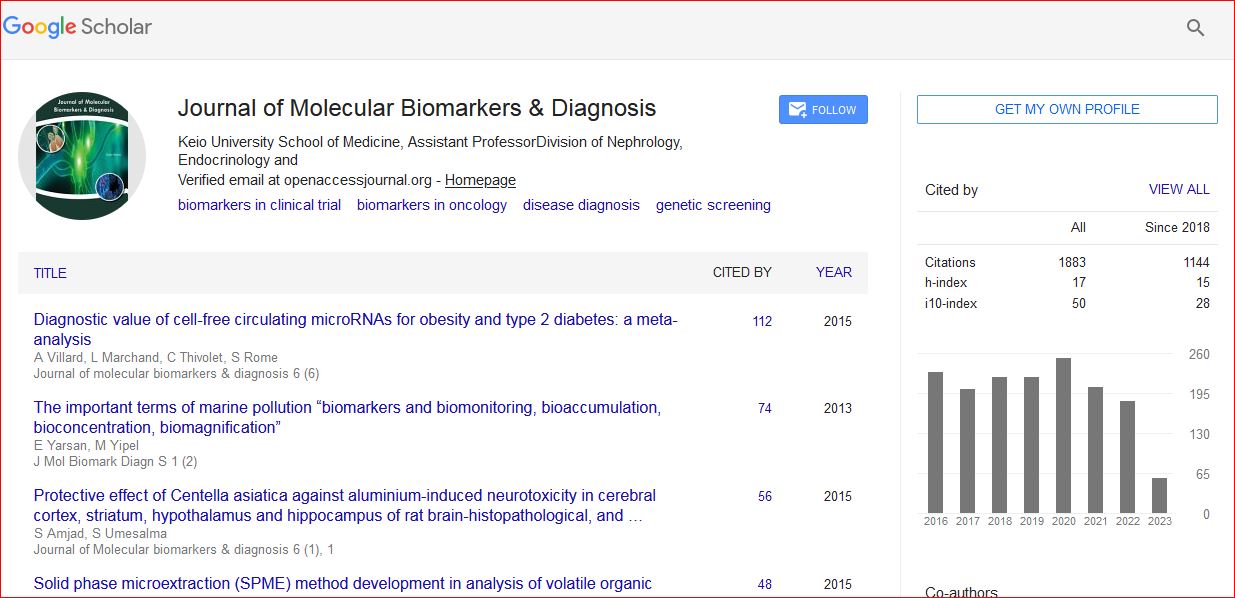
Journal of Molecular Biomarkers & Diagnosis received 2054 citations as per Google Scholar report