Brief Report - (2025) Volume 16, Issue 5
Received: 01-Oct-2025, Manuscript No. jmbd-26-179578;
Editor assigned: 03-Oct-2025, Pre QC No. P-179578;
Reviewed: 15-Oct-2025, QC No. Q-179578;
Revised: 23-Oct-2025, Manuscript No. R-179578;
Published:
30-Oct-2025
, DOI: 10.37421/2155-9929.2025.16.719
Citation: Horváth, Viktor. ”Biomarkers Revolutionizing Diagnosis: Genomics, Proteomics, AI.” J Mol Biomark Diagn 16 (2025):719.
Copyright: © 2025 Horváth V. This is an open-access article distributed under the terms of the Creative Commons Attribution License, which permits unrestricted use,
distribution and reproduction in any medium, provided the original author and source are credited.
Molecular biomarkers are fundamentally transforming the landscape of clinical diagnosis, ushering in an era of unparalleled precision for disease detection, prognostication, and the selection of optimal treatment strategies. These advancements are driven by innovations across a spectrum of disciplines, including genomics, proteomics, and metabolomics, which collectively enable the early identification of complex conditions such as various forms of cancer and neurodegenerative diseases. Despite these remarkable strides, the field continues to grapple with significant challenges. Foremost among these are the rigorous validation of newly discovered biomarkers, their seamless integration into routine clinical practice, and the crucial imperative of ensuring equitable access to these sophisticated diagnostic tools for all patient populations [1].
Recent breakthroughs in liquid biopsy technologies represent a paradigm shift in the detection and management of cancer. The ability to non-invasively monitor tumors by analyzing circulating tumor DNA (ctDNA) and circulating tumor cells (CTCs) holds immense promise for early recurrence detection and the fine-tuning of personalized therapeutic regimens. The sophisticated integration of multi-omics data further amplifies the sensitivity and specificity of these cutting-edge diagnostic approaches, paving the way for more effective cancer care [2].
Genomic profiling has emerged as an indispensable tool for the accurate diagnosis of rare genetic disorders. Techniques such as whole-exome sequencing (WES) and whole-genome sequencing (WGS) have dramatically improved diagnostic yields, enabling the identification of causal genetic variants in patients who have historically remained undiagnosed. Nevertheless, the interpretation of identified variants and the discovery of entirely novel disease-causing genes continue to present substantial hurdles within this specialized domain [3].
Proteomic approaches are actively uncovering novel biomarkers that show significant potential for the early detection of Alzheimer's disease, a condition with a devastating impact. Mass spectrometry-based profiling of both cerebrospinal fluid and blood has successfully identified candidate proteins that can reliably differentiate between healthy individuals and those exhibiting mild cognitive impairment or overt Alzheimer's disease. While promising, the critical processes of standardization and validation of these potential biomarkers are still actively underway [4].
The development and widespread implementation of point-of-care diagnostic tests that leverage molecular biomarkers are paramount for enhancing healthcare accessibility, particularly in regions with limited resources. Innovative technologies, including CRISPR-based diagnostics and advanced microfluidic devices, are facilitating the rapid and highly sensitive detection of infectious agents and a diverse range of other disease markers, thereby democratizing diagnostic capabilities [5].
Metabolomic profiling offers a dynamic and insightful window into the intricate metabolic state of cells, providing crucial insights into the metabolic dysregulation that underpins numerous diseases, including diabetes and metabolic syndrome. The identification of key metabolic pathways and the precise characterization of their alterations can illuminate the discovery of novel diagnostic targets and promising therapeutic strategies for a variety of conditions [6].
The synergy between artificial intelligence (AI) and machine learning (ML) is significantly accelerating the pace of biomarker discovery and concurrently enhancing the overall accuracy of molecular diagnostics. Sophisticated AI algorithms possess the remarkable capability to meticulously analyze highly complex multi-omics datasets, discern subtle yet significant patterns, and predict disease risk with an unprecedented level of precision [7].
Epigenetic modifications, encompassing phenomena such as DNA methylation and histone modifications, are increasingly recognized as highly valuable biomarkers, especially in the context of various forms of cancer. Aberrant epigenetic patterns can serve as exceptionally early indicators of tumorigenesis and possess the potential to predict a patient's response to specific therapeutic interventions [8].
A substantial impediment to the widespread clinical utility of molecular biomarkers frequently arises from the absence of standardized pre-analytical and analytical procedures. Ensuring a high degree of reproducibility and comparability across diverse laboratory settings and analytical platforms is absolutely critical for their successful and widespread adoption into routine diagnostic workflows [9].
Ethical considerations that surround the application of molecular biomarkers in clinical diagnosis, with a particular emphasis on genetic testing, necessitate careful and thorough deliberation. Issues pertaining to data privacy, the process of obtaining informed consent, and the potential for genetic discrimination are all critical aspects that must be proactively addressed to ensure the responsible and equitable implementation of these powerful technologies [10].
Molecular biomarkers are revolutionizing clinical diagnosis by providing unprecedented precision in disease detection, prognostication, and treatment selection. Innovations in genomics, proteomics, and metabolomics are enabling the early identification of conditions like cancer and neurodegenerative diseases. However, significant challenges persist in biomarker validation, clinical implementation, and ensuring equitable access to these advanced diagnostic tools [1].
Advances in liquid biopsy technologies are transforming cancer diagnostics, allowing for non-invasive tumor monitoring through the detection of circulating tumor DNA (ctDNA) and circulating tumor cells (CTCs). This enables early recurrence detection and personalized therapy, with multi-omics data integration further enhancing sensitivity and specificity [2].
Genomic profiling, including whole-exome and whole-genome sequencing, is crucial for diagnosing rare genetic disorders by identifying causal variants in previously undiagnosed patients. Challenges remain in variant interpretation and identifying novel disease-causing genes [3].
Proteomic approaches are uncovering novel biomarkers for early Alzheimer's disease detection. Mass spectrometry-based profiling of cerebrospinal fluid and blood has identified candidate proteins distinguishing healthy individuals from those with cognitive impairment or Alzheimer's, with ongoing standardization and validation efforts [4].
The development of point-of-care diagnostic tests using molecular biomarkers is vital for improving healthcare access, especially in resource-limited settings. Technologies like CRISPR-based diagnostics and microfluidic devices facilitate rapid and sensitive detection of disease markers [5].
Metabolomic profiling offers dynamic insights into cellular states and metabolic dysregulation in diseases like diabetes. Identifying key metabolic pathways and their alterations can lead to the discovery of novel diagnostic and therapeutic targets [6].
The integration of artificial intelligence (AI) and machine learning (ML) is accelerating biomarker discovery and improving molecular diagnostic accuracy. AI algorithms analyze complex multi-omics datasets to identify subtle patterns and predict disease risk with greater precision [7].
Epigenetic modifications, such as DNA methylation and histone modifications, are emerging as valuable biomarkers in cancer diagnosis and prognosis. Aberrant epigenetic patterns can indicate early tumorigenesis and predict therapeutic response [8].
The clinical utility of molecular biomarkers is often hindered by the lack of standardized pre-analytical and analytical procedures. Ensuring reproducibility and comparability across different laboratories and platforms is critical for widespread adoption in routine diagnostics [9].
Ethical considerations surrounding molecular biomarkers, particularly in genetic testing, require careful attention to data privacy, informed consent, and potential genetic discrimination to ensure responsible implementation in clinical practice [10].
Molecular biomarkers are revolutionizing clinical diagnosis with advancements in genomics, proteomics, and metabolomics, enabling early disease detection and personalized treatment. Liquid biopsies are transforming cancer diagnostics, while genomic profiling is crucial for rare genetic disorders. Proteomics offers potential for early Alzheimer's detection. Point-of-care diagnostics and metabolomics aim to improve accessibility and understand metabolic dysregulation. The integration of AI and ML is accelerating biomarker discovery and diagnostic accuracy. Epigenetic modifications are emerging as key cancer biomarkers. However, challenges remain in biomarker validation, standardization of assays, ethical considerations, and equitable access to these advanced diagnostic tools.
None
None
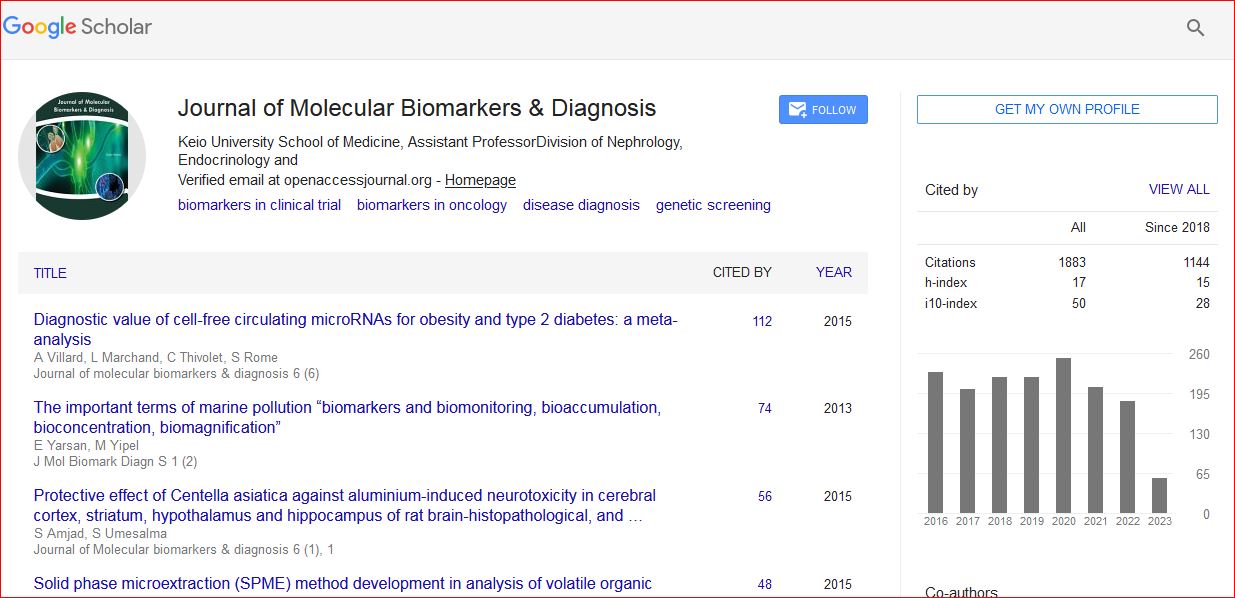
Journal of Molecular Biomarkers & Diagnosis received 2054 citations as per Google Scholar report