Short Communication - (2025) Volume 16, Issue 4
Received: 01-Aug-2025, Manuscript No. jmbd-26-179495;
Editor assigned: 04-Aug-2025, Pre QC No. P-179495;
Reviewed: 14-Aug-2025, QC No. Q-179495;
Revised: 21-Aug-2025, Manuscript No. R-179495;
Published:
28-Aug-2025
, DOI: 10.37421/2155-9929.2025.16.718
Citation: Martínez, Laura. ”Biomarkers Revolutionize Diagnostics: Promise, Challenges, Future.” J Mol Biomark Diagn 16 (2025): 718.
Copyright: © 2025 Martínez L. This is an open-access article distributed under the terms of the Creative Commons Attribution License, which permits unrestricted use,
distribution and reproduction in any medium, provided the original author and source are credited.
Molecular biomarkers are fundamental to the advancement of diagnostics, enabling precise, early detection and the development of personalized treatment strategies across a spectrum of diseases. Their integration into clinical practice holds immense promise for improving patient outcomes and reshaping healthcare paradigms. Despite this potential, the widespread adoption of molecular biomarkers faces significant hurdles, necessitating a comprehensive understanding of these challenges and the exploration of emerging opportunities. The field is rapidly evolving, driven by technological advancements and a growing appreciation for the power of molecular insights in understanding disease pathogenesis and progression. This introduction will explore the current landscape of molecular biomarker-based diagnostics, highlighting key areas of progress and the critical factors influencing their clinical translation. The development and application of circulating tumor DNA (ctDNA) as a biomarker present significant challenges in standardization and interpretation across different platforms. Nevertheless, the opportunity to non-invasively monitor tumor evolution, detect minimal residual disease, and guide therapy selection makes ctDNA a highly promising tool in oncology. Addressing these challenges through robust validation and consensus guidelines is key. MicroRNAs (miRNAs) hold immense potential as diagnostic and prognostic biomarkers due to their inherent stability and tissue-specific expression patterns. Key challenges in their utilization include identifying robust and reproducible miRNA signatures, overcoming the significant pre-analytical variability associated with their isolation and detection, and establishing standardized methods for their accurate measurement. The opportunity presented by miRNAs lies in their broad application for early disease detection, prognosis prediction, and the monitoring of therapeutic response across a diverse range of diseases. Proteomic biomarkers offer a rich and comprehensive source of information for disease diagnosis and prognosis, reflecting the complex biological processes underlying health and disease. The inherent complexity of the proteome, coupled with the vast dynamic range of protein abundance, presents significant analytical challenges that have historically hindered their widespread clinical use. However, recent and ongoing advancements in highly sensitive mass spectrometry techniques and sophisticated bioinformatics tools are increasingly enabling the identification of novel and robust protein signatures, thereby creating significant opportunities for improved diagnostic accuracy and the development of truly personalized treatment strategies. The integration of artificial intelligence and machine learning methodologies into the processes of biomarker discovery and diagnostic development represents a critical and transformative opportunity for modern medicine. While significant challenges persist, including ensuring data quality, enhancing the interpretability of complex AI models, and the necessity for extensive and rigorous validation studies, AI possesses the remarkable ability to accelerate the identification of intricate biomarker patterns, substantially improve diagnostic accuracy, and enable highly personalized treatment decisions, ultimately leading to more effective and efficient healthcare delivery. Biomarker standardization and validation represent a significant, overarching challenge that critically impacts the successful clinical translation of promising molecular discoveries into routine patient care. Ensuring the reproducibility and reliability of diagnostic tests across different laboratories, analytical platforms, and diverse patient populations is absolutely essential for building confidence and enabling widespread adoption. Opportunities to surmount these challenges arise from the proactive development of consensus guidelines, the rigorous design and implementation of robust assay development protocols, and the systematic execution of inter-laboratory comparison studies aimed at unequivocally establishing the reliability and validity of molecular diagnostic tests. The cost associated with the development and implementation of molecular biomarker-based diagnostics, along with their overall accessibility, remain significant practical challenges, particularly when considering their application in resource-limited settings globally. Developing genuinely cost-effective technologies and implementing scalable, user-friendly diagnostic platforms are therefore crucial opportunities that must be prioritized. Efforts to successfully integrate these advanced diagnostics into routine healthcare systems must carefully consider both the economic feasibility of their deployment and the imperative of ensuring equitable access for all patient populations. Single-cell technologies have emerged as a revolutionary force, offering unprecedented opportunities for dissecting the intricate cellular heterogeneity that characterizes many diseases and for identifying cell-type-specific biomarkers that were previously undetectable. However, significant challenges persist, including the immense complexity of processing and analyzing vast single-cell datasets, inherent technical variability in cell preparation and analysis, and the essential need for highly robust and sophisticated bioinformatics pipelines. Nevertheless, the ability to analyze biomarkers at the single-cell level is becoming increasingly crucial for gaining a deeper understanding of complex disease mechanisms and for developing precisely targeted therapies that act on specific cellular populations. The regulatory landscape governing the approval and clinical implementation of molecular biomarker-based diagnostics is in a constant state of evolution, presenting a dynamic interplay of both significant challenges and emerging opportunities. Successfully navigating the often complex and lengthy approval processes, while simultaneously ensuring the demonstrable clinical utility and analytical validity of newly discovered biomarkers, requires close and effective collaboration among biomarker developers, regulatory agencies, and frontline healthcare providers. The establishment of streamlined and efficient regulatory pathways is therefore critically important for accelerating the translation of promising scientific discoveries into tangible clinical benefits for patients. The integration of data from multiple 'omics' layers, including genomics, transcriptomics, proteomics, and metabolomics, offers a powerfully synergistic opportunity to discover more comprehensive, accurate, and mechanistically informative molecular biomarkers. Significant challenges remain in harmonizing and integrating these diverse datasets, interpreting the complex inter-omic interactions, and managing the substantial computational demands. However, by effectively combining information from these various molecular levels, researchers can gain much deeper insights into intricate disease mechanisms and identify novel diagnostic and therapeutic targets with greater precision.
Molecular biomarkers are central to the ongoing revolution in diagnostics, offering the potential for precise, early detection and the tailoring of treatment strategies to individual patients. However, their widespread clinical adoption is impeded by multifaceted challenges. These include the complexities inherent in rigorous validation processes, the critical need for standardization across diverse platforms and laboratories, and navigating the intricate regulatory pathways required for approval. Nevertheless, significant opportunities are emerging. The integration of multi-omics data holds promise for a more holistic understanding of disease. The development of advanced bioinformatics tools is crucial for extracting meaningful insights from complex biological datasets. Furthermore, fostering collaborative research efforts is essential to overcome existing barriers and fully realize the potential of molecular diagnostics for improving patient outcomes. The field continues to advance rapidly, driven by innovation and a commitment to translating scientific discoveries into clinical practice [1].
The development and application of circulating tumor DNA (ctDNA) as a biomarker present significant challenges in standardization and interpretation across different platforms. Nevertheless, the opportunity to non-invasively monitor tumor evolution, detect minimal residual disease, and guide therapy selection makes ctDNA a highly promising tool in oncology. Addressing these challenges through robust validation and consensus guidelines is key [2].
MicroRNAs (miRNAs) hold immense potential as diagnostic and prognostic biomarkers due to their stability and tissue-specific expression. Key challenges include identifying robust miRNA signatures, overcoming pre-analytical variability, and establishing standardized detection methods. The opportunity lies in their application for early disease detection, prognosis prediction, and therapeutic response monitoring across various diseases [3].
Proteomic biomarkers offer a rich source of information for disease diagnosis and prognosis. The complexity of the proteome, coupled with the dynamic range of protein abundance, presents significant analytical challenges. However, advancements in mass spectrometry and bioinformatics are enabling the identification of novel protein signatures, creating opportunities for improved diagnostic accuracy and personalized treatment [4].
The integration of artificial intelligence and machine learning in biomarker discovery and diagnostic development is a critical opportunity. Challenges include data quality, interpretability of AI models, and the need for extensive validation. However, AI can accelerate the identification of complex biomarker patterns, improve diagnostic accuracy, and personalize treatment decisions, leading to more effective healthcare [5].
Biomarker standardization and validation represent a significant challenge for clinical translation. Ensuring reproducibility and reliability across different laboratories and platforms is essential. Opportunities arise from developing consensus guidelines, robust assay development, and inter-laboratory comparison studies to build confidence in molecular diagnostic tests [6].
The cost and accessibility of molecular biomarker-based diagnostics remain significant challenges, particularly in resource-limited settings. Developing cost-effective technologies and implementing scalable diagnostic platforms are crucial opportunities. Efforts to integrate these diagnostics into routine healthcare must consider economic feasibility and equitable access [7].
Single-cell technologies offer unprecedented opportunities for dissecting cellular heterogeneity and identifying cell-type-specific biomarkers. Challenges include data processing complexity, technical variability, and the need for robust bioinformatics pipelines. The ability to analyze biomarkers at the single-cell level is crucial for understanding complex diseases and developing targeted therapies [8].
The regulatory landscape for molecular biomarker-based diagnostics is evolving, presenting both challenges and opportunities. Navigating the complex approval processes and ensuring the clinical utility of new biomarkers require collaboration between developers, regulators, and healthcare providers. Streamlined regulatory pathways are critical for accelerating the translation of promising biomarkers into clinical practice [9].
Multi-omics integration offers a powerful opportunity to discover more comprehensive and accurate molecular biomarkers. Challenges include data integration, interpretation of complex interactions, and computational demands. However, by combining genomic, transcriptomic, proteomic, and metabolomic data, we can gain deeper insights into disease mechanisms and identify novel diagnostic and therapeutic targets [10].
Molecular biomarkers are revolutionizing diagnostics with their potential for precise, early detection and personalized treatment. Key challenges include validation complexities, standardization issues, and regulatory hurdles. Opportunities lie in integrating multi-omics data, developing advanced bioinformatics tools, and fostering collaboration. Specific biomarker types like ctDNA, miRNAs, and proteomic signatures offer significant promise but also present unique challenges in their development and application. Artificial intelligence and single-cell technologies are accelerating discovery, while standardization and cost-effectiveness remain crucial for clinical translation. Addressing regulatory considerations and ensuring equitable access are vital for maximizing the impact of these advancements on patient care.
None
None
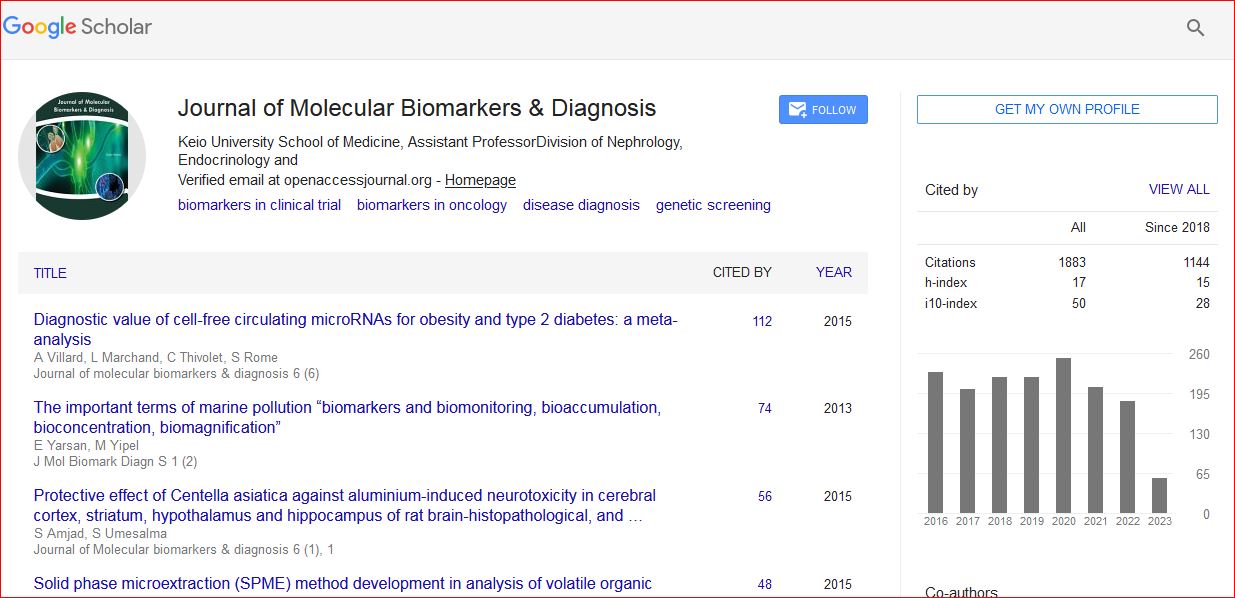
Journal of Molecular Biomarkers & Diagnosis received 2054 citations as per Google Scholar report