Brief Report - (2025) Volume 16, Issue 3
Received: 02-Jun-2025, Manuscript No. jmbd-26-179383;
Editor assigned: 04-Jun-2025, Pre QC No. P-179383;
Reviewed: 15-Jun-2025, QC No. Q-179383;
Revised: 23-Jun-2025, Manuscript No. R-179383;
Published:
30-Jun-2025
, DOI: 10.37421/2155-9929.2025.16.700
Citation: Tan, Mei Ling. ”Biomarkers and Imaging for Neurodegenerative Disease Diagnosis.” J Mol Biomark Diagn 16 (2025):700.
Copyright: © 2025 Tan L. Mei This is an open-access article distributed under the terms of the Creative Commons Attribution License, which permits unrestricted use, distribution and reproduction in any medium, provided the original author and source are credited.
The early detection of neurodegenerative diseases remains a significant challenge in modern medicine, necessitating the development of sensitive and specific diagnostic tools. Molecular biomarkers have emerged as a critical component in this endeavor, offering the potential to identify disease at its earliest stages, even before the onset of overt clinical symptoms. Identifying specific molecular signatures within biological samples can significantly expedite diagnostic timelines, paving the way for earlier interventions and potentially altering the course of devastating conditions like Alzheimer's, Parkinson's, and Huntington's disease [1].
Significant advancements have been made in the realm of blood-based biomarkers for Alzheimer's disease, with particular focus on markers such as phosphorylated tau (p-tau) and amyloid-beta (Aβ) fragments. The utility of these markers for non-invasive diagnosis and prognosis is being rigorously assessed, alongside their potential for monitoring the efficacy of therapeutic interventions. However, the path to widespread clinical application is paved with challenges in standardization and validation, which are crucial for their reliable integration into routine diagnostic protocols [2].
Emerging research highlights the promising role of microRNAs (miRNAs) as potential biomarkers for Parkinson's disease. Altered miRNA expression profiles observed in readily accessible bodily fluids, such as blood and cerebrospinal fluid, have shown the capacity to reflect underlying disease pathology. This opens avenues for their use as both diagnostic and prognostic indicators, although significant translational challenges concerning their widespread clinical adoption still need to be addressed [3].
Neurofilament light chain (NfL) has garnered considerable attention as a versatile biomarker for a spectrum of neurodegenerative conditions, including amyotrophic lateral sclerosis (ALS) and frontotemporal dementia. Its inherent sensitivity to neuronal damage makes it a valuable tool for tracking disease progression and assessing therapeutic responses. A key focus in harnessing NfL's potential lies in the critical need for assay standardization to ensure its reliable implementation in clinical settings [4].
In the context of Huntington's disease, proteomic profiling is being actively investigated to unearth novel biomarkers. Studies are focused on identifying specific protein signatures within cerebrospinal fluid that exhibit a strong correlation with disease severity and progression. These findings offer valuable insights into the development of potential diagnostic and prognostic tools that can aid in the management of this complex condition [5].
The field of neurodegenerative disease diagnosis is also being revolutionized by advancements in imaging biomarkers. Techniques such as positron emission tomography (PET) and magnetic resonance imaging (MRI) play a crucial role in detecting subtle pathological changes, including the deposition of amyloid and tau proteins, as well as patterns of brain atrophy. These imaging modalities are indispensable for achieving early and accurate diagnoses [6].
Glial fibrillary acidic protein (GFAP) is emerging as a significant biomarker for neurodegeneration, particularly in the context of Alzheimer's disease. Elevated levels of GFAP in both cerebrospinal fluid and blood can serve as an indicator of astrogliosis and neuronal injury. This makes GFAP a promising candidate for early detection strategies, offering a window into the pathological processes occurring in the brain [7].
Extracellular vesicles (EVs) and their encapsulated cargo, including proteins and nucleic acids, are demonstrating considerable potential as biomarkers for neurodegenerative diseases. A key advantage of EVs lies in their ability to reflect the biological state of the originating cells. This characteristic positions them as valuable tools for the development of non-invasive diagnostic approaches, offering a less intrusive method for disease assessment [8].
The integration of multi-omics approaches is proving to be a powerful strategy for identifying robust biomarkers in neurodegenerative diseases. By combining data from genomics, transcriptomics, proteomics, and metabolomics, researchers can achieve a more comprehensive understanding of disease pathophysiology. This holistic approach is crucial for the discovery of more accurate and reliable diagnostic markers [9].
Despite the remarkable progress in identifying potential biomarkers, a significant hurdle remains in translating these discoveries from the research laboratory to routine clinical practice. Addressing challenges related to assay validation, standardization, cost-effectiveness, and ethical considerations is paramount for the widespread adoption and accessibility of these invaluable diagnostic tools [10].
The critical role of molecular biomarkers in the early detection of neurodegenerative diseases is being thoroughly explored, with a particular emphasis on how identifying specific molecular signatures in biological samples can significantly enhance diagnostic timelines. This proactive approach enables earlier interventions, which holds the potential to profoundly influence disease progression for conditions such as Alzheimer's, Parkinson's, and Huntington's disease [1].
Focusing on Alzheimer's disease, current research details significant advancements in the development and application of blood-based biomarkers. Markers like phosphorylated tau (p-tau) and amyloid-beta (Aβ) fragments are being assessed for their utility in non-invasive diagnosis and prognosis, as well as their capacity to monitor therapeutic responses. Nevertheless, substantial challenges persist in achieving the necessary standardization and validation for seamless clinical integration [2].
The emerging role of microRNAs (miRNAs) as promising biomarkers for Parkinson's disease is a significant area of investigation. This research examines how altered miRNA expression profiles detected in bodily fluids, including blood and cerebrospinal fluid, can serve as indicators of disease pathology. Consequently, these miRNAs hold promise as both diagnostic and prognostic indicators, though translational hurdles remain a key consideration [3].
Neurofilament light chain (NfL) is being recognized for its potential as a biomarker across various neurodegenerative conditions, such as ALS and frontotemporal dementia. Its sensitivity to neuronal damage makes it an excellent marker for tracking disease progression and evaluating the effectiveness of therapeutic treatments. A primary focus for clinical implementation is the essential need for assay standardization [4].
The investigation into the potential of proteomic profiling for identifying novel biomarkers in Huntington's disease is yielding significant insights. Researchers are actively working to identify specific protein signatures within cerebrospinal fluid that correlate with disease severity and progression, thereby offering valuable information for the development of diagnostic and prognostic tools [5].
Imaging biomarkers are also playing an increasingly important part in the early diagnosis of neurodegenerative diseases. Techniques such as PET and MRI are fundamental in detecting pathological changes, including the accumulation of amyloid and tau, as well as indicators of brain atrophy, all of which are crucial for accurate and timely diagnosis [6].
The diagnostic utility of glial fibrillary acidic protein (GFAP) as a biomarker for neurodegeneration, especially in Alzheimer's disease, is a subject of intense study. Elevated GFAP levels in cerebrospinal fluid and blood are indicative of astrogliosis and neuronal injury, positioning GFAP as a potential marker for early disease detection [7].
Extracellular vesicles (EVs) and their associated components, such as proteins and nucleic acids, are being explored for their promise as biomarkers in neurodegenerative diseases. A key advantage of EVs is their ability to reflect the biological status of the cells from which they originate, making them a valuable tool for non-invasive diagnostic applications [8].
The integration of multi-omics approaches is a vital strategy for discovering robust biomarkers in the field of neurodegenerative diseases. By synergizing data from genomics, transcriptomics, proteomics, and metabolomics, a more comprehensive understanding of disease pathophysiology can be achieved, leading to the identification of more precise diagnostic markers [9].
Translating the potential of molecular biomarkers from research settings to clinical practice for neurodegenerative diseases presents a complex set of challenges and opportunities. Addressing issues such as assay validation, standardization, cost-effectiveness, and ethical considerations is critical for the successful and widespread adoption of these diagnostic tools [10].
This collection of research highlights the pivotal role of molecular and imaging biomarkers in the early detection and management of neurodegenerative diseases. Studies explore blood-based markers like p-tau and Aβ for Alzheimer's, microRNAs for Parkinson's, and neurofilament light chain (NfL) for various conditions including ALS and frontotemporal dementia. Proteomic profiling is identifying novel biomarkers for Huntington's disease, while GFAP shows promise in detecting astrogliosis. Extracellular vesicles offer a non-invasive diagnostic avenue. Imaging techniques like PET and MRI are crucial for detecting pathological changes. Multi-omics approaches are enhancing biomarker discovery by integrating diverse data types. A significant focus remains on overcoming translational challenges, including standardization and validation, to ensure these biomarkers can be effectively implemented in clinical practice.
None
None
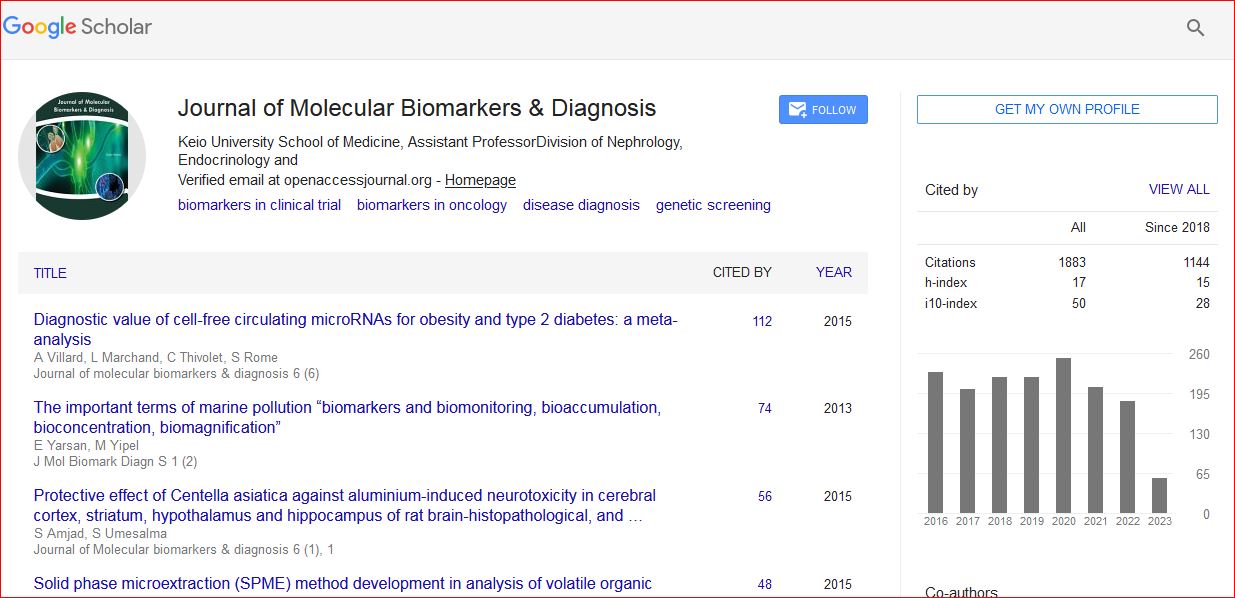
Journal of Molecular Biomarkers & Diagnosis received 2054 citations as per Google Scholar report