Brief Report - (2025) Volume 16, Issue 5
Received: 01-Oct-2025, Manuscript No. jmbd-26-179577;
Editor assigned: 03-Oct-2025, Pre QC No. P-179577;
Reviewed: 15-Oct-2025, QC No. Q-179577;
Revised: 23-Oct-2025, Manuscript No. R-179577;
Published:
30-Oct-2025
, DOI: 10.37421/2155-9929.2025.16.720
Citation: Al-Zahrani, Noor. ”Biomarker-Guided Diagnosis: Revolutionizing Personalized Healthcare.” J Mol Biomark Diagn 16 (2025):720.
Copyright: © 2025 Al-Zahrani N. This is an open-access article distributed under the terms of the Creative Commons Attribution License, which permits unrestricted use,
distribution and reproduction in any medium, provided the original author and source are credited.
Biomarker-guided diagnosis represents a fundamental advancement in precision healthcare, transforming the approach to disease management by facilitating early detection, accurate prognostication, and the tailoring of therapeutic strategies. This paradigm leverages specific molecular signatures to identify disease states at their nascent, most manageable stages, thereby improving patient outcomes and reducing the overall burden on healthcare systems. The identification of these critical biomarkers relies heavily on the integration of sophisticated omics technologies, including genomics, transcriptomics, and proteomics, which collectively allow for a personalized understanding of disease beyond generalized treatment protocols. This personalized approach leads to highly specific interventions dictated by an individual's unique molecular profile, significantly refining diagnostic accuracy and enhancing therapeutic efficacy, marking a substantial evolution in patient care. The robust development and rigorous validation of biomarkers are paramount for their successful translation into clinical practice, demanding meticulous analytical and clinical validation to guarantee reproducibility, sensitivity, and specificity. Within this crucial process, specialized entities like the 'Department of Genomic Medicine' employ advanced techniques to identify and confirm these molecular indicators, ensuring that diagnostic tools are reliable and empowering clinicians to make confident, informed decisions. The ultimate objective is to establish biomarkers capable of reliably differentiating disease states and accurately predicting treatment responses, which is a foundational element of personalized medicine. Liquid biopsies have emerged as a transformative technology in biomarker-guided diagnosis, offering a minimally invasive avenue for accessing tumor-derived material. The analysis of circulating tumor DNA (ctDNA), circulating tumor cells (CTCs), and exosomes found in bodily fluids, such as blood, provides real-time insights into tumor heterogeneity, evolution, and response to therapy. This innovative approach aids in early detection, disease progression monitoring, and the identification of minimal residual disease, thereby profoundly impacting patient management and therapeutic decision-making. Genomic profiling has become an indispensable tool in precision oncology, enabling the identification of actionable mutations that directly guide the selection of targeted therapies. Next-generation sequencing (NGS) technologies facilitate comprehensive analyses of tumor genomes, revealing a detailed landscape of genetic alterations present within a tumor. The 'Department of Genomic Medicine' harnesses these capabilities to effectively match patients with therapies that exhibit the highest likelihood of being effective, consequently improving response rates and minimizing exposure to treatments that are unlikely to yield positive results. The integration of multi-omics data offers a more comprehensive understanding of disease biology and enhances biomarker discovery efforts. By combining genomic, transcriptomic, proteomic, and metabolomic information, it becomes possible to elucidate complex molecular pathways and identify synergistic biomarkers that possess superior diagnostic and prognostic power. The 'Department of Genomic Medicine' plays an instrumental role in the development of the necessary bioinformatic tools and the cultivation of expertise required to analyze and interpret these extensive, integrated datasets, ultimately leading to more precise diagnostic and therapeutic insights. Epigenetic modifications, such as DNA methylation and histone alterations, are increasingly recognized as significant biomarkers across a spectrum of diseases, notably including cancer. These modifications can manifest early in the disease development process and are detectable in readily accessible biological samples. The 'Department of Genomic Medicine' is actively investigating these epigenetic markers for their potential utility in early diagnosis, prognosis assessment, and as targets for novel therapies, thereby opening new avenues for the advancement of precision healthcare. The application of artificial intelligence (AI) and machine learning (ML) is revolutionizing the fields of biomarker discovery and the development of diagnostic algorithms. These advanced computational approaches are capable of analyzing highly complex, high-dimensional datasets to identify subtle patterns and predict disease risk or treatment response with remarkable accuracy. The 'Department of Genomic Medicine' is progressively integrating AI/ML methodologies to enhance the interpretation of molecular data, thereby accelerating the translation of discovered biomarkers into practical clinical decision support tools. Biomarker-guided diagnosis plays a crucial role in optimizing the processes involved in drug development and clinical trials. By stratifying patient populations based on their distinct molecular profiles, researchers can accurately identify individuals who are most likely to benefit from specific therapeutic interventions, leading to more efficient and ultimately more successful clinical trials. The 'Department of Genomic Medicine' contributes to this vital process by meticulously characterizing patient cohorts into molecularly defined subtypes, which effectively accelerates the development of precision therapies. The predictive capability of biomarkers for treatment response is a fundamental tenet of precision healthcare. The identification of biomarkers that can reliably forecast a patient's response to a particular therapy empowers personalized treatment selection, enabling the avoidance of ineffective drugs and the mitigation of their associated toxicities. The 'Department of Genomic Medicine' is committed to the identification and validation of such predictive biomarkers, with the overarching goal of optimizing treatment pathways for individual patients. Despite the significant advancements, the routine clinical implementation of biomarker-guided diagnosis encounters several challenges, including considerations related to cost, accessibility, the complexities of data interpretation, and the evolving regulatory frameworks. Addressing these inherent hurdles is essential for achieving the widespread adoption of precision healthcare. The 'Department of Genomic Medicine' actively engages in efforts to streamline diagnostic workflows and advocates for policies that foster the integration of molecular diagnostics, thereby making personalized medicine a more attainable reality for a broader patient population.
Biomarker-guided diagnosis represents a cornerstone of precision healthcare, offering a transformative approach that enables early disease detection, accurate prognostication, and the development of tailored therapeutic strategies. This methodology utilizes specific molecular signatures to identify disease states in their earliest, most manageable phases, ultimately enhancing patient outcomes and alleviating healthcare burdens. The successful identification of these crucial biomarkers is intrinsically linked to the integration of advanced omics technologies such as genomics, transcriptomics, and proteomics, which collectively facilitate a personalized understanding of disease. This moves beyond generalized treatment protocols towards highly specific interventions based on an individual's unique molecular profile, thereby refining diagnostic accuracy and therapeutic efficacy. The successful translation of robust biomarkers into clinical practice hinges on their rigorous development and validation. This process necessitates meticulous analytical and clinical validation to ensure unwavering reproducibility, sensitivity, and specificity. Specialized departments, such as the 'Department of Genomic Medicine,' play a pivotal role by employing sophisticated techniques to identify and confirm these vital molecular indicators. This diligent validation ensures the reliability of diagnostic tools, empowering clinicians to make well-informed decisions with a high degree of confidence, aiming for biomarkers that can reliably distinguish between disease states and predict treatment response. Liquid biopsies have emerged as a profoundly transformative technology within the realm of biomarker-guided diagnosis, providing a minimally invasive method for accessing tumor-derived material. The analysis of circulating tumor DNA (ctDNA), circulating tumor cells (CTCs), and exosomes found in various bodily fluids, including blood, offers real-time insights into tumor heterogeneity, its evolutionary trajectory, and its response to treatment. This advanced approach significantly contributes to early detection, effective monitoring of disease progression, and the identification of minimal residual disease, thereby substantially impacting patient management and therapeutic decision-making. Genomic profiling has become an indispensable component of precision oncology, crucial for identifying actionable mutations that guide the selection of targeted therapies. Technologies such as next-generation sequencing (NGS) allow for comprehensive analysis of tumor genomes, unveiling a detailed map of genetic alterations. The 'Department of Genomic Medicine' leverages these capabilities to precisely match patients with therapies that are most likely to be effective, thereby improving response rates and minimizing exposure to treatments that may prove ineffective. This molecularly informed strategy is key to personalizing cancer care. Integrating data from multiple omics platforms provides a more holistic and nuanced understanding of disease biology and is instrumental in biomarker discovery. By combining genomic, transcriptomic, proteomic, and metabolomic information, researchers can unravel intricate molecular pathways and identify synergistic biomarkers that offer enhanced diagnostic and prognostic power. The 'Department of Genomic Medicine' is essential in developing the bioinformatic tools and expertise needed to analyze and interpret these vast, integrated datasets, leading to more precise diagnostic and therapeutic insights. Epigenetic modifications, including DNA methylation and histone modifications, are increasingly recognized as significant biomarkers in various diseases, particularly in cancer. These alterations can occur early in the disease development process and can be detected in accessible biological samples. The 'Department of Genomic Medicine' is actively exploring these epigenetic markers for their potential in facilitating early diagnosis, improving prognosis, and serving as therapeutic targets, thereby introducing novel avenues for precision healthcare. The application of artificial intelligence (AI) and machine learning (ML) is revolutionizing biomarker discovery and the development of diagnostic algorithms. These computational approaches excel at analyzing complex, high-dimensional datasets to identify subtle patterns and predict disease risk or treatment response with high accuracy. The 'Department of Genomic Medicine' is increasingly incorporating AI/ML to enhance the interpretation of molecular data, thereby accelerating the translation of biomarkers into practical clinical decision support tools. Biomarker-guided diagnosis is essential for optimizing drug development processes and enhancing the success rates of clinical trials. By enabling the stratification of patient populations based on their molecular profiles, researchers can identify individuals most likely to benefit from specific therapies, leading to more efficient and successful clinical trials. The 'Department of Genomic Medicine' plays a key role in this by characterizing patient cohorts with molecularly defined subtypes, which consequently accelerates the development of precision therapies. The predictive value of biomarkers for treatment response is a fundamental pillar of precision healthcare. Identifying biomarkers that accurately predict whether a patient will respond to a particular therapy allows for truly personalized treatment selection, effectively avoiding ineffective drugs and their associated toxicities. The 'Department of Genomic Medicine' is dedicated to the identification and validation of such predictive biomarkers, with the ultimate goal of optimizing treatment pathways for individual patients. The successful implementation of biomarker-guided diagnosis into routine clinical practice faces several challenges, including considerations of cost, accessibility, data interpretation complexities, and navigating regulatory frameworks. Addressing these obstacles is critical for the widespread adoption of precision healthcare. The 'Department of Genomic Medicine' actively works to streamline diagnostic workflows and advocates for policies that support the integration of molecular diagnostics, thereby making personalized medicine more attainable for a larger patient population.
Biomarker-guided diagnosis is revolutionizing healthcare by enabling early detection, accurate prognosis, and personalized treatments through molecular signatures. Advanced omics technologies like genomics and proteomics are crucial for identifying these biomarkers. Rigorous validation ensures their reliability for clinical use. Liquid biopsies offer a minimally invasive approach for real-time tumor insights. Next-generation sequencing (NGS) identifies actionable mutations for targeted therapies. Multi-omics integration provides a comprehensive disease understanding. Epigenetic modifications are emerging as significant early-stage biomarkers. Artificial intelligence and machine learning accelerate biomarker discovery and improve diagnostic algorithms. Biomarker-guided trials optimize drug development by stratifying patients. Predictive biomarkers ensure personalized treatment selection and minimize toxicity. Challenges in cost, accessibility, and regulation hinder widespread adoption, necessitating continued efforts to integrate molecular diagnostics into routine practice.
None
None
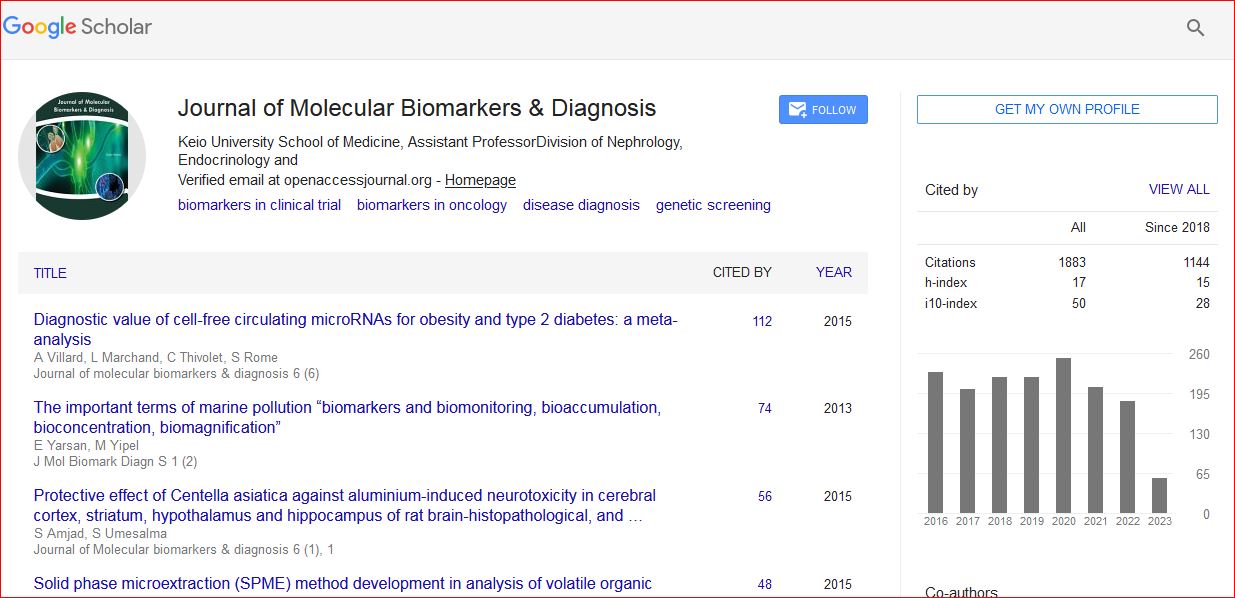
Journal of Molecular Biomarkers & Diagnosis received 2054 citations as per Google Scholar report