Short Communication - (2025) Volume 16, Issue 5
Received: 01-Oct-2025, Manuscript No. jmbd-26-179563;
Editor assigned: 03-Oct-2025, Pre QC No. P-179563;
Reviewed: 16-Oct-2025, QC No. Q-179563;
Revised: 22-Oct-2025, Manuscript No. R-179563;
Published:
30-Oct-2025
, DOI: 10.37421/2155-9929.2025.16.728
Citation: Nasser, Farah. ”Biomarker Journey: Discovery to Diagnostics and Beyond.” J Mol Biomark Diagn 16 (2025):728.
Copyright: © 2025 Nasser F. This is an open-access article distributed under the terms of the Creative Commons Attribution License, which permits unrestricted use,
distribution and reproduction in any medium, provided the original author and source are credited.
The field of diagnostic pathology is undergoing a profound transformation driven by advancements in molecular technologies and their integration into clinical practice. This evolution centers on the critical journey of molecular biomarkers from their initial discovery to their widespread clinical implementation, a process fraught with both challenges and opportunities. The rigorous validation of these markers is paramount to ensure their reliability for diagnostic and prognostic applications, ultimately enhancing patient care. Robust analytical and clinical validation are indispensable pillars in this translational pathway, guaranteeing the utility and accuracy of these emerging tools. The development of personalized medicine, a cornerstone of modern healthcare, is inextricably linked to the successful clinical translation of molecular biomarkers. This endeavor necessitates navigating complex regulatory pathways and establishing standardization efforts to bring novel biomarkers into routine diagnostic practice. Ensuring accuracy and reproducibility across different settings is a key objective, alongside considering the economic implications and their impact on informed clinical decision-making. Emerging technologies like liquid biopsies are revolutionizing diagnostic pathology by offering non-invasive methods for disease detection and monitoring. These techniques, which analyze circulating tumor DNA (ctDNA), RNA, and proteins, hold significant potential for early cancer detection, assessing treatment response, and identifying minimal residual disease. The clinical translation of these promising biomarkers is a focal point of ongoing research and development. Artificial intelligence (AI) and machine learning (ML) are rapidly reshaping diagnostic pathology, offering new avenues for biomarker identification and interpretation. These algorithms can significantly enhance the accuracy and efficiency of analyzing complex datasets, thereby accelerating the clinical translation of novel molecular findings derived from imaging and histopathology. A crucial aspect of biomarker development is the establishment of standardized methodologies for assay development and validation. This standardization is essential for achieving reproducible results in diagnostic pathology and building confidence in biomarker-based diagnostics. Meticulous attention to pre-analytical, analytical, and post-analytical phases is vital throughout the clinical translation process. Genomic technologies, particularly next-generation sequencing (NGS), are playing a pivotal role in identifying and validating novel molecular biomarkers for cancer. These technologies facilitate the discovery of actionable mutations, enabling the integration of molecular insights into clinical workflows for precise patient management and the selection of targeted therapies. The translation of diagnostic biomarkers for rare diseases presents a unique set of challenges. This pathway demands robust study designs, extensive collaborative efforts among researchers and clinicians, and efficient data sharing to effectively validate these biomarkers. Ensuring accessibility to patients with rare conditions is a primary goal. Single-cell technologies are providing unprecedented insights into cellular heterogeneity, which is crucial for identifying novel biomarkers in diagnostic pathology. These advanced techniques enable a deeper understanding of individual cell behavior, paving the way for the discovery of more precise and sensitive diagnostic markers that can be translated into clinical applications. Proteomics offers significant potential for biomarker development within diagnostic pathology. Protein-based biomarkers can be valuable for disease detection and prognosis, but their clinical translation faces hurdles related to standardization and validation, particularly for mass spectrometry-based assays, which require careful optimization. Circulating tumor cells (CTCs) are gaining prominence as biomarkers in cancer management, offering insights into disease progression and therapeutic response. While technical challenges in isolating and analyzing CTCs persist, their potential to guide treatment decisions and monitor disease progression is substantial, underscoring the need for standardization for reliable clinical use.
The critical journey of molecular biomarkers from their discovery in diagnostic pathology to their clinical implementation is explored, highlighting the challenges and opportunities in validating these markers for reliable diagnostic and prognostic applications. Emphasis is placed on the necessity of robust analytical and clinical validation to ensure their utility in patient care, with the integration of genomics and advanced molecular techniques being a key driver in this process [1].
The foundation of personalized medicine rests heavily on the successful clinical translation of molecular biomarkers. This requires navigating intricate regulatory pathways and concerted standardization efforts to integrate novel biomarkers into routine diagnostic practice, ensuring consistent accuracy and reproducibility. Economic considerations and the subsequent impact on clinical decision-making are also integral aspects of this translation [2].
Liquid biopsies are emerging as a transformative non-invasive tool in diagnostic pathology, offering significant opportunities for early cancer detection, monitoring treatment efficacy, and identifying minimal residual disease. The analytical challenges associated with detecting and quantifying circulating tumor DNA (ctDNA), RNA, and proteins are being actively addressed to facilitate their widespread clinical translation in oncology [3].
Artificial intelligence (AI) and machine learning (ML) are fundamentally altering diagnostic pathology by enhancing the accuracy and efficiency of biomarker identification and interpretation. These technologies are accelerating the clinical translation of novel molecular findings derived from diverse data sources, including imaging and histopathology, thereby improving diagnostic capabilities [4].
A critical factor for the reliable implementation of biomarkers in diagnostic pathology is the standardization of assay development and validation methodologies. This standardization is crucial for achieving reproducible results and building confidence in biomarker-based diagnostics, requiring meticulous attention to pre-analytical, analytical, and post-analytical phases throughout the translation process [5].
Emerging genomic technologies, such as next-generation sequencing (NGS), are revolutionizing biomarker discovery and clinical application in cancer diagnosis and treatment selection. These technologies enable the identification of actionable mutations and facilitate their integration into clinical workflows, promoting precise patient management and personalized therapeutic strategies [6].
The translation of diagnostic biomarkers for rare diseases presents a complex pathway characterized by unique challenges. Overcoming these obstacles necessitates robust study designs, fostering collaborative efforts among stakeholders, and implementing efficient data-sharing mechanisms to validate rare disease biomarkers and ensure their accessibility to affected patients [7].
Single-cell technologies are significantly advancing diagnostic pathology by enabling the unravelling of cellular heterogeneity, which is key to identifying novel biomarkers. These sophisticated techniques provide a deeper understanding of cellular diversity, leading to the discovery of more precise and sensitive diagnostic markers poised for clinical translation [8].
Proteomics holds considerable potential for biomarker development in diagnostic pathology, with protein-based markers offering promise for disease detection and prognosis. However, challenges related to standardization and validation, particularly for mass spectrometry-based assays, must be addressed to facilitate their successful clinical translation [9].
Circulating tumor cells (CTCs) are increasingly recognized for their utility as biomarkers in cancer management, offering insights into disease progression and therapeutic response. Addressing the technical hurdles in isolating and analyzing CTCs, alongside establishing standardization for reliable clinical use, is crucial for maximizing their current and future roles in guiding therapeutic decisions [10].
This collection of research highlights the critical journey of molecular biomarkers from discovery to clinical implementation in diagnostic pathology. Key themes include the importance of rigorous validation, navigating regulatory landscapes, and the role of emerging technologies such as liquid biopsies, artificial intelligence, next-generation sequencing, single-cell analysis, and proteomics. Standardization of methodologies is emphasized as crucial for reproducibility and confidence in biomarker-based diagnostics. Challenges in translating biomarkers for rare diseases and the application of circulating tumor cells are also discussed, all contributing to the advancement of personalized medicine and improved patient care.
None
None
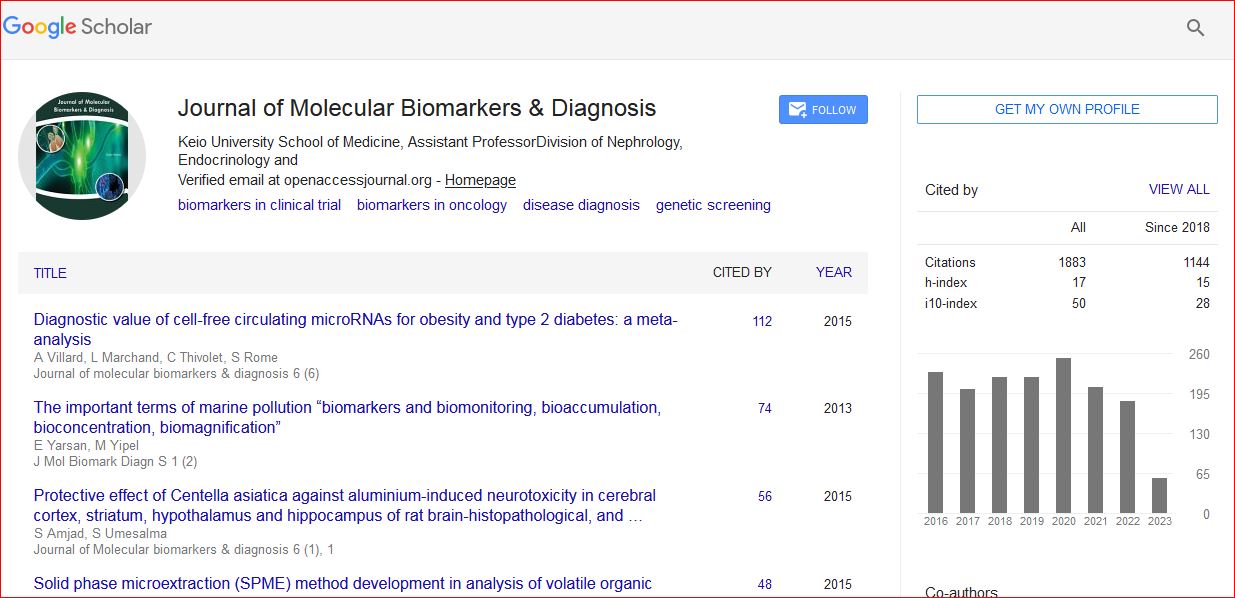
Journal of Molecular Biomarkers & Diagnosis received 2054 citations as per Google Scholar report