Short Communication - (2025) Volume 16, Issue 5
Received: 30-Sep-2025, Manuscript No. gjto-25-176028;
Editor assigned: 02-Oct-2025, Pre QC No. P-176028;
Reviewed: 14-Oct-2025, QC No. QC-176028;
Revised: 21-Oct-2025, Manuscript No. R-176028;
Published:
29-Oct-2025
, DOI: 10.37421/2229-8711.2025.16.472
Citation: Lorentz, Eva. ”Bio-inspired Optimization: Algorithms, Applications, Evolution.” Global J Technol Optim 16 (2025):472.
Copyright: © 2025 Lorentz E. This is an open-access article distributed under the terms of the Creative Commons Attribution License, which permits unrestricted use, distribution and reproduction in any medium, provided the original author and source are credited.
This comprehensive survey delves into the Whale Optimization Algorithm (WOA), exploring its fundamental principles, mathematical models, and the various improvements and hybridizations developed since its inception. It sheds light on WOA's diverse applications across engineering, computer science, and other fields, highlighting its strengths and areas for future research and refinement in solving complex optimization problems[1].
This systematic review offers an in-depth analysis of the Ant Colony Optimization (ACO) algorithm, examining its numerous variants, strategies for hybridization with other metaheuristics, and its broad spectrum of applications. The paper categorizes and discusses these advancements, providing researchers with insights into the state-of-the-art developments and potential future directions for ACO in solving challenging combinatorial optimization problems[2].
This systematic review explores the application of various bio-inspired algorithms in the context of sustainable smart cities. It identifies how these optimization techniques contribute to critical aspects like energy management, traffic control, waste management, and resource allocation, highlighting their potential to enhance urban efficiency and sustainability. The paper offers a clear overview of current trends and challenges in integrating bio-inspired solutions for urban development[3].
This review provides an extensive overview of the Grey Wolf Optimizer (GWO), a popular metaheuristic algorithm inspired by the hunting behavior of grey wolves. It covers the algorithm's foundational concept, its various enhanced variants, and hybrid approaches that combine GWO with other techniques. The paper also comprehensively details the diverse range of applications where GWO has been successfully employed, showcasing its adaptability and effectiveness[4].
This comprehensive survey presents a broad landscape of metaheuristic optimization algorithms, including many inspired by nature. It categorizes these algorithms based on their design principles and provides detailed discussions on their operational mechanisms and core components. The review extensively covers a wide array of practical applications where these algorithms have been successfully deployed, offering a valuable resource for researchers and practitioners in optimization[5].
This survey provides an overview of recent developments and applications of Genetic Algorithms (GAs), a foundational bio-inspired optimization technique. It discusses how GAs continue to evolve with new operators, hybridizations, and adaptations to tackle increasingly complex real-world problems. The paper illustrates GA's widespread utility across various domains, showcasing its enduring relevance in the field of computational intelligence[6].
This comprehensive review delves into Particle Swarm Optimization (PSO), a prominent bio-inspired algorithm, offering an examination of its algorithmic variants, diverse applications, and emerging trends. It explores how PSO has been adapted and improved to address various optimization challenges, providing insights into its effectiveness and the ongoing research to enhance its performance and applicability across different fields[7].
This review provides a current perspective on bio-inspired optimization algorithms, classifying them by their natural inspiration and discussing their underlying mechanisms. It highlights their widespread utility across various domains and examines the increasing trend of hybrid approaches that combine the strengths of multiple algorithms to overcome individual limitations, offering a clear picture of their evolution and future potential[8].
This review focuses on the crucial role of bio-inspired algorithms in enhancing the efficiency and reliability of power systems. It discusses their applications in various aspects, including optimal power flow, fault diagnosis, renewable energy integration, and economic dispatch. The paper emphasizes how these intelligent algorithms contribute to smarter grid management and the transition towards more sustainable energy infrastructures[9].
This comprehensive survey provides a detailed examination of the Bat Algorithm (BA), a metaheuristic inspired by the echolocation behavior of bats. It meticulously covers the algorithm's foundational principles, its numerous variants, and hybridizations designed to improve its performance and address specific challenges. The paper extensively documents the wide range of successful applications of BA across various engineering and scientific domains[10].
A broad landscape of metaheuristic optimization algorithms, many inspired by nature, has been extensively surveyed. These algorithms are categorized based on their design principles, with detailed discussions on their operational mechanisms and core components. Reviews comprehensively cover a wide array of practical applications where these algorithms have been successfully deployed, serving as valuable resources for researchers and practitioners in optimization[5, 8]. The current perspective classifies bio-inspired optimization algorithms by their natural inspiration, delving into their underlying mechanisms and highlighting their widespread utility across various domains. There's an increasing trend of hybrid approaches, which combine the strengths of multiple algorithms to overcome individual limitations, offering a clear picture of their evolution and future potential[8].
Specific algorithms like the Whale Optimization Algorithm (WOA) have undergone comprehensive surveys, exploring fundamental principles, mathematical models, and various improvements and hybridizations since their inception. Such studies shed light on WOA's diverse applications across engineering, computer science, and other fields, underscoring its strengths and areas for future research in solving complex optimization problems[1]. Similarly, the Grey Wolf Optimizer (GWO), a popular metaheuristic inspired by grey wolf hunting behavior, has been reviewed extensively. These reviews cover its foundational concept, enhanced variants, and hybrid approaches, detailing the diverse range of applications where GWO has shown adaptability and effectiveness[4]. Another detailed examination focuses on the Bat Algorithm (BA), a metaheuristic inspired by bat echolocation. This covers its foundational principles, numerous variants, and hybridizations designed to improve performance and address specific challenges, documenting its successful applications across engineering and scientific domains[10].
Beyond these, the Ant Colony Optimization (ACO) algorithm has been systematically analyzed, with a focus on its numerous variants, strategies for hybridization with other metaheuristics, and its broad spectrum of applications. Such analyses categorize and discuss advancements, offering insights into the state-of-the-art developments and potential future directions for ACO in solving challenging combinatorial optimization problems[2]. Genetic Algorithms (GAs), a foundational bio-inspired optimization technique, continue to see recent developments and applications. Surveys discuss their evolution with new operators, hybridizations, and adaptations for complex real-world problems, illustrating GA's widespread utility in computational intelligence[6]. Particle Swarm Optimization (PSO), another prominent bio-inspired algorithm, has been reviewed for its algorithmic variants, diverse applications, and emerging trends, exploring how it has been adapted and improved to address optimization challenges and enhance performance across fields[7].
Bio-inspired algorithms find critical applications in various domains. For instance, their role in sustainable smart cities has been systematically reviewed, identifying how these techniques contribute to energy management, traffic control, waste management, and resource allocation. This highlights their potential to enhance urban efficiency and sustainability, providing an overview of current trends and challenges in integrating bio-inspired solutions for urban development[3]. Furthermore, their crucial role in enhancing the efficiency and reliability of power systems is well-documented. Applications include optimal power flow, fault diagnosis, renewable energy integration, and economic dispatch, emphasizing their contribution to smarter grid management and the transition towards sustainable energy infrastructures[9].
Overall, the field consistently sees advancements in these algorithms. Researchers actively explore not only their individual merits but also the power of combining them through hybridization to overcome limitations and achieve superior performance. The widespread adoption of these methods across diverse scientific and engineering domains underscores their significant impact on solving complex optimization problems and shaping intelligent systems for the future.
This collection offers an extensive overview of prominent bio-inspired and metaheuristic optimization algorithms, detailing their fundamental principles, diverse variants, and advanced hybridization strategies. Key algorithms discussed include the Whale Optimization Algorithm (WOA), Ant Colony Optimization (ACO), Grey Wolf Optimizer (GWO), Bat Algorithm (BA), Genetic Algorithms (GAs), and Particle Swarm Optimization (PSO). Each survey meticulously explores the operational mechanisms, continuous improvements, and inherent adaptability of these methods, underscoring their evolution and effectiveness in tackling complex computational challenges across various disciplines. The surveys comprehensively document a wide spectrum of practical applications spanning engineering, computer science, and diverse scientific domains. Notable application areas feature energy management, traffic control, waste management, and resource allocation within sustainable smart cities. Additionally, their crucial role in power systems, covering optimal power flow, fault diagnosis, and renewable energy integration, is highlighted. A consistent emphasis is placed on the capacity of these intelligent optimization techniques to significantly enhance efficiency, reliability, and sustainability in urban development and critical infrastructure. The ongoing trend of developing hybrid approaches, which synergize algorithmic strengths to overcome individual limitations, emerges as a central theme, illustrating the dynamic and continually evolving landscape of computational intelligence in optimization.
None
None
Majdi AA, Muna AA, Zaid AAA. "Whale Optimization Algorithm: A comprehensive survey, variants and applications".Neural Comput Applic 33 (2021):1-63.
Indexed at, Google Scholar, Crossref
Sarah S, Alaa D, Aboul EH. "Ant colony optimization algorithm: a systematic review on its variants, hybridization, and applications".Artif Intell Rev 55 (2022):6697-6751.
Indexed at, Google Scholar, Crossref
Hussain A, Adham N, Mohammed A. "Applications of bio-inspired algorithms in sustainable smart cities: a systematic review".Ain Shams Eng J 13 (2022):101569.
Indexed at, Google Scholar, Crossref
Bo S, Hao Z, Jia W. "Grey Wolf Optimizer: A comprehensive review with its variants, hybridization, and applications".Expert Syst Appl 185 (2021):115655.
Indexed at, Google Scholar, Crossref
Mohammed HA, Mohammed AAA, Zaid AAA. "A Comprehensive Survey of Metaheuristic Optimization Algorithms and Their Applications".Arab J Sci Eng 48 (2023):8645-8687.
Indexed at, Google Scholar, Crossref
Saurabh S, Jashandeep S, Monica S. "Recent advances in genetic algorithm and its applications: A survey".Mater Today Proc 46 (2021):7048-7053.
Indexed at, Google Scholar, Crossref
Seyedali M, Seyed S, Seyed MM. "Particle Swarm Optimization: A Comprehensive Review on Variants, Applications, and Trends".J Adv Eng Comput 7 (2023):1-28.
Indexed at, Google Scholar, Crossref
Mohammed A, Majdi AA, Mohammed AAA. "A Review of Bio-Inspired Optimization Algorithms: Types, Applications, and Hybrid Approaches".Comput Intell Neurosci 2024 (2024):4945763.
Indexed at, Google Scholar, Crossref
Rakesh S, Neha S, Anjali S. "Applications of bio-inspired algorithms in power systems: A review".J Energy Storage 29 (2020):101373.
Indexed at, Google Scholar, Crossref
Xin-She Y, Amir HG, Seyedali M. "Bat algorithm: A comprehensive survey, variants, and applications".Appl Soft Comput 108 (2021):107474.
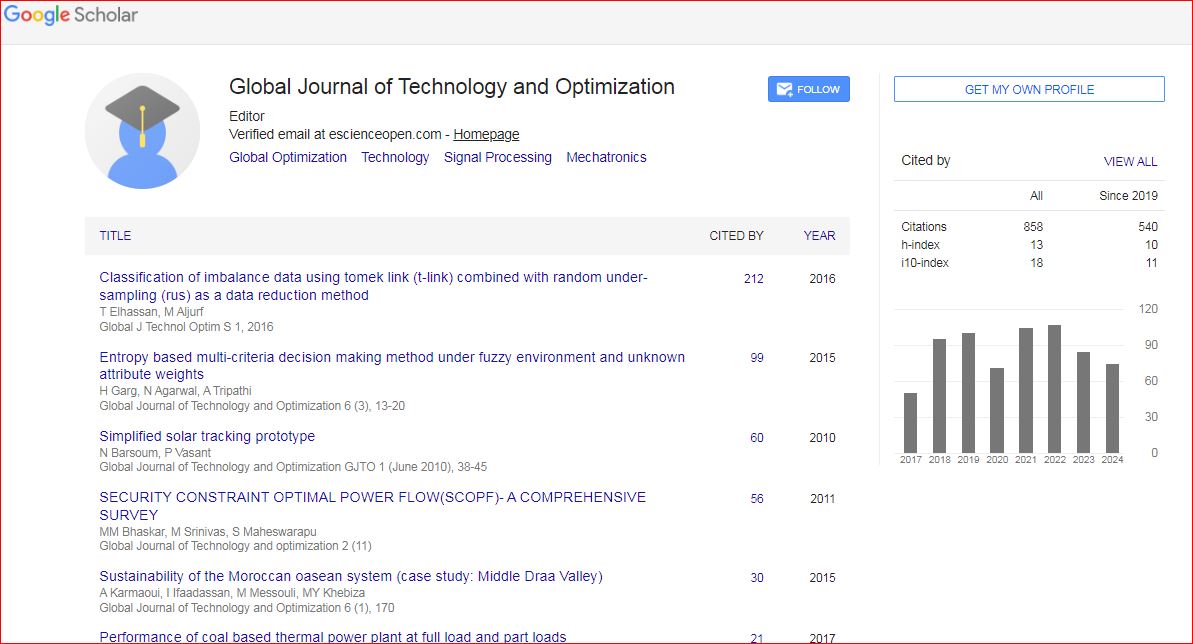
Global Journal of Technology and Optimization received 847 citations as per Google Scholar report