Short Communication - (2025) Volume 17, Issue 4
Received: 01-Aug-2025, Manuscript No. jbabm-26-182352;
Editor assigned: 03-Aug-2025, Pre QC No. P-182352;
Reviewed: 17-Aug-2025, QC No. Q-182352;
Revised: 24-Aug-2025, Manuscript No. R-182352;
Published:
31-Aug-2025
, DOI: 10.37421/1948-593X.2025.17.510
Citation: Ruiz, Pedro J.. ”Bioanalysis: Precision Oncology’s Personalized Treatment Engine.” J Bioanal Biomed 17 (2025):510.
Copyright: © 2025 Ruiz J. Pedro This is an open-access article distributed under the terms of the Creative Commons Attribution License, which permits unrestricted use, distribution and reproduction in any medium, provided the original author and source are credited.
Bioanalysis stands as a cornerstone in the advancement of precision oncology, facilitating the identification of critical biomarkers that steer patient treatment strategies. This intricate process involves the application of sophisticated analytical techniques to precisely quantify therapeutic agents, their metabolic byproducts, and relevant molecular targets within biological specimens, thereby ensuring the delivery of personalized therapeutic interventions and effective patient monitoring. The Department of Bioanalytical Sciences is instrumental in pioneering and validating these essential analytical methodologies, establishing the foundation for data-driven cancer care [1].
Liquid biopsies represent a transformative approach in modern diagnostics and treatment surveillance for cancer. These utilize advanced bioanalytical methods to detect circulating tumor DNA (ctDNA) and a spectrum of other biomarkers present in peripheral blood. This non-invasive modality enables detailed assessments of tumor heterogeneity and the mechanisms of therapeutic resistance, significantly influencing treatment decisions within the framework of precision oncology [2].
The precise quantification of both targeted therapies and immunotherapies is a critical determinant for optimizing patient outcomes in the realm of precision oncology. Bioanalytical assays, encompassing techniques such as liquid chromatography-tandem mass spectrometry (LC-MS/MS) and various immunoassays, are indispensable for accurately determining drug exposure levels and the extent of target engagement. This data is crucial for guiding necessary dose adjustments and evaluating treatment efficacy [3].
Biomarker discovery and subsequent validation in cancer research are heavily reliant on the robustness and reliability of bioanalytical platforms. The implementation of high-throughput screening methodologies and cutting-edge omics technologies, combined with sophisticated data analysis techniques, is essential for identifying novel predictive and prognostic markers. These markers are fundamental to the development and implementation of effective precision oncology strategies [4].
Pharmacokinetic (PK) and pharmacodynamic (PD) studies are pivotal for gaining a comprehensive understanding of how drugs behave within patients undergoing cancer therapy. Bioanalysis provides the indispensable data required for these critical studies, enabling the optimization of dosing regimens and the accurate prediction of treatment response. This is particularly vital in the personalized context of precision oncology [5].
Genomic and proteomic profiling initiatives generate exceptionally large and complex datasets, necessitating the application of highly sophisticated bioanalytical approaches for their meaningful interpretation. The effective integration of data from multiple omics layers, achieved through advanced bioanalytical tools, is paramount to fully realizing the potential of precision oncology and deriving actionable insights [6].
Ensuring stringent quality control and adherence to regulatory compliance are of utmost importance in bioanalytical laboratories that support precision oncology initiatives. Rigorous adherence to Good Laboratory Practice (GLP) principles and the development of thoroughly validated analytical methods are critical for guaranteeing the reliability and reproducibility of results. This is fundamental for informed clinical decision-making [7].
The continuous development of novel bioanalytical techniques, including advancements in microfluidics and single-cell analysis, is actively expanding the capabilities available for precision oncology applications. These innovative technologies facilitate the detection of rare biological events and the detailed analysis of complex biological matrices with unprecedented levels of sensitivity and specificity [8].
Companion diagnostics, which frequently depend on precise bioanalytical methods for their execution, play an essential role in identifying patients most likely to benefit from specific targeted therapies. The accurate and reliable assessment of these diagnostic markers is a fundamental requirement and a cornerstone of successful precision oncology [9].
The intricate interplay between the human microbiome and the development of cancer, as well as the response to cancer treatments, represents an increasingly significant area of investigation within precision oncology. Bioanalytical techniques are vital for the comprehensive profiling of microbial communities and their associated metabolic products, offering potential avenues for novel therapeutic strategies [10].
Bioanalysis forms the bedrock of precision oncology, providing the essential tools to identify actionable biomarkers that guide patient treatment decisions. This involves the meticulous application of advanced analytical techniques designed to quantify drugs, their metabolites, and critical molecular targets within biological samples, thereby enabling personalized therapeutic selection and continuous monitoring of treatment efficacy. The Department of Bioanalytical Sciences holds a crucial position in the development and rigorous validation of these analytical methodologies, ensuring their suitability for clinical application [1].
Liquid biopsies are rapidly revolutionizing cancer diagnosis and the monitoring of treatment response through the application of sophisticated bioanalytical methods. These methods are employed to detect circulating tumor DNA (ctDNA) and other key biomarkers directly from blood samples. This allows for non-invasive assessments of tumor heterogeneity and the identification of resistance mechanisms, directly informing and impacting treatment decisions in the field of precision oncology [2].
The accurate and reliable quantification of administered targeted therapies and immunotherapies is indispensable for optimizing patient outcomes within the context of precision oncology. Bioanalytical assays, such as those employing LC-MS/MS and immunoassays, are critically important for establishing drug exposure levels and confirming target engagement. This vital information guides essential dose adjustments and provides crucial insights into treatment efficacy [3].
Biomarker discovery and subsequent validation efforts in cancer research are critically dependent on the availability of robust and dependable bioanalytical platforms. The integration of high-throughput screening technologies and advanced omics methodologies, coupled with sophisticated data analysis pipelines, is extensively employed to identify novel predictive and prognostic markers that form the basis of precision oncology strategies [4].
Pharmacokinetic (PK) and pharmacodynamic (PD) studies are fundamental to understanding the behavior of therapeutic agents within patients undergoing cancer treatment. Bioanalysis provides the essential empirical data that underpins these studies, enabling the optimization of dosing regimens and the prediction of treatment response, which are central tenets of precision oncology [5].
Genomic and proteomic profiling platforms generate vast quantities of complex biological data that necessitate sophisticated bioanalytical approaches for their accurate interpretation. The successful integration of multi-omics data, facilitated by advanced bioanalytical tools, is a key factor in unlocking the full therapeutic and diagnostic potential of precision oncology [6].
Maintaining stringent quality control and ensuring adherence to regulatory guidelines are of paramount importance for bioanalytical laboratories engaged in supporting precision oncology. Compliance with Good Laboratory Practice (GLP) standards and the thorough validation of analytical methods are essential to guarantee the reliability and reproducibility of results, which are critical for sound clinical decision-making [7].
The ongoing development of innovative bioanalytical technologies, including advancements in microfluidics and single-cell analysis techniques, is significantly enhancing the capabilities available for precision oncology applications. These emerging technologies allow for the detection of rare biological events and the detailed analysis of complex biological matrices with unprecedented sensitivity and specificity [8].
Companion diagnostics, which inherently rely on precise bioanalytical methodologies, are crucial for identifying patients who are most likely to respond favorably to specific targeted therapies. The accurate and consistent assessment of these diagnostic biomarkers is a fundamental component and a critical success factor in precision oncology [9].
The complex relationship between the microbiome and both cancer development and treatment response is an actively emerging area within precision oncology research. Bioanalytical techniques play a vital role in the comprehensive profiling of microbial communities and their metabolic products, holding significant promise for the development of novel therapeutic strategies [10].
Bioanalysis is fundamental to precision oncology, enabling biomarker identification for personalized treatment. Advanced techniques quantify drugs and targets, guiding therapy selection and monitoring. Liquid biopsies and companion diagnostics offer non-invasive assessment and patient stratification. Pharmacokinetic and pharmacodynamic studies, supported by bioanalysis, optimize drug regimens. High-throughput screening, omics technologies, and novel analytical tools drive biomarker discovery and data interpretation. Quality control and regulatory compliance ensure reliable results for clinical decisions. The interplay with the microbiome is also becoming increasingly important, with bioanalysis providing insights for new therapeutic strategies.
None
None
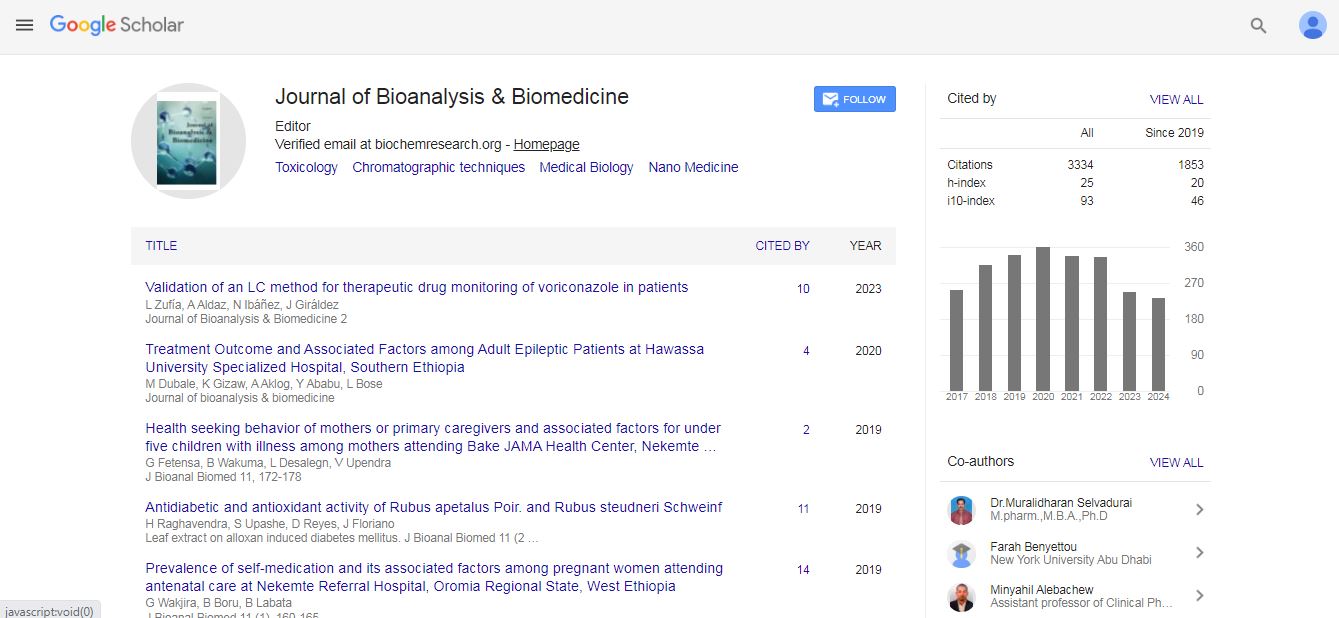
Journal of Bioanalysis & Biomedicine received 3099 citations as per Google Scholar report