Short Communication - (2025) Volume 17, Issue 5
Received: 02-Oct-2025, Manuscript No. jbabm-26-182362;
Editor assigned: 05-Oct-2025, Pre QC No. P-182362;
Reviewed: 19-Oct-2025, QC No. Q-182362;
Revised: 23-Oct-2025, Manuscript No. R-182362;
Published:
30-Oct-2025
, DOI: 10.37421/1948-593X.2025.17.520
Citation: Kovalenko, Viktor L.. ”Bioanalysis: Fueling Drug Development and Personalized Medicine.” J Bioanal Biomed 17 (2025):520.
Copyright: © 2025 Kovalenko L. V iktorThis is an open-access article distributed under the terms of the Creative Commons Attribution License, which permits unrestricted use, distribution and reproduction in any medium, provided the original author and source are credited.
Bioanalysis stands as a cornerstone in the advancement of drug development and the execution of clinical trials, furnishing indispensable data that guides decisions concerning drug safety, efficacy, and pharmacokinetic profiles. Its influence spans the entire drug lifecycle, commencing with preclinical investigations and extending through post-market surveillance, underscoring its critical role in bringing new therapies to patients. The meticulous application of sophisticated bioanalytical techniques is paramount to ensuring the integrity and reliability of generated data, which ultimately shapes patient outcomes and secures regulatory approvals for novel therapeutics.
The rigorous development and validation of bioanalytical methodologies are fundamental prerequisites for producing accurate and consistently reproducible data within the drug development pipeline. This crucial process guarantees that the analytical procedures employed are suitable for their intended purpose, adhering strictly to stringent regulatory mandates and industry best practices. Method validation encompasses a comprehensive evaluation of key parameters such as accuracy, precision, selectivity, and stability, all of which directly impact the dependability of pharmacokinetic and pharmacodynamic assessments.
Pharmacokinetic (PK) and pharmacodynamic (PD) studies are intrinsically central to elucidating a drug's behavior within the biological system and its resulting therapeutic or toxicological effects. Bioanalysis provides the essential quantitative data that underpins these studies, enabling the precise determination of absorption, distribution, metabolism, and excretion (ADME) profiles, alongside the measurement of drug concentrations at the target site of action. This critical information is indispensable for rational dose selection and the optimization of therapeutic regimens.
The emergence and integration of biomarkers have profoundly transformed therapeutic development by offering objective and quantifiable measures of biological processes, disease states, and an individual's response to a given treatment. Bioanalysis plays an exceptionally vital role in the discovery, validation, and precise quantification of these biomarkers, thereby facilitating the implementation of personalized medicine strategies and enabling the early assessment of a drug's clinical efficacy.
Bioanalytical data serves as direct evidence that informs regulatory submissions and critical decision-making processes. Regulatory authorities place significant reliance on robust and meticulously validated bioanalytical results to evaluate the safety and efficacy of therapeutic agents, thus establishing the quality of bioanalytical studies as a fundamental pillar for drug approval. Strict adherence to Good Laboratory Practice (GLP) guidelines and other relevant regulatory frameworks is therefore an absolute necessity.
Continuous advancements in bioanalytical technologies, including the sophisticated application of mass spectrometry, highly sensitive immunoassays, and cutting-edge omics technologies, are perpetually enhancing the sensitivity, specificity, and overall throughput of analytical methods. These technological leaps are indispensable for the accurate analysis of complex biological matrices and the successful development of innovative therapeutic agents.The comprehensive characterization of both small molecules and large molecules (biologics) necessitates the implementation of distinct and often specialized bioanalytical approaches. While bioanalysis of small molecules typically concentrates on quantifying drug concentrations, the analysis of large molecules requires a more intricate assessment of their structure, biological function, and potential immunogenicity, presenting unique analytical challenges and demanding the development of highly specialized methodologies.
Integral to the successful execution of bioanalytical operations are robust quality control (QC) and quality assurance (QA) systems. The implementation of comprehensive QC/QA protocols ensures the utmost integrity of data generated throughout the entire lifecycle of a bioanalytical study, from the initial collection of biological samples to the final dissemination of research findings, thereby upholding the credibility of the scientific outcomes.The accurate interpretation of bioanalytical data is profoundly dependent on a comprehensive understanding of both the specific analytical methodologies employed and the intricate biological context of the study. Consequently, fostering close collaborative relationships between bioanalysts, pharmacologists, toxicologists, and clinical researchers is essential for drawing meaningful and actionable conclusions that propel therapeutic development forward.
Personalized medicine, a paradigm shift focused on tailoring therapeutic strategies to individual patient characteristics, fundamentally relies on the precise bioanalytical measurement of relevant biomarkers and drug metabolites. This capability allows for the determination of optimal dosing regimens and the selection of therapies most likely to yield positive outcomes for a specific patient, while simultaneously minimizing the risk of adverse events.
Bioanalysis forms the bedrock of successful clinical trials and the development of novel therapeutics, providing the essential data required to assess drug safety, efficacy, and pharmacokinetic properties. It is an indispensable component that informs critical decisions throughout the entire lifecycle of a drug, from its initial preclinical research phases through to post-market surveillance, ensuring that therapeutic interventions are both safe and effective for patient populations.
The development and subsequent validation of bioanalytical methods represent a critical juncture in drug development, ensuring that the data generated is both accurate and reproducible. This stringent process confirms that the analytical procedures implemented are fit for their intended purpose and meet the exacting standards set by regulatory bodies. Key parameters evaluated during method validation, including accuracy, precision, selectivity, and stability, directly contribute to the reliability of pharmacokinetic and pharmacodynamic evaluations, which are vital for understanding drug behavior in the body.
Pharmacokinetic (PK) and pharmacodynamic (PD) studies are pivotal in comprehending how a drug functions within the human body and its subsequent effects. Bioanalysis provides the fundamental quantitative data required for these studies, enabling the detailed characterization of a drug's absorption, distribution, metabolism, and excretion (ADME) profiles, as well as the measurement of its concentration at the site where it exerts its action. This granular information is crucial for determining appropriate dosages and optimizing treatment schedules.
The advent of biomarkers has significantly revolutionized the landscape of therapeutic development by introducing objective metrics to evaluate biological processes, disease progression, and treatment responses. Bioanalysis is instrumental in the discovery, validation, and precise quantification of these biomarkers, thereby paving the way for personalized medicine approaches and facilitating the early assessment of a drug's efficacy in diverse patient groups.
Bioanalytical data directly influences the content and quality of regulatory submissions and plays a crucial role in decision-making processes for drug approval. Regulatory agencies critically assess validated bioanalytical results to determine the safety and efficacy of pharmaceutical products, making the quality and robustness of bioanalytical studies a non-negotiable requirement for market authorization. Adherence to Good Laboratory Practice (GLP) and other regulatory guidelines is paramount.
Advancements in bioanalytical technologies, including sophisticated techniques such as mass spectrometry, sensitive immunoassays, and various omics technologies, are continually improving the sensitivity, specificity, and throughput of analytical methods. These technological innovations are essential for analyzing complex biological samples and are critical for the successful development of new therapeutic agents, particularly in specialized fields.
The bioanalytical characterization of both small molecules and large molecules, such as biologics, requires distinct methodologies tailored to their unique properties. While small molecule bioanalysis often focuses on measuring drug concentrations, large molecule bioanalysis involves a more complex assessment of structure, function, and potential immunogenicity, presenting significant challenges that necessitate specialized analytical techniques and expertise.
Robust quality control (QC) and quality assurance (QA) systems are integral to the effective functioning of bioanalytical laboratories. These systems are designed to ensure the integrity of the data generated throughout the entire process of a bioanalytical study, from the initial collection of samples to the final reporting of results, thereby safeguarding the reliability and credibility of the research.
The interpretation of bioanalytical findings necessitates a profound understanding of the analytical methods employed and the biological context in which the samples were obtained. This complex task requires close collaboration among bioanalysts, pharmacologists, toxicologists, and clinicians to derive meaningful conclusions that can effectively guide and advance therapeutic development efforts.
Personalized medicine, which aims to tailor treatments to individual patient profiles, is heavily reliant on the precise bioanalytical measurement of biomarkers and drug metabolites. This capability allows for the fine-tuning of drug dosages and the selection of therapies most likely to be effective for a particular patient, while simultaneously minimizing the risk of adverse effects and optimizing treatment outcomes.
Bioanalysis is fundamental to drug development and clinical trials, providing essential data on drug safety, efficacy, and pharmacokinetics. Method validation ensures accuracy and reliability, crucial for pharmacokinetic and pharmacodynamic studies. Bioanalysis supports biomarker discovery for personalized medicine and informs regulatory submissions. Advancements in technology like mass spectrometry enhance analytical capabilities. Characterizing small and large molecules requires distinct bioanalytical approaches. Quality control and assurance are vital for data integrity. Interpretation of bioanalytical data requires interdisciplinary collaboration. Personalized medicine relies on bioanalytical measurements for tailored therapies.
None
None
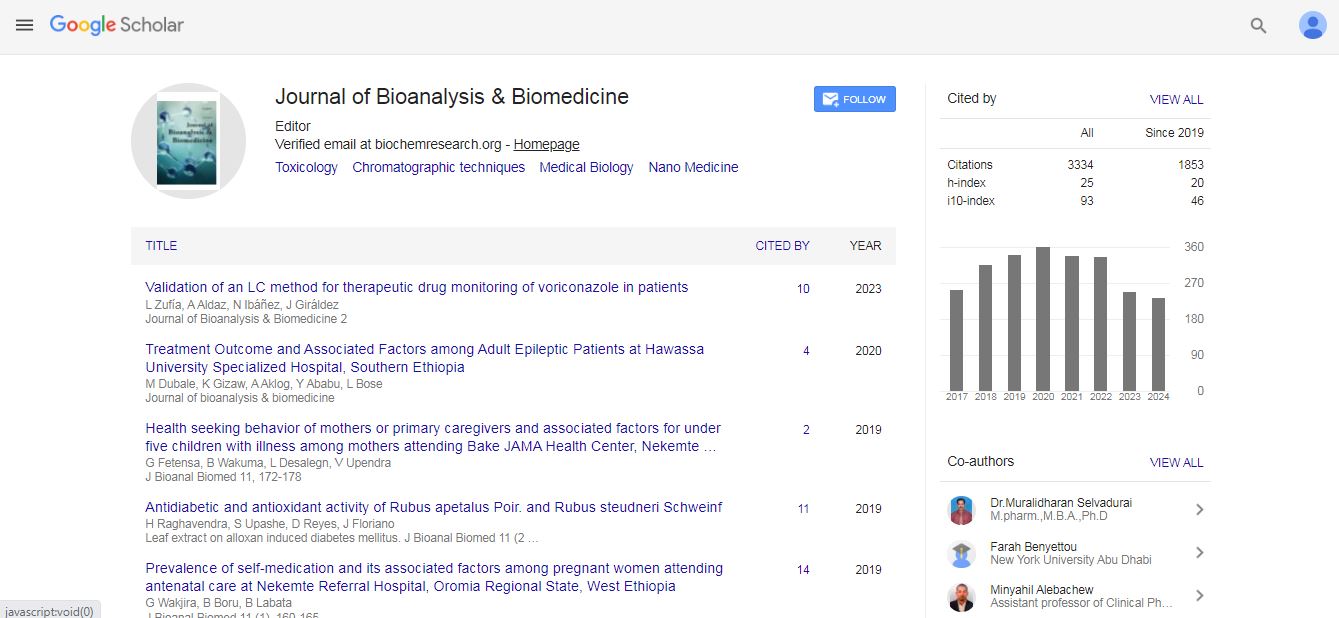
Journal of Bioanalysis & Biomedicine received 3099 citations as per Google Scholar report