Opinion - (2025) Volume 17, Issue 3
Received: 01-Jun-2025, Manuscript No. jbabm-26-182337;
Editor assigned: 03-Jun-2025, Pre QC No. P-182337;
Reviewed: 17-Jun-2025, QC No. Q-182337;
Revised: 22-Jun-2025, Manuscript No. R-182337;
Published:
29-Jun-2025
, DOI: 10.37421/1948-593X.2025.17.495
Citation: Brooks, Emily R.. ”Bioanalysis: Bridging Science and Medicine.” J Bioanal Biomed 17 (2025):495.
Copyright: © 2025 Brooks R. Emily This is an open-access article distributed under the terms of the Creative Commons Attribution License, which permits unrestricted use, distribution and reproduction in any medium, provided the original author and source are credited.
Bioanalysis serves as a critical bridge between fundamental scientific insights and their practical application in clinical settings, a process crucial for advancing healthcare. This field is dedicated to the development and rigorous validation of analytical methodologies that can precisely and sensitively detect biomarkers within biological matrices. These validated methods are indispensable for numerous aspects of medical progress, including the intricate process of drug development, the establishment of reliable diagnostic tools, and the ongoing monitoring of patient health, effectively connecting laboratory discoveries with patient care. For bioanalytical methods to be effectively employed in translational medicine, adherence to stringent regulatory guidelines is absolutely essential. The core principles of accuracy, precision, selectivity, and robustness must be meticulously upheld throughout the validation process. This rigorous approach ensures the generation of trustworthy data, which is paramount for making sound and informed decisions in both the development of new pharmaceuticals and the diagnosis of diseases. Revolutionizing the landscape of translational medicine are advanced high-throughput bioanalytical techniques that facilitate the efficient analysis of vast numbers of samples. Technologies such as mass spectrometry and next-generation sequencing are of immense importance for the discovery and validation of biomarkers. Their application significantly accelerates the translation of research findings into tangible clinical benefits for patients. A significant development in translational medicine is the creation of point-of-care bioanalytical devices. These innovations enable rapid diagnostic capabilities and real-time patient monitoring, often bypassing the need for extensive laboratory infrastructure. By bringing analytical results closer to the patient, these devices expedite clinical decision-making and improve patient outcomes. In the realm of translational medicine, bioinformatics and computational approaches are no longer optional but indispensable tools for dissecting the immense datasets generated by modern bioanalytical techniques. These sophisticated tools are vital for identifying potential biomarkers, understanding biological pathways, and formulating personalized medicine strategies, thereby enabling a deeper comprehension of complex biological information. The standardization and harmonization of bioanalytical assays are paramount for ensuring the reproducibility and comparability of results obtained across diverse laboratories and studies within the field of translational medicine. Concerted efforts to establish consensus guidelines and best practices are vital for guaranteeing the reliability of the data that underpins clinical decision-making. Metabolomics, as a prominent bioanalytical discipline, offers a comprehensive molecular snapshot of cellular states, yielding invaluable insights for translational medicine. The detailed analysis of small molecule metabolites holds significant promise for the identification of novel biomarkers that can aid in disease diagnosis, prognosis, and the prediction of therapeutic responses. The integration of data from multiple â??omicsâ?? levels â?? encompassing genomics, transcriptomics, proteomics, and metabolomics â?? is fundamental to achieving a holistic understanding of disease mechanisms in translational medicine. Bioanalytical methods play a pivotal role in generating the high-quality data necessary for these complex integrated analyses. Pharmacokinetic and pharmacodynamic (PK/PD) studies are foundational pillars of drug development within the translational medicine framework. The precise bioanalytical quantification of drug concentrations within biological systems, alongside their corresponding effects, is critically important for optimizing drug dosages and accurately predicting therapeutic outcomes. The regulatory framework governing bioanalytical methods in translational medicine is continuously evolving to incorporate emerging technologies and novel data types. A thorough understanding of and strict adherence to these evolving regulations are essential for the successful translation of innovative diagnostics and therapeutics from the research laboratory to the patient bedside.
Bioanalysis is fundamental to bridging the gap between laboratory-based scientific discoveries and their practical implementation in clinical applications. This vital process involves the meticulous development and rigorous validation of analytical methods designed to quantify biomarkers in biological samples with high sensitivity and specificity. These validated methods are indispensable components of modern drug development, diagnostic advancements, and continuous patient monitoring, effectively serving as the conduit that translates research into improved patient care [1].
The validation of bioanalytical methods for use in translational medicine necessitates strict adherence to established regulatory guidelines and best practices. Key performance characteristics such as accuracy, precision, selectivity, and robustness must be rigorously assessed and confirmed. This comprehensive validation process instills confidence in the generated data, a critical requirement for informed decision-making in both pharmaceutical development and clinical diagnostics [2].
High-throughput bioanalytical techniques are at the forefront of transforming translational medicine by enabling the efficient analysis of large sample cohorts. Cutting-edge technologies, including mass spectrometry and next-generation sequencing, are pivotal for biomarker discovery and validation. The accelerated pace at which these techniques operate significantly hastens the translation of research discoveries into clinical practice [3].
A significant advancement in translational medicine is the development of point-of-care bioanalytical devices. These devices offer the capability for rapid diagnostics and real-time patient monitoring, thereby reducing reliance on complex laboratory infrastructure. By delivering results closer to the patient, they expedite clinical decision-making and enhance patient management [4].
Bioinformatics and computational approaches are indispensable tools for interpreting the vast and complex datasets generated by bioanalytical techniques in translational medicine. These analytical tools are crucial for biomarker identification, pathway analysis, and the development of personalized medicine strategies, ultimately facilitating the comprehension of intricate biological information [5].
Standardization of bioanalytical assays is paramount for ensuring the reproducibility and comparability of results across different laboratories and research studies within translational medicine. Dedicated efforts towards establishing consensus guidelines and best practices are essential for guaranteeing the reliability of data used in clinical decision-making processes [6].
Metabolomics, as a sophisticated bioanalytical discipline, provides a comprehensive snapshot of cellular states, offering profound insights relevant to translational medicine. The detailed analysis of small molecule metabolites can lead to the identification of novel biomarkers critical for disease diagnosis, prognosis, and the prediction of patient response to therapy [7].
The integration of multi-omics data, encompassing genomics, transcriptomics, proteomics, and metabolomics, is crucial for a comprehensive understanding of disease mechanisms in translational medicine. High-quality data generated by bioanalytical methods are fundamental to the success of these integrated analyses [8].
Pharmacokinetic and pharmacodynamic (PK/PD) studies form the bedrock of drug development within translational medicine. Accurate bioanalytical quantification of drug concentrations and their physiological effects in biological systems is essential for optimizing dosing regimens and predicting therapeutic outcomes with greater precision [9].
The regulatory environment surrounding bioanalytical methods used in translational medicine is continually adapting to incorporate new technologies and diverse data types. A thorough understanding of and compliance with these evolving regulations are indispensable for the successful transition of novel diagnostics and therapeutics from the research bench to the clinical bedside [10].
Bioanalysis is crucial for translating scientific discoveries into clinical applications, involving the development and validation of sensitive analytical methods for biomarkers. These methods are essential for drug development, diagnostics, and patient monitoring. Strict adherence to guidelines for accuracy, precision, selectivity, and robustness is paramount in translational medicine. High-throughput techniques and point-of-care devices are revolutionizing the field by enabling efficient sample analysis and rapid diagnostics. Bioinformatics and computational approaches are vital for interpreting large datasets and identifying biomarkers. Standardization of assays ensures reproducibility, while metabolomics offers insights into cellular states. Multi-omics data integration and robust bioanalytical methods are key to understanding disease mechanisms. Pharmacokinetic and pharmacodynamic studies rely on accurate bioanalytical quantification for drug development. Evolving regulations require careful compliance for clinical translation of diagnostics and therapeutics.
None
None
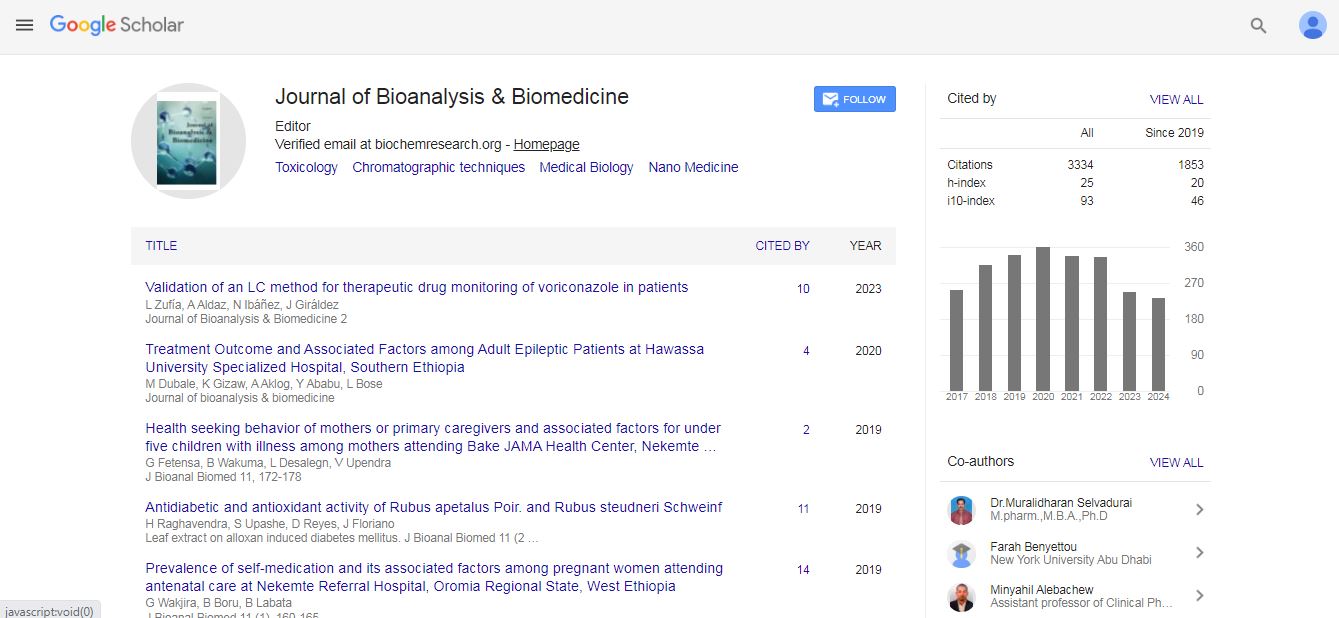
Journal of Bioanalysis & Biomedicine received 3099 citations as per Google Scholar report