Perspective - (2025) Volume 9, Issue 6
Received: 01-Dec-2025, Manuscript No. ahbs-26-182573;
Editor assigned: 03-Dec-2025, Pre QC No. P-182573;
Reviewed: 17-Dec-2025, QC No. Q-182573;
Revised: 22-Dec-2025, Manuscript No. R-182573;
Published:
29-Dec-2025
, DOI: 10.37421/2952-8097.2025.9.350
Citation: Mendes, Joao. "Behavioral Science: Transforming Veterinary
Care and Animal Welfare." J Anim Health Behav Sci 09 (2025):350.
Copyright: © 2025 Mendes J. This is an open-access article distributed under the terms of the Creative Commons Attribution License, which permits unrestricted use,
distribution and reproduction in any medium, provided the original author and source are credited.
The integration of behavioral science principles into veterinary clinical practice represents a significant advancement in animal welfare and client experience. By understanding animal cognition, motivation, and emotional states, veterinarians can profoundly improve patient care and reduce stress during veterinary visits, thereby strengthening the human-animal bond [1].
Applied behavior analysis (ABA), a well-established field, offers a robust framework that can be specifically adapted for veterinary diagnostics and treatment planning, particularly for complex behavioral disorders and enhancing cooperation during medical procedures [2].
Positive reinforcement strategies are a cornerstone of modern veterinary behavior modification, proving highly effective in minimizing fear and anxiety in veterinary clinics by creating relaxed and trusting environments for pets through reward-based methods [3].
Environmental enrichment within veterinary hospital settings is also crucial for improving the psychological well-being of hospitalized animals, employing various strategies to mitigate stress, boredom, and frustration, ultimately contributing to better patient outcomes [4].
The quality of veterinary communication, informed by behavioral science, plays a pivotal role in client adherence to treatment plans, as empathetic listening and clear explanations foster trust and improve compliance, especially for chronic conditions or behavioral modifications [5].
Examining the ethical considerations of applying behavioral science in veterinary practice is paramount, ensuring a balance between modifying behavior for medical necessity and respecting an animal's intrinsic nature and welfare through ethical frameworks [6].
Cognitive bias modification techniques offer a novel approach to managing stress in dogs during veterinary visits by identifying and addressing underlying cognitive biases that contribute to anxiety, helping to develop more positive associations with the clinic environment [7].
The 'fear-free' approach, heavily drawing on behavioral science, outlines essential training and environmental modifications to create a veterinary experience that minimizes fear, anxiety, and stress for pets, leading to improved animal welfare and client satisfaction [8].
The synergy of wearable technology and behavioral science provides a promising avenue for understanding and managing animal stress in clinical settings by monitoring physiological indicators, allowing for more precise interventions and personalized care plans [9].
Ultimately, behavioral science is instrumental in fostering a strong human-animal bond within veterinary care, enhancing owner trust and engagement through understanding animal behavior and employing positive communication strategies, leading to better preventative care and improved management of chronic conditions [10].
This article delves into the practical application of behavioral science principles within veterinary clinical settings, highlighting how understanding animal cognition, motivation, and emotional states can significantly improve patient care, reduce stress during veterinary visits, and enhance the human-animal bond through techniques like positive reinforcement and desensitization protocols [1].
The research explores how applied behavior analysis (ABA) can be adapted for veterinary diagnostics and treatment planning, particularly for complex behavioral disorders, by outlining specific ABA techniques like shaping and chaining to modify problematic behaviors and increase cooperation during medical procedures [2].
This paper discusses the role of positive reinforcement in reducing fear and anxiety in veterinary clinics, detailing how implementing reward-based methods during examinations and vaccinations can create a more relaxed and trusting environment for pets, contributing to long-term trust and better compliance with veterinary care [3].
This review focuses on the application of environmental enrichment in veterinary hospital settings to improve the psychological well-being of hospitalized animals, exploring various enrichment strategies that can mitigate stress, boredom, and frustration, ultimately contributing to better patient outcomes [4].
This study investigates the impact of veterinary communication skills, informed by behavioral science, on client adherence to treatment plans, examining how empathetic listening and clear explanation of procedures can significantly improve compliance, leading to more successful treatment outcomes [5].
This article explores the ethical considerations of applying behavioral science in veterinary practice, addressing the balance between modifying animal behavior for human convenience or medical necessity and respecting the animal's intrinsic nature and welfare, focusing on ethical frameworks that guide behavioral modification strategies [6].
This paper examines the use of cognitive bias modification techniques in managing stress and improving coping mechanisms in dogs during veterinary visits, exploring how veterinarians can identify and address underlying cognitive biases that contribute to anxiety to help dogs develop more positive associations with the clinic environment [7].
This article discusses the implementation of a 'fear-free' approach in veterinary hospitals, drawing heavily on principles of behavioral science, outlining the training and environmental modifications necessary to create a veterinary experience that minimizes fear, anxiety, and stress for pets [8].
This paper explores the potential of using wearable technology and biofeedback to understand and manage animal stress in clinical settings, allowing veterinarians to gain objective insights into an animal's emotional state during encounters and enabling more precise interventions and personalized care plans [9].
This review examines the crucial role of behavioral science in fostering a strong human-animal bond within the context of veterinary care, discussing how understanding animal behavior and employing positive communication strategies can enhance owner trust and engagement, leading to better preventative care and improved management of chronic conditions [10].
Veterinary clinical practice is being transformed by the integration of behavioral science principles. This approach enhances animal welfare and client experience by focusing on animal cognition, motivation, and emotional states. Techniques such as applied behavior analysis, positive reinforcement, and environmental enrichment are crucial for managing behavioral challenges, reducing stress during visits, and improving patient cooperation during procedures. Effective communication, informed by behavioral science, is vital for client adherence to treatment plans. Ethical considerations guide the application of these principles, ensuring interventions are in the animal's best interest. Novel approaches like cognitive bias modification and wearable technology are emerging to further manage stress and improve the human-animal bond. The overall goal is to create a more positive, effective, and compassionate veterinary experience for both animals and their caregivers.
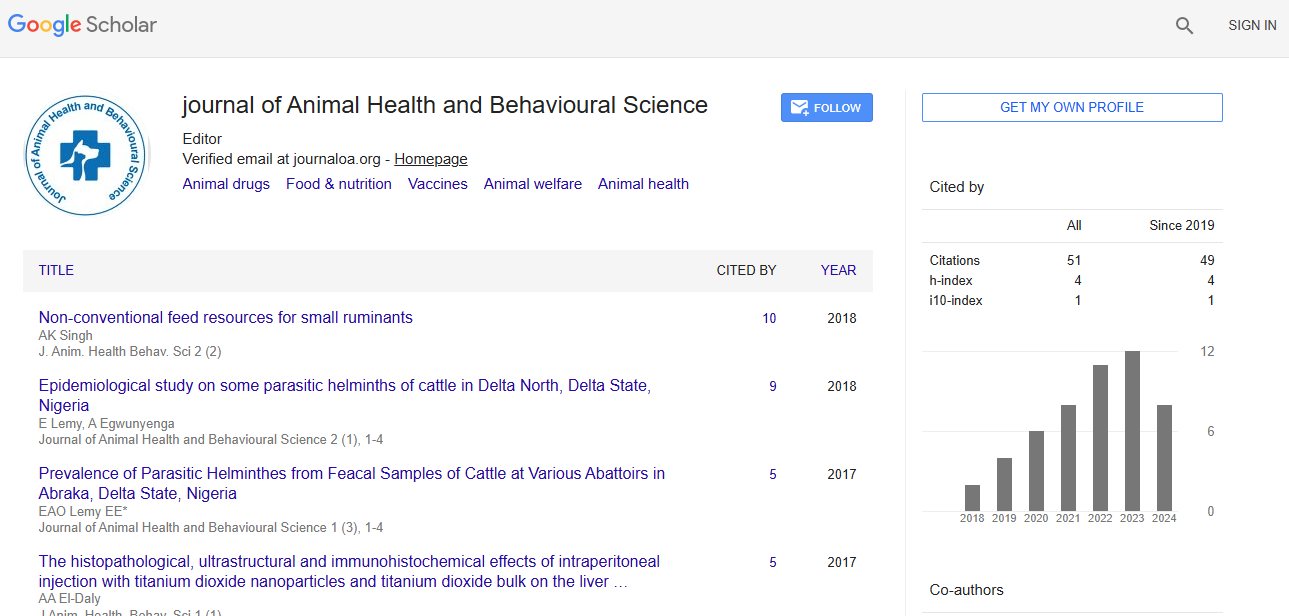
Journal of Animal Health and Behavioural Science received 38 citations as per Google Scholar report