Brief Report - (2025) Volume 9, Issue 5
Received: 01-Oct-2025, Manuscript No. ahbs-26-182525;
Editor assigned: 03-Oct-2025, Pre QC No. P-182525;
Reviewed: 17-Oct-2025, QC No. Q-182525;
Revised: 22-Oct-2025, Manuscript No. R-182525;
Published:
29-Oct-2025
, DOI: 10.37421/2952-8097.2025.9.335
Citation: Yusuf, Amina. ”Behavioral Ecology’s Influence on Animal
Health and Welfare.” J Anim Health Behav Sci 09 (2025):335.
Copyright: © 2025 Yusuf A. This is an open-access article distributed under the terms of the Creative Commons Attribution License, which permits unrestricted use, distribution
and reproduction in any medium, provided the original author and source are credited.
Behavioral ecology offers profound insights into animal health by elucidating how an animal's interactions with its environment and conspecifics directly influence disease transmission dynamics, stress physiology, and overall well-being [1].
A comprehensive understanding of foraging strategies, intricate social structures, and sophisticated anti-predator behaviors can reveal critical vulnerabilities to pathogens and assess the efficacy of various management interventions. This scientific discipline provides an essential theoretical framework for predicting how ongoing environmental transformations, such as accelerating habitat fragmentation or significant climate shifts, will inevitably impact animal health dynamics. Ultimately, this knowledge is indispensable for advancing both conservation efforts and public health initiatives, recognizing the interconnectedness of ecological and health outcomes.
Social behavior profoundly shapes disease dynamics within animal populations. The inherent structure and complexity of social groups, encompassing aspects like contact rates, established hierarchies, and cooperative behaviors, directly dictate the pathways of pathogen transmission and an individual's susceptibility to infection. A nuanced understanding of these complex social interactions is therefore absolutely crucial for accurately predicting the occurrence of disease outbreaks. This knowledge is also vital for the subsequent design and implementation of effective disease control strategies, applicable to both wild and domestic animal populations. This field is critical for understanding disease spread. [2] Foraging decisions and the strategies animals employ to acquire food resources have a direct and significant impact on their exposure risk to various pathogens and parasites. The specific selection of food resources, the choice of feeding sites, and the temporal duration spent foraging can markedly increase or decrease an animal's contact with contaminated environments or the vectors that carry disease agents. Furthermore, behavioral plasticity observed in foraging patterns, often driven by prevailing ecological pressures, emerges as a key determinant of an animal's overall health status and its inherent resistance to diseases. [3] Stress physiology is intrinsically and inextricably linked to an animal's behavioral responses to its environment. Gaining a thorough understanding of how animals adapt and cope with diverse environmental stressors, including but not limited to resource scarcity, intense social conflict, or disruptive anthropogenic disturbances, is of paramount importance for accurately assessing their health status. Prolonged or chronic stress can lead to a significant suppression of immune function, thereby rendering animals considerably more susceptible to various diseases. Consequently, observable behavioral indicators of stress can serve as crucial early warning signs of compromised animal health. [4] Habitat use and an animal's movement patterns, which are fundamentally driven by the principles of behavioral ecology, directly influence an animal's level of exposure to disease agents and their associated vectors. Animals that utilize fragmented or degraded habitats may experience altered contact rates with pathogens or exhibit increased susceptibility due to the physiological stress associated with nutritional deficiencies. Therefore, a deep understanding of these spatial behaviors is essential for accurately predicting the emergence of disease hotspots and for designing effective and targeted management strategies. [5] Reproductive behaviors and the diverse strategies animals employ for reproduction have profound and far-reaching implications for animal health. This is particularly evident in the transmission dynamics of vertically transmitted diseases and the significant energetic costs that are inherently associated with the reproductive process. Understanding the intricacies of mating systems, the nuances of parental care, and the dynamics of group breeding can effectively reveal critical vulnerabilities within populations. It also highlights their resilience to various health challenges. [6] Human-wildlife interactions, frequently exacerbated by anthropogenic changes in land use patterns and resultant shifts in animal behavior, play a critical role in understanding the emergence and subsequent spread of zoonotic diseases. The behavioral responses exhibited by wildlife to the increasing presence of humans can significantly alter their susceptibility to various pathogens. Moreover, these responses can influence their capacity to transmit these pathogens to either human populations or domestic livestock. This underscores the critical importance of behavioral ecology within the broader context of One Health approaches. [7] Animal communication and signaling systems, which are integral components of behavioral ecology, can exert a notable influence on both disease avoidance and transmission processes within animal populations. For instance, the emission of alarm calls can effectively alert conspecifics to immediate dangers, potentially reducing encounters with infected individuals or disease vectors. Conversely, certain communication modalities, under specific circumstances, might inadvertently facilitate the wider spread of pathogens through the population. [8] Understanding how animals respond to environmental pollutants, a key area of investigation within behavioral ecology, is of paramount importance for assessing and safeguarding animal health. Exposure to various contaminants can lead to significant alterations in an animal's behavior. These behavioral changes can, in turn, result in increased vulnerability to diseases, reduced reproductive success, and impaired immune system function. Consequently, behavioral monitoring can serve as a highly sensitive indicator of environmental contamination and its associated health consequences for wildlife. [9] Animal welfare, a foundational principle in the assessment of animal health, is intrinsically and inextricably linked to the study of behavioral ecology. Ensuring that animals have the opportunity to express their natural, innate behaviors, such as foraging, engaging in social interactions, and exhibiting exploratory tendencies, is absolutely essential for their psychological and physical well-being. Deviations from typical or normal behavioral patterns can often serve as crucial indicators of underlying health issues or compromised welfare. Thus, systematic behavioral observation becomes an indispensable tool in veterinary medicine and animal care. [10]Behavioral ecology provides crucial insights into animal health by examining how interactions with the environment and conspecifics affect disease transmission, stress levels, and overall well-being. Understanding foraging, social structures, and anti-predator behaviors reveals vulnerabilities to pathogens and the effectiveness of management interventions. This field helps predict the impact of environmental changes on animal health dynamics, aiding conservation and public health. [1]
The structure of social groups, including contact rates and cooperative behaviors, directly influences pathogen transmission and susceptibility. Understanding these social complexities is vital for predicting disease outbreaks and designing effective control strategies in both wildlife and domestic animals. [2] Foraging decisions and strategies directly impact an animal's exposure to pathogens and parasites. The selection of food resources, feeding sites, and foraging time can increase or decrease contact with contaminated environments or vectors. Behavioral plasticity in foraging, driven by ecological pressures, is a key factor in an animal's overall health and disease resistance. [3] Stress physiology is intimately linked to behavioral responses. Understanding how animals cope with environmental stressors like resource scarcity or social conflict is vital for health assessment. Chronic stress suppresses immune function, increasing disease susceptibility. Behavioral indicators of stress can serve as early warning signs of compromised health. [4] Habitat use and movement patterns, driven by behavioral ecology, directly influence exposure to disease agents and vectors. Animals in fragmented habitats may have altered contact rates with pathogens or increased susceptibility due to nutritional stress. Understanding these spatial behaviors is key to predicting disease hotspots and designing effective management strategies. [5] Reproductive behaviors and strategies have profound implications for animal health, especially in the transmission of vertically transmitted diseases and the energetic costs of reproduction. Understanding mating systems, parental care, and group breeding can reveal population vulnerabilities and resilience to health challenges. [6] Human-wildlife interactions, often driven by anthropogenic land-use changes and shifts in animal behavior, are critical for understanding zoonotic disease emergence. Wildlife's behavioral responses to human presence can alter their susceptibility to pathogens and their capacity to transmit them to humans or livestock, highlighting behavioral ecology's importance in One Health approaches. [7] Animal communication and signaling can play a role in disease avoidance or transmission. Alarm calls can alert conspecifics to danger, potentially reducing encounters with infected individuals or vectors. Conversely, certain communication modalities might inadvertently facilitate pathogen spread. [8] Understanding animal responses to environmental pollutants is critical for animal health. Exposure to contaminants can alter behavior, leading to increased disease vulnerability, reduced reproductive success, and impaired immune function. Behavioral monitoring can serve as a sensitive indicator of environmental contamination and its health consequences. [9] Animal welfare is intrinsically linked to behavioral ecology. Ensuring animals can express natural behaviors like foraging and social interaction is essential for their well-being. Deviations from normal behavior can indicate underlying health issues or poor welfare, making behavioral observation a vital tool in veterinary medicine. [10]Behavioral ecology plays a crucial role in understanding animal health by examining how an animal's interactions with its environment and social group influence disease transmission, stress, and overall well-being. Key behaviors such as foraging, social structures, predator avoidance, habitat use, and reproductive strategies directly impact an animal's exposure to pathogens and its susceptibility to disease. Environmental factors like pollutants and anthropogenic disturbances, along with an animal's physiological responses to stress, further influence health outcomes. Communication and welfare are also intrinsically linked to behavior. By studying these behavioral patterns, researchers can predict disease dynamics, develop effective management strategies, and contribute to conservation and public health efforts.
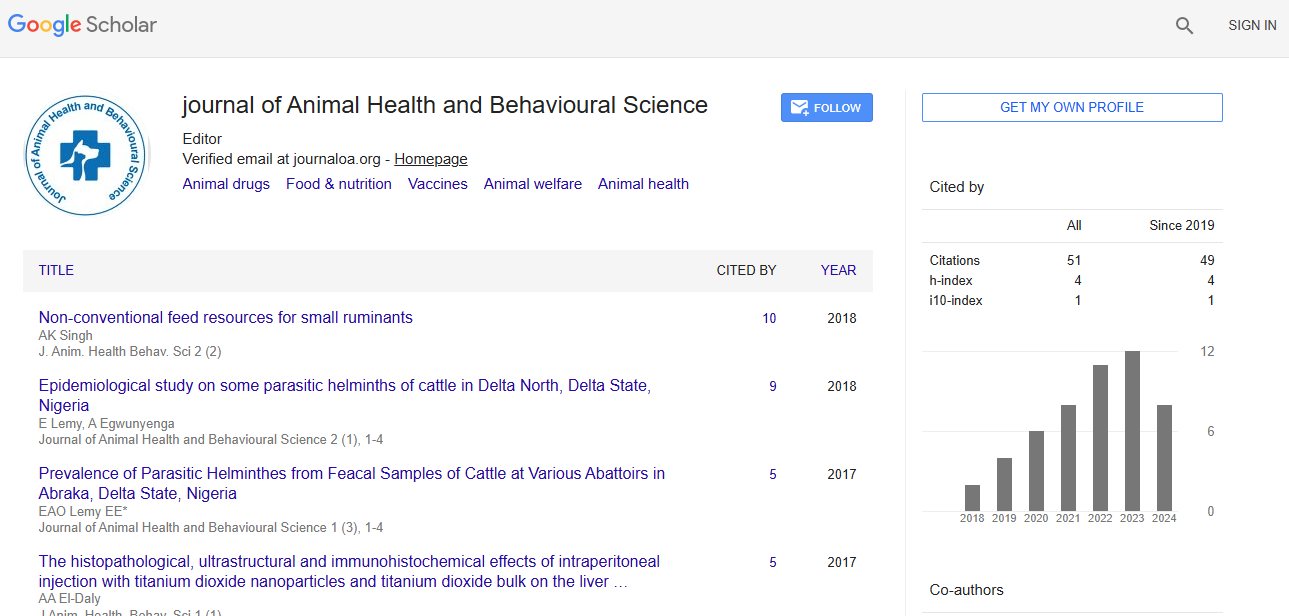
Journal of Animal Health and Behavioural Science received 38 citations as per Google Scholar report