Brief Report - (2025) Volume 14, Issue 2
Received: 01-Mar-2025, Manuscript No. aim-25-177339;
Editor assigned: 03-Mar-2025, Pre QC No. P-177339;
Reviewed: 17-Mar-2025, QC No. Q-177339;
Revised: 24-Mar-2025
Published:
31-Mar-2025
, DOI: 10.37421/2427-5162.2025.14.559
Citation: Rao, Kavita. ”Ayurveda: Integrating Ancient Wisdom with Modern Science.” Alt Integr Med 14 (2025):560.
Copyright: © 2025 Rao K. This is an open-access article distributed under the terms of the Creative Commons Attribution License, which permits unrestricted use, distribution and reproduction in any medium, provided the original author and source are credited.
The ancient Indian system of medicine, Ayurveda, is increasingly gaining recognition for its potential in addressing a wide array of health conditions. Its holistic principles, rooted in a deep understanding of the human body and its relationship with nature, offer unique perspectives that often complement modern medical approaches. The current body of research seeks to validate these traditional practices through rigorous scientific inquiry, exploring their efficacy and mechanisms of action across various physiological and pathological states. This growing interest underscores a broader shift towards integrative healthcare paradigms, where conventional and complementary systems can collaboratively optimize patient outcomes. One significant area of focus for Ayurvedic research is the management of chronic diseases, a global health challenge. Studies have explored how Ayurvedic interventions, encompassing herbal formulations, dietary recommendations, and lifestyle modifications, can contribute to managing conditions like metabolic disorders, autoimmune diseases, and neurodegenerative conditions. A comprehensive review synthesized findings from both animal and human studies, indicating Ayurveda's potential for safe and effective management, suggesting it could serve as a valuable complement to modern treatments[1].
Beyond physical ailments, Ayurveda's ancient texts extensively detail mental well-being, emphasizing the intricate connection between mind, body, and spirit. Contemporary research is now examining its role in supporting psychological health. A narrative review specifically discusses Ayurveda's capacity in promoting mental well-being and managing various psychological conditions, highlighting its holistic approach and offering unique perspectives for mental health support through personalized care and natural remedies[2].
The personalized nature of Ayurvedic treatment aligns remarkably with the contemporary concept of personalized medicine, which advocates for tailoring medical interventions to individual patient characteristics. Ayurvedaâ??s emphasis on an individualâ??s unique constitution, or Prakriti, offers a historical framework for such bespoke approaches. Research in this domain proposes using systems biology to understand health and disease from an Ayurvedic perspective, thereby bridging traditional wisdom with cutting-edge scientific methodologies for stratified healthcare[3].
Type 2 diabetes mellitus represents another major public health concern where traditional systems like Ayurveda are being investigated for their therapeutic potential. Given the rising prevalence and complex pathophysiology of diabetes, effective and sustainable management strategies are crucial. A systematic review and meta-analysis evaluated the performance of Ayurvedic interventions in managing type 2 diabetes, with findings pointing towards the potential efficacy of specific Ayurvedic treatments in glucose control, suggesting their integration could benefit patient outcomes[4].
The immune system, central to health and disease, is viewed through a distinct lens in Ayurveda, incorporating concepts like 'Agni' (digestive fire) and 'Ojas' (vital essence) as crucial for robust immunity. Understanding these traditional perspectives can enrich modern immunology. A narrative review explores how Ayurvedic principles view immune system regulation and inflammation, delving into these traditional concepts and their potential relevance to contemporary understanding of immune responses and inflammatory processes, offering new avenues for research[5].
Integrative oncology, combining conventional cancer treatments with complementary therapies, aims to improve patient quality of life and manage side effects. Ayurveda is being explored for its potential contributions in this complex field. A systematic review examines how Ayurveda can fit into integrative cancer care, reviewing current practices and discussing future directions, underscoring Ayurveda's potential to support patients alongside conventional cancer treatments, focusing on quality of life and symptom management[6].
The gut microbiome's profound influence on overall health, including immunity, metabolism, and mental health, is a rapidly expanding area of modern research. Interestingly, Ayurvedic texts have long emphasized the importance of digestion and gut health. An article adopting a systems biology view on the connection between Ayurveda and the gut microbiome suggests that Ayurvedic concepts, particularly regarding digestion and individual constitution, offer a unique framework for understanding gut health and disease[7].
Cardiovascular diseases remain a leading cause of morbidity and mortality worldwide, necessitating diverse preventive and therapeutic strategies. Ayurvedic approaches, with their focus on lifestyle, diet, and herbal remedies, may offer significant contributions. A comprehensive review compiles mechanistic and clinical evidence for Ayurvedic strategies in cardiovascular diseases, indicating that Ayurvedic approaches could offer supportive and preventive benefits for heart health[8].
Chronic skin diseases often significantly impact quality of life and can be challenging to manage with conventional treatments alone. Ayurveda has a rich tradition of dermatological remedies. A systematic review focused on clinical trials of Ayurvedic treatments for chronic skin diseases, assessing the available evidence, highlighting areas where Ayurveda shows promise, and identifying where further rigorous research is needed to solidify its role in dermatology[9].
Finally, the global health crisis presented by the COVID-19 pandemic spurred interest in traditional medicine systems for their potential in supportive care and immune modulation. Ayurvedic interventions were extensively explored during this period. A systematic review of clinical studies and perspectives on Ayurvedic interventions for COVID-19 summarizes clinical findings and perspectives, suggesting that traditional Ayurvedic practices might have a role in supportive care or improving resilience against viral infections[10].
The increasing global health burden of chronic diseases underscores the urgent need for diverse and effective management strategies. Traditional systems of medicine, particularly Ayurveda, are being rigorously re-examined for their potential contributions. The principles of Ayurveda, which emphasize personalized care, lifestyle modifications, and natural remedies, offer a complementary paradigm to conventional treatments. This body of research collectively highlights how ancient wisdom can inform and enhance modern healthcare practices, paving the way for more integrated and patient-centered approaches to health and well-being. Specifically, a detailed paper has investigated the utility of Ayurveda in the management of chronic diseases. This work systematically reviews both animal and human studies to provide a comprehensive overview of existing evidence. It critically examines various Ayurvedic interventions, elucidating their potential for safe and effective disease management, thereby suggesting a viable role for Ayurveda as a complementary modality in conjunction with modern medical treatments for long-term conditions[1]. In the realm of mental health, Ayurveda presents a profound, holistic perspective that considers the interconnectedness of mind, body, and spirit. A significant narrative review explores Ayurveda's potential in promoting mental well-being and managing diverse psychological conditions. This review elucidates the unique strengths of the Ayurvedic approach, particularly its emphasis on individualized care and natural therapies, offering fresh insights and supportive strategies for mental health challenges[2]. The concept of personalized medicine, which tailors treatments to an individualâ??s unique genetic and physiological profile, finds a natural precursor in Ayurvedic philosophy. This ancient system inherently practices personalized healthcare by recognizing distinct individual constitutions (Prakriti). An article articulates this synergy, proposing that Ayurvedaâ??s personalized approach aligns effectively with modern personalized medicine principles and suggesting the application of systems biology to stratify health and disease from an Ayurvedic perspective[3]. Type 2 diabetes mellitus continues to be a prevalent and complex metabolic disorder, necessitating multifaceted treatment strategies. A robust systematic review and meta-analysis meticulously evaluates the effectiveness of Ayurvedic interventions specifically for managing type 2 diabetes. The aggregated findings from this study suggest a promising potential for specific Ayurvedic treatments in achieving better glucose control, indicating that their thoughtful integration could significantly improve patient outcomes and quality of life[4]. The intricate mechanisms of the immune system and the processes of inflammation are fundamental to understanding human health. Ayurvedic principles offer a unique, historically informed framework for conceptualizing these vital biological functions. A narrative review thoughtfully explores Ayurvedic perspectives on immune system regulation and inflammation, delving into traditional concepts such and their potential relevance to contemporary scientific understanding of immune responses and inflammatory processes[5]. For individuals facing cancer, integrative care models are gaining traction as a means to enhance quality of life and manage treatment-related side effects. Ayurveda is emerging as a potentially valuable component within such integrative strategies. A systematic review meticulously examines the role of Ayurveda in integrative cancer care, scrutinizing current practices and outlining future directions, thereby illustrating its capacity to support patients holistically alongside conventional cancer treatments, with a focus on symptom management[6]. The human gut microbiome is increasingly recognized as a critical determinant of overall health, influencing metabolism, immunity, and even neurological functions. Ayurvedic texts have long highlighted the central role of digestion (Agni) and gut health. An article specifically adopts a systems biology perspective to explore the profound connection between Ayurveda and the gut microbiome, suggesting that traditional Ayurvedic concepts offer a unique and valuable framework for understanding gut health and disease states[7]. Cardiovascular diseases pose a significant global health burden, prompting the continuous search for effective preventive and therapeutic modalities. Ayurvedic approaches, traditionally focused on diet, lifestyle, and herbal remedies, offer a rich source of potential interventions. A comprehensive review consolidates both mechanistic and clinical evidence regarding Ayurvedic strategies for cardiovascular diseases, underscoring that these approaches could provide substantial supportive and preventive benefits for maintaining optimal heart health[8]. Chronic skin diseases often present persistent challenges, impacting patients' physical and psychological well-being. Ayurveda has historically offered a diverse array of treatments for dermatological conditions. A systematic review specifically investigates clinical trials of Ayurvedic treatments for chronic skin diseases, assessing the existing evidence base. This review highlights promising areas where Ayurveda demonstrates efficacy and identifies crucial gaps requiring further rigorous research to establish broader clinical applications[9]. The unprecedented challenges of the COVID-19 pandemic prompted a global re-evaluation of all available health resources, including traditional medicine systems. Ayurvedic interventions were studied for their potential role in mitigating symptoms and enhancing recovery. A systematic review of clinical studies and perspectives on Ayurvedic interventions for COVID-19 summarizes these findings, suggesting that traditional Ayurvedic practices might indeed have a role in supportive care or in improving an individualâ??s resilience against viral infections[10].
This collection of research underscores the growing scientific interest in Ayurveda across diverse medical fields. Papers review Ayurveda's potential in managing chronic diseases, enhancing mental well-being, and integrating with personalized medicine through systems biology approaches. Specific efficacy is explored for type 2 diabetes, cardiovascular diseases, and chronic skin conditions, often through systematic reviews and meta-analyses. The body of work also examines Ayurveda's foundational perspectives on immune system regulation, inflammation, and the gut microbiome, demonstrating how traditional concepts align with modern biological understanding. Furthermore, its role in integrative cancer care and as a supportive measure during the COVID-19 pandemic is discussed. Collectively, these studies suggest Ayurveda offers a holistic, personalized approach with promising therapeutic potential that can complement conventional medicine, while also identifying areas requiring further rigorous research.
None
None
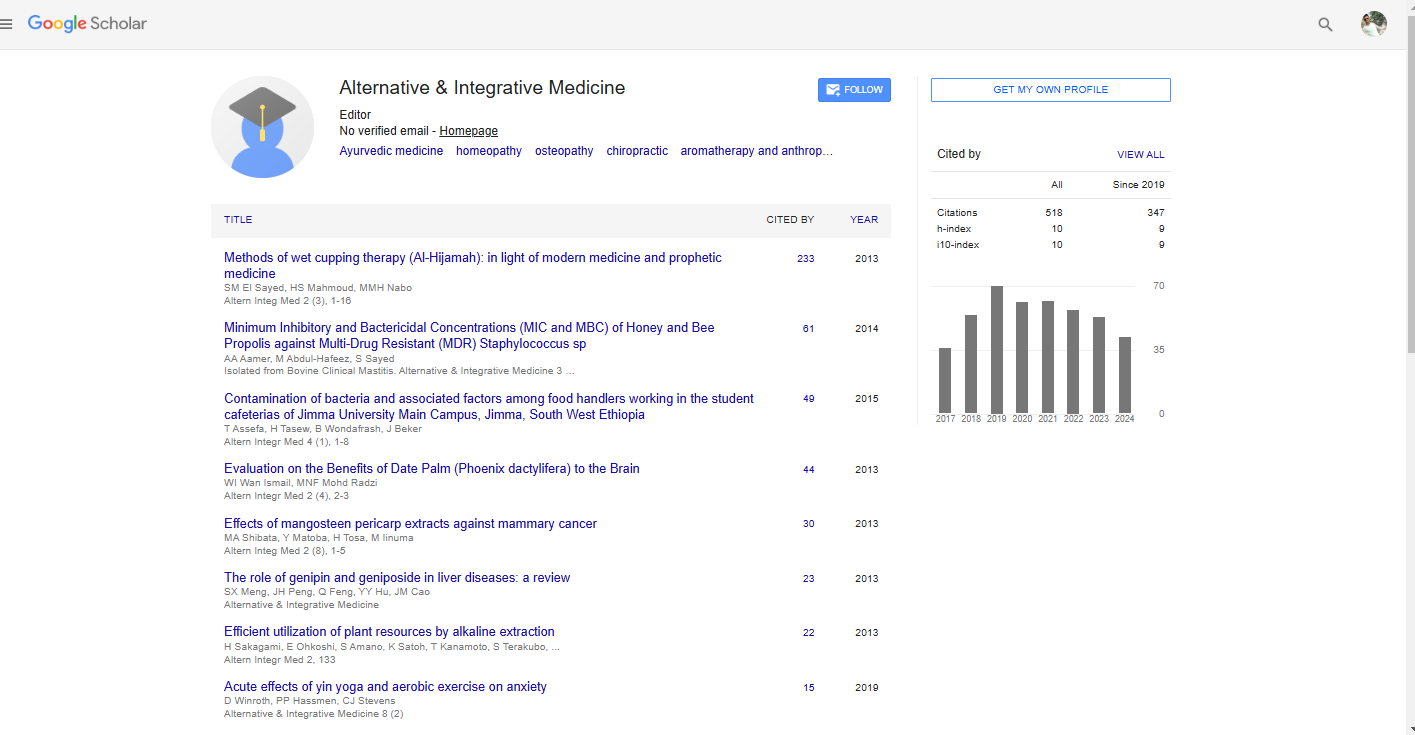
Alternative & Integrative Medicine received 476 citations as per Google Scholar report